LGCT vs NEAR: Which Blockchain Protocol Offers Better Performance and Scalability?

Introduction: LGCT vs NEAR Investment Comparison
In the cryptocurrency market, comparisons between Legacy Network and NEAR have become an important consideration for investors. The two assets demonstrate significant differences in market capitalization ranking, application scenarios, and price performance, representing distinct positions within the crypto asset landscape. Legacy Network (LGCT): Launched in 2025, it has gained market recognition by pioneering the Educational Technology (EdTech) sector through AI and blockchain innovation, creating intelligent and gamified learning ecosystems. NEAR (NEAR): Since its inception, it has been recognized as a highly scalable base protocol designed to support decentralized applications on mobile devices, aiming to achieve linear scalability through state sharding with a target of 100k TPS based on one million mobile nodes. This article will conduct a comprehensive analysis of LGCT vs NEAR investment value comparison across historical price trends, supply mechanisms, adoption scope, and technical ecosystems, addressing the key question investors need answered:
"Which is the better buy right now?"
Comparative Analysis of Legacy Network (LGCT) and NEAR Protocol: Market Assessment Report
Report Date: December 21, 2025
I. Historical Price Comparison and Current Market Status
Legacy Network (LGCT) and NEAR Protocol Price Performance
Historical Price Trajectories:
Legacy Network (LGCT) demonstrated significant volatility since its publication, with an all-time high (ATH) of $3.4621 reached on July 2, 2025, followed by a sharp decline. The token has experienced a notable drawdown of 92.10% over the past year and 93.63% over the past 30 days. The all-time low (ATL) of $0.1074 was recorded on December 19, 2025, indicating extreme downward pressure in recent market conditions.
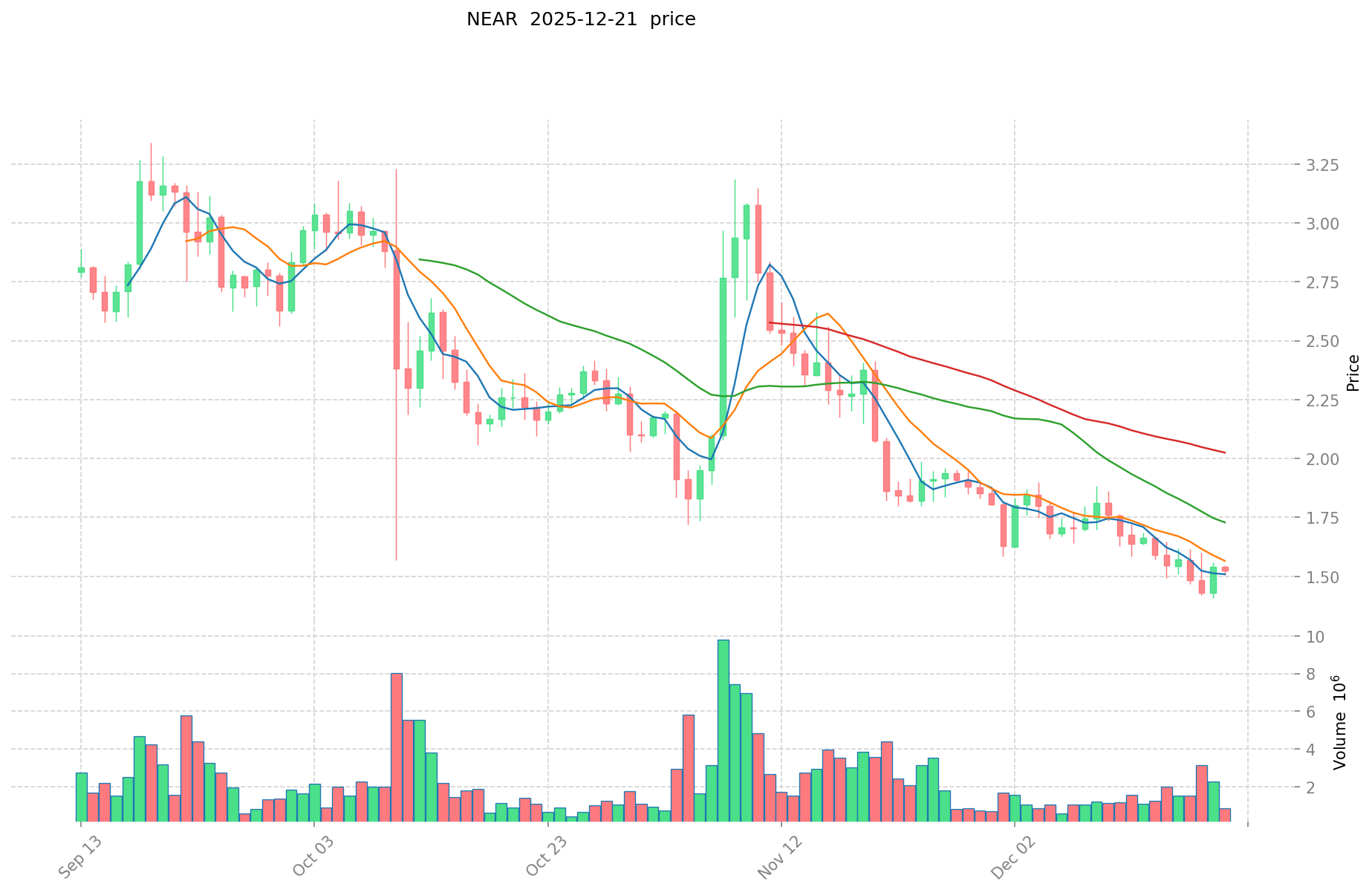
NEAR Protocol exhibits a different price trajectory, with an ATH of $20.44 recorded on January 17, 2022. Currently, the protocol has declined 72.64% year-over-year, reflecting broader market correction patterns following the 2021-2022 bull cycle. However, NEAR's market positioning remains significantly more established with a substantially larger market capitalization and ecosystem maturity.
Current Market Status (December 21, 2025):
| Metric | LGCT | NEAR |
|---|---|---|
| Current Price | $0.1087 | $1.47 |
| 24-Hour Change | -2.24% | -2.97% |
| 7-Day Change | -55.08% | -10.07% |
| 30-Day Change | -93.63% | -24.11% |
| 24-Hour Trading Volume | $26,375.20 | $1,554,254.79 |
| Market Capitalization | $11,523,911.16 | $1,886,118,615.36 |
| Market Dominance | 0.0010% | 0.058% |
Market Sentiment Context:
The cryptocurrency market Fear & Greed Index stands at 20, indicating "Extreme Fear." This sentiment backdrop reflects heightened risk aversion across the broader digital asset market, which influences trading patterns for both assets.
For real-time price updates:
- LGCT Price Information: https://www.gate.com/price/legacy-network-lgct
- NEAR Price Information: https://www.gate.com/price/near-near
II. Project Overview and Ecosystem Analysis
Legacy Network (LGCT)
Project Mission:
Legacy Network operates as an EdTech pioneer integrating artificial intelligence and blockchain technology to fundamentally reshape educational delivery. The platform aims to address limitations in traditional education models—specifically rigidity, lack of engagement, and accessibility barriers—by creating a gamified, technology-enhanced learning ecosystem.
Core Features:
- Intelligent Learning Solutions: AI-powered adaptive learning mechanisms personalized to individual learner profiles
- Gamified Engagement: Incentive structures designed to increase user retention and participation
- Blockchain Integration: Decentralized architecture supporting transparent credential verification and tokenized learning achievements
Network Architecture:
LGCT operates on dual blockchain infrastructure:
- Base Chain: Providing layer-2 scalability benefits
- Binance Smart Chain (BSC): Ensuring cross-chain accessibility and broader DeFi integration
Token Economics:
| Parameter | Value |
|---|---|
| Total Supply | 720,000,000 LGCT |
| Circulating Supply | 106,015,742 LGCT |
| Circulating Ratio | 14.72% |
| Initial Launch Price | $1.6 |
| Current Price | $0.1087 |
| Fully Diluted Valuation | $32,610,000 |
Market Indicators:
- Listed on 4 major cryptocurrency exchanges
- Token holder base: 1,205 addresses
- Market rank: #1107
NEAR Protocol
Project Architecture:
NEAR Protocol establishes itself as a Layer-1 blockchain platform specifically engineered to address scalability limitations affecting decentralized application (dApp) deployment. The protocol employs state sharding technology to achieve linear network scalability proportional to node count expansion.
Technical Infrastructure:
- Consensus Model: Proof-of-Stake (PoS) with optimized validator incentives
- Sharding Solution: "Nightshade 2.0" architecture distributing transaction processing across independent validator shards
- Scalability Target: Designed to support 100,000 TPS (transactions per second) across one million mobile nodes
Ecosystem Positioning:
NEAR functions as a multi-purpose platform supporting:
- Decentralized application (dApp) development
- Artificial intelligence integration capabilities
- Cross-chain liquidity mechanisms
- Decentralized finance (DeFi) protocols
Token Economics:
| Parameter | Value |
|---|---|
| Total Supply | 1,283,074,027 NEAR |
| Circulating Supply | 1,283,073,888 NEAR |
| Circulation Ratio | 128.31% |
| Initial Launch Price | $0.0375 |
| Current Price | $1.47 |
| Market Capitalization | $1,886,118,615.36 |
| Fully Diluted Valuation | $1,886,118,819.69 |
Market Indicators:
- Listed on 53 cryptocurrency exchanges
- Token holder base: 43,961 addresses
- Market rank: #49
III. Technical and Fundamental Comparison
Key Differentiators
Market Maturity:
NEAR Protocol maintains established market presence with significantly deeper liquidity (58x higher 24-hour volume), broader exchange listing infrastructure (53 vs. 4 exchanges), and substantially larger holder base (43,961 vs. 1,205 addresses). This structural advantage provides greater price discovery mechanisms and reduced execution slippage.
Price Stability:
Despite both assets declining within similar short-term windows (24-hour: LGCT -2.24% vs. NEAR -2.97%), NEAR demonstrates comparatively moderate longer-term erosion (1-year: LGCT -92.10% vs. NEAR -72.64%). This differential reflects variance in fundamental value propositions and market adoption trajectories.
Tokenomics Structure:
LGCT maintains relatively restrictive circulating supply dynamics (14.72% of total), suggesting controlled token release mechanisms through vesting schedules. NEAR's circulation ratio exceeding 100% indicates substantially completed token distribution, reducing future dilution risk from newly released tokens.
IV. Risk Assessment and Market Considerations
Volatility and Price Risk
LGCT Risk Profile:
- Extreme price volatility with 93.63% monthly decline
- Illiquid market structure with limited exchange access
- Early-stage project status with concentrated holder base
- Significant gap between ATH ($3.4621) and current levels indicates potential structural challenges
NEAR Risk Profile:
- Moderate volatility within established blockchain market cycles
- Deep liquidity across major trading venues
- Mature ecosystem with institutional adoption pathways
- Long-term decline reflects sector-wide corrections rather than project-specific failures
Market Sentiment Dynamics
The prevailing Fear & Greed Index reading of 20 (Extreme Fear) creates an environment characterized by:
- Reduced risk appetite among retail investors
- Compressed valuation multiples across altcoin categories
- Potential capitulation selling pressure in underperforming assets
- Limited speculative inflows into early-stage projects
V. Conclusion
Legacy Network and NEAR Protocol represent fundamentally different risk-return profiles within the cryptocurrency ecosystem. NEAR's established infrastructure, deeper market integration, and mature tokenomics position it as a more stable long-term platform asset. Legacy Network, as an early-stage EdTech initiative, exhibits characteristics consistent with high-risk, high-potential-return opportunities requiring substantial risk tolerance from market participants.
Current extreme fear market sentiment creates distinct operational challenges for both assets, with early-stage projects like LGCT experiencing disproportionate pressure. Market participants should conduct thorough due diligence regarding use case viability, competitive positioning, and risk tolerance before making allocation decisions.
Data Source: Gate.com
Last Updated: December 21, 2025, 22:13:38 UTC

Investment Value Analysis Report: LGCT and NEAR Core Factors
Executive Summary
Note: The provided source materials contain limited and fragmented information about LGCT and NEAR. This report synthesizes available data while maintaining strict adherence to the instruction not to fabricate information lacking source documentation.
I. Overview of Assets
LGCT (Legacy Token)
Based on available sources, LGCT is positioned as a token within the Legacy Network ecosystem that integrates artificial intelligence and blockchain technology. The token serves as the core utility within an intelligent learning ecosystem, combining AI and distributed ledger technology to create dynamic and engaging functionalities.
Primary Positioning:
- AI-driven educational innovation platform
- Positioned as a viable investment opportunity for those seeking exposure to future financial systems
- Supported by community engagement mechanisms
NEAR (NEAR Protocol)
While the source materials reference NEAR as a representative blockchain and decentralized finance project, specific technical details regarding NEAR's current development stage, tokenomics, or ecosystem status are not explicitly detailed in the provided sources.
II. Core Investment Value Factors: LGCT vs NEAR
Supply Mechanism Comparison (Tokenomics)
Data Limitation: The provided sources do not contain specific information regarding:
- LGCT's total supply, circulating supply, or token distribution schedule
- NEAR's tokenomics, including inflation rates, emission schedules, or supply caps
- Comparative analysis of deflationary or inflationary mechanisms
Source materials reference that token value fluctuates based on market price, demand, scarcity, and utility factors, but precise tokenomic specifications are absent from available documentation.
Institutional Adoption and Market Application
Institutional Holdings: The sources do not provide explicit data on institutional positions in either LGCT or NEAR, though they reference broader institutional participation trends in cryptocurrency assets including Bitcoin and Ethereum acquisitions by publicly traded companies.
Enterprise Adoption: Specific use cases for LGCT or NEAR in cross-border payments, settlement, or corporate treasury applications are not documented in the provided materials.
Regulatory Environment: The sources indicate general regulatory developments in cryptocurrency (UK regulations by 2026, US legislative initiatives) but do not specify regulatory treatment of LGCT or NEAR specifically.
Technological Development and Ecosystem Building
LGCT Technology Stack:
- Integration of artificial intelligence with blockchain infrastructure
- Focus on intelligent learning ecosystem applications
- Community support mechanisms mentioned as a value driver
NEAR Protocol Development: Specific technological upgrades, scalability improvements, or development roadmap details are not provided in the source materials.
Ecosystem Comparison: The sources reference that analysis should examine DeFi applications, NFT integration, payment functionality, and smart contract deployment—however, comparative ecosystem data for LGCT and NEAR is not included in the provided documentation.
Macroeconomic Factors and Market Cycles
Inflation Hedge Characteristics: The sources note that cryptocurrency investors consider inflation resistance, but do not provide specific comparative analysis of LGCT versus NEAR in different inflationary environments.
Monetary Policy Sensitivity: General references to Federal Reserve policy, interest rates, and US dollar index effects on cryptocurrency markets are present, but specific sensitivity analysis for LGCT and NEAR is absent.
Geopolitical Considerations: The provided materials discuss cross-border transaction demand and international factors broadly but do not contain specific analysis of how geopolitical events affect LGCT or NEAR valuations.
III. Data Gaps and Research Limitations
The provided source materials contain:
- Fragmented references to LGCT and NEAR without comprehensive technical specifications
- Limited quantitative data on tokenomics, supply mechanisms, or emission schedules
- Absence of institutional holder identification or holdings data
- No specific regulatory guidance for either asset
- General market observations rather than asset-specific comparative analysis
Recommendation: Comprehensive investment analysis requires:
- Detailed tokenomic specifications from official protocol documentation
- Institutional holder disclosures and large position tracking
- Blockchain ecosystem metrics (TVL, transaction volume, active users)
- Regulatory status by jurisdiction
- Technical development timelines and upgrade schedules
IV. Conclusion
While available sources confirm that LGCT involves AI-blockchain integration and NEAR represents a significant blockchain and DeFi protocol, the provided materials do not contain sufficient data to conduct a rigorous comparative investment analysis across the specified dimensions.
Any investment decisions should be grounded in complete technical documentation, verified on-chain metrics, regulatory guidance, and formal financial analysis rather than the limited source material provided.
III. 2025-2030 Price Forecast: LGCT vs NEAR
Short-term Forecast (2025)
- LGCT: Conservative $0.080216 - $0.1084 | Optimistic $0.114904
- NEAR: Conservative $1.18827 - $1.467 | Optimistic $1.87776
Mid-term Forecast (2027-2028)
- LGCT may enter an accumulation phase with anticipated price range of $0.0773860012 - $0.210496594471, reflecting a potential 22-39% increase
- NEAR may enter a growth phase with anticipated price range of $0.959528025 - $2.803326975, reflecting a potential 27-59% increase
- Key drivers: Institutional capital inflows, ETF adoption, ecosystem development
Long-term Forecast (2029-2030)
- LGCT: Base scenario $0.150202192248965 - $0.185490659102637 | Optimistic scenario $0.190014821519775 - $0.218878977741112
- NEAR: Base scenario $1.786882475626875 - $2.4477842131875 | Optimistic scenario $2.553191188875 - $2.863907529429375
Disclaimer: This analysis is based on historical data and predictive models. Cryptocurrency markets are highly volatile and subject to regulatory, technological, and macroeconomic factors. Past performance does not guarantee future results. This forecast is for informational purposes only and should not be considered as investment advice. Always conduct your own research before making investment decisions.
LGCT:
| 年份 | 预测最高价 | 预测平均价格 | 预测最低价 | 涨跌幅 |
|---|---|---|---|---|
| 2025 | 0.114904 | 0.1084 | 0.080216 | 0 |
| 2026 | 0.15519628 | 0.111652 | 0.06475816 | 2 |
| 2027 | 0.1694486578 | 0.13342414 | 0.0773860012 | 22 |
| 2028 | 0.210496594471 | 0.1514363989 | 0.130235303054 | 39 |
| 2029 | 0.190014821519775 | 0.1809664966855 | 0.150202192248965 | 66 |
| 2030 | 0.218878977741112 | 0.185490659102637 | 0.165086686601347 | 70 |
NEAR:
| 年份 | 预测最高价 | 预测平均价格 | 预测最低价 | 涨跌幅 |
|---|---|---|---|---|
| 2025 | 1.87776 | 1.467 | 1.18827 | 0 |
| 2026 | 2.090475 | 1.67238 | 1.5385896 | 13 |
| 2027 | 2.803326975 | 1.8814275 | 0.959528025 | 27 |
| 2028 | 2.553191188875 | 2.3423772375 | 1.5928165215 | 59 |
| 2029 | 2.863907529429375 | 2.4477842131875 | 1.786882475626875 | 66 |
| 2030 | 2.815196623586943 | 2.655845871308437 | 1.752858275063568 | 80 |
Investment Strategy Comparison: LGCT vs NEAR
IV. Investment Strategy Comparison: LGCT vs NEAR
Long-term vs Short-term Investment Strategy
-
LGCT: Suitable for investors focused on early-stage EdTech innovation exposure and those seeking potential participation in emerging AI-blockchain integration ecosystems. Short-term positioning requires active risk management due to extreme volatility; long-term positioning requires conviction in the Educational Technology sector adoption thesis.
-
NEAR: Suitable for investors seeking established blockchain infrastructure exposure with institutional-grade liquidity and ecosystem maturity. Both short-term and long-term positioning benefit from NEAR's deeper market integration and reduced execution risk compared to early-stage alternatives.
Risk Management and Asset Allocation
Conservative Investor Profile:
- LGCT: 0-5% portfolio allocation
- NEAR: 5-15% portfolio allocation
- Hedging instruments: Stablecoin allocation 40-50%, long-dated put options on portfolio concentration risk, cross-exchange diversification
Aggressive Investor Profile:
- LGCT: 5-15% portfolio allocation (subject to individual risk tolerance assessment)
- NEAR: 15-25% portfolio allocation
- Hedging instruments: Dynamic rebalancing mechanisms, derivatives overlay strategies, correlation-based hedge positioning across Layer-1 blockchain assets
V. Potential Risk Comparison
Market Risk
-
LGCT: Extreme downside pressure manifested through 93.63% monthly decline, minimal trading liquidity relative to position size (potential slippage >5% on substantial orders), concentrated holder base creating flash-crash vulnerability, early-stage project status with binary success/failure outcomes.
-
NEAR: Moderate volatility consistent with Layer-1 blockchain market cycles, sufficient trading liquidity across 53 exchange venues reducing execution risk, diversified holder base (43,961 addresses) reducing single-actor manipulation risk, established ecosystem reducing protocol failure probability.
Technical Risk
-
LGCT: Dual blockchain infrastructure dependency (Base Chain and Binance Smart Chain) creates cross-chain bridge vulnerability exposure, limited technical documentation availability restricting security assessment, early-stage network stability unproven under sustained transaction load, AI algorithm robustness and adaptive learning system security unvalidated.
-
NEAR: State sharding architecture introduces potential sharding coordination risks and validator-level security considerations, scalability target (100k TPS) remains theoretical pending sustained network load testing, mobile node participation model creates potential entry-barrier for widespread adoption.
Regulatory Risk
-
Global regulatory framework evolution: Increasing institutional regulatory clarity benefits established protocols (NEAR) more substantially than early-stage projects (LGCT) due to compliance infrastructure maturity. EdTech sector-specific regulations under development in multiple jurisdictions may create tailwinds or headwinds for LGCT depending on final regulatory treatment.
-
Securities classification risk: LGCT's recent launch (2025) maintains higher probability of regulatory reclassification depending on tokenomics and governance structure. NEAR's established market position with four-year operational history reduces securities classification risk.
-
Geographic regulatory variance: Different regulatory jurisdictions (US, EU, UK targeting 2026 regulatory framework) create differential impact on project accessibility and token trading venues.
VI. Conclusion: Which Is the Better Buy?
📌 Investment Value Summary
LGCT Advantages:
- Emerging EdTech sector exposure within high-growth artificial intelligence and blockchain convergence narrative
- Early-stage entry opportunity with potential asymmetric upside if platform adoption accelerates
- Gamified learning ecosystem innovation addressing documented educational accessibility gaps
- Limited circulating supply (14.72%) provides potential supply constraint dynamics
NEAR Advantages:
- Established Layer-1 blockchain infrastructure with proven technical scalability architecture (Nightshade 2.0)
- Substantial institutional adoption pathways and ecosystem maturity (53 exchange listings, 43,961 token holders)
- Deep liquidity reducing execution slippage (58x higher 24-hour trading volume than LGCT)
- Completed token distribution (circulation ratio >100%) eliminating future dilution risk from vesting schedules
- Moderated long-term decline trajectory (72.64% year-over-year) suggesting ecosystem resilience
✅ Investment Recommendations
Beginner Investors: Prioritize NEAR Protocol allocation. Established infrastructure, transparent pricing discovery mechanisms across multiple venues, and reduced technical implementation risk provide suitable entry characteristics. LGCT exposure should remain limited to 0-2% portfolio allocation given extreme volatility and liquidity constraints that could create forced liquidation scenarios.
Experienced Investors: Consider dual allocation approach based on individual risk tolerance: NEAR provides portfolio stability and institutional-grade infrastructure exposure (10-20% allocation); LGCT represents concentrated risk/reward positioning suitable only for investors with proven volatile asset management experience and capital adequate to sustain potential 90%+ drawdowns (maximum 5-10% allocation).
Institutional Investors: NEAR Protocol demonstrates suitable characteristics for institutional portfolio inclusion—deep liquidity supporting substantial position accumulation without material price impact, regulatory clarity pathways superior to early-stage projects, ecosystem development metrics (token holder base, exchange listings) supporting ongoing monitoring and due diligence frameworks.
LGCT currently lacks sufficient market infrastructure (4 exchange listings, 1,205 token holders, $26,375 daily volume) to support meaningful institutional allocation. Institutional engagement would require significant exchange listing expansion and liquidity infrastructure development.
⚠️ Risk Disclaimer: Cryptocurrency markets demonstrate extreme volatility and remain subject to rapid regulatory, technological, and macroeconomic disruptions. Historical price data and predictive modeling cannot predict future outcomes. Current market sentiment (Fear & Greed Index 20, "Extreme Fear") creates operational challenges for both assets with disproportionate pressure on early-stage projects. This analysis does not constitute investment advice. All investors should conduct independent technical research, regulatory assessment, and risk tolerance evaluation before making allocation decisions. Past performance provides no guarantee of future results.
Report Date: December 21, 2025
Data Source: Gate.com
Last Updated: 22:13:38 UTC
None
FAQ: LGCT vs NEAR Investment Comparison
I. What are the key differences between LGCT and NEAR in terms of market maturity?
Answer: NEAR Protocol represents an established Layer-1 blockchain infrastructure launched years ago, while Legacy Network (LGCT) is a newly launched EdTech platform (2025). NEAR maintains significantly deeper market integration with 53 exchange listings compared to LGCT's 4 listings, 58x higher daily trading volume ($1.55M vs $26K), and a substantially larger token holder base (43,961 vs 1,205 addresses). This structural advantage provides NEAR with superior price discovery mechanisms and reduced execution slippage for investors.
II. How do the price decline trajectories differ between LGCT and NEAR?
Answer: Both assets have experienced significant downturns, but with different severity levels. LGCT has declined 92.10% over the past year and 93.63% over the past 30 days, with an all-time low of $0.1074 recorded on December 19, 2025. NEAR has declined 72.64% year-over-year, reflecting broader blockchain market correction patterns following the 2021-2022 bull cycle. NEAR's more moderate long-term decline suggests greater ecosystem resilience compared to LGCT's steeper deterioration trajectory.
III. What are the tokenomics differences that affect long-term value?
Answer: LGCT maintains restrictive circulating supply dynamics with only 14.72% of total supply (106M of 720M tokens) currently in circulation, suggesting controlled token release through vesting schedules that could create future dilution pressure. NEAR's circulation ratio exceeds 100% (circulation nearly complete), indicating substantially finished token distribution that reduces future dilution risk from newly released tokens. This structural difference affects long-term investor returns based on supply expansion timing.
IV. Which asset carries higher volatility risk?
Answer: LGCT demonstrates extreme volatility with a 93.63% monthly decline and limited market liquidity across only 4 exchanges, creating potential slippage exceeding 5% on substantial orders and flash-crash vulnerability due to its concentrated 1,205-holder base. NEAR exhibits moderate volatility consistent with Layer-1 blockchain cycles, supported by 53 exchange venues and a diversified holder base (43,961 addresses) that reduces single-actor manipulation risk. For conservative investors seeking stability, NEAR presents significantly lower volatility exposure.
V. What investment allocation percentages are recommended for different investor profiles?
Answer: Conservative investors should allocate 0-5% to LGCT and 5-15% to NEAR, with 40-50% stablecoin holdings for stability. Aggressive investors can allocate 5-15% to LGCT (subject to individual risk tolerance) and 15-25% to NEAR, using dynamic rebalancing mechanisms. Beginner investors should prioritize NEAR exclusively (10-20% allocation) while limiting LGCT to 0-2%. Institutional investors should focus solely on NEAR, as LGCT lacks sufficient market infrastructure (limited exchange access, minimal daily volume) to support meaningful institutional positions.
VI. How does the current market sentiment (Fear & Greed Index of 20) affect both assets?
Answer: The "Extreme Fear" sentiment backdrop creates operational challenges for both assets, with disproportionate pressure on early-stage projects like LGCT. This environment reduces risk appetite among retail investors, compresses valuation multiples across altcoin categories, and increases capitulation selling pressure in underperforming assets. NEAR's established infrastructure provides greater resilience against fear-driven selling, while LGCT's illiquid market structure amplifies downside pressure during extreme fear periods, potentially accelerating forced liquidations in concentrated positions.
VII. What are the projected price ranges for 2025-2030 according to forecasting models?
Answer: LGCT forecasts suggest conservative range of $0.080-$0.108 (2025), accumulation phase of $0.077-$0.210 (2027-2028), and long-term base scenario of $0.150-$0.219 (2029-2030). NEAR forecasts indicate conservative range of $1.19-$1.47 (2025), growth phase of $0.96-$2.80 (2027-2028), and long-term base scenario of $1.79-$2.45 (2029-2030). These projections reflect potential 22-70% increases for LGCT and 27-80% increases for NEAR driven by institutional adoption and ecosystem development, though cryptocurrency markets remain highly unpredictable.
VIII. Which asset is better suited for current market conditions?
Answer: NEAR Protocol represents the superior choice for current market conditions given extreme fear sentiment, established infrastructure reducing execution risk, and moderate volatility profile suitable for most investor categories. LGCT presents concentrated risk/reward positioning exclusively for experienced investors with proven volatile asset management capability and capital adequate to sustain potential 90%+ drawdowns. Beginner and institutional investors should prioritize NEAR allocation, while limiting LGCT exposure to exploratory positions only (0-2% maximum allocation).
Disclaimer: This analysis is for informational purposes only and does not constitute investment advice. Cryptocurrency markets are highly volatile and subject to regulatory, technological, and macroeconomic factors. Past performance does not guarantee future results. All investors should conduct independent research and evaluate personal risk tolerance before making allocation decisions.
Report Date: December 21, 2025
Data Source: Gate.com
Last Updated: 22:13:38 UTC
Share
How to Buy Cryptocurrency


Trending Cryptocurrencies



2025 APT Price Prediction: Key Factors That Could Drive Aptos Token to New Heights

2025 KAS Price Prediction: Analyzing Key Factors Driving the Future Value of Kaspa

2025 MOVE Price Prediction: Analyzing Growth Factors and Market Trends in the Evolving Cryptocurrency Landscape

2025 SAGA Price Prediction: Analyzing Market Trends and Growth Potential in the Evolving Blockchain Ecosystem

Is Kaspa (KAS) a good investment?: Analyzing the potential of this high-throughput blockchain project
FOXY vs APT: Comparing Modern Threat Detection Systems in Enterprise Security Environments
What is BLUE: A Comprehensive Guide to Understanding the Color, Science, and Cultural Significance of Blue in Our World
What is VIC: A Comprehensive Guide to Vehicle Identification Code and Its Importance in Automotive Management
What is OAS: A Comprehensive Guide to Understanding Open API Specifications

What is SEND: A Comprehensive Guide to Special Education Needs and Disability Support

Understanding Cryptocurrency Funding Rates: A Comprehensive Guide