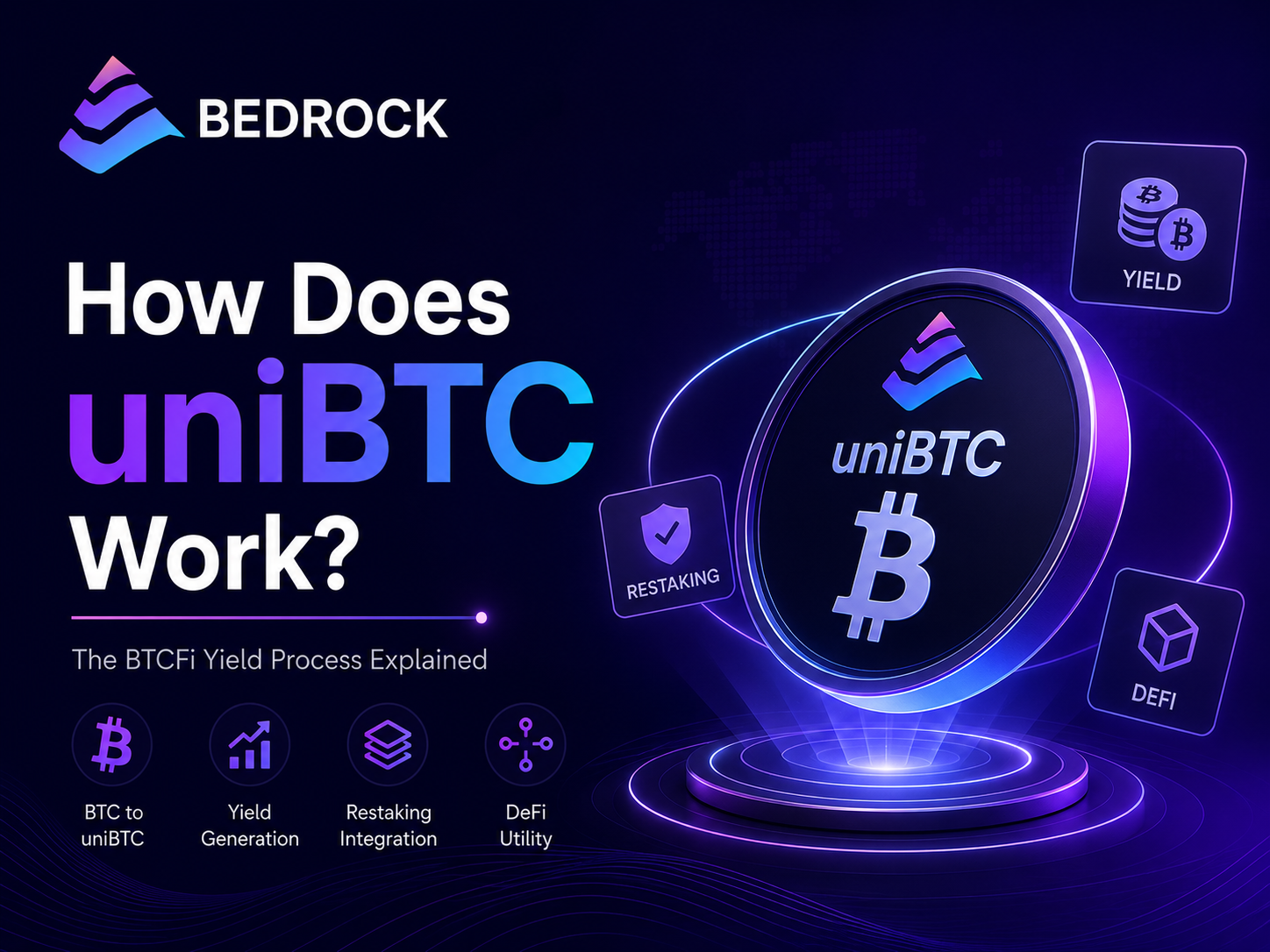
When users search for how uniBTC works, they’re typically looking to understand how BTC deposited into Bedrock becomes a liquid asset, where the returns come from, and how these assets can be further utilized in on-chain scenarios. For those interested in BTCFi, uniBTC is the primary gateway to understanding Bedrock’s yield structure.
This topic usually covers the asset conversion process, sources of return, liquidity utilization, Restaking integration, and cross-chain risk factors.
What Is uniBTC
uniBTC is a liquid BTC asset developed by the Bedrock protocol to serve the BTCFi ecosystem. Its core purpose is to enable BTC to participate in on-chain yield and DeFi scenarios while maintaining its value peg.
From a structural perspective, users do not interact with native BTC directly for all on-chain operations. Instead, they first convert BTC to uniBTC via Bedrock. The process begins with users submitting BTC or supported assets; the system then confirms the deposit and mints new tokens; users receive uniBTC, which can be used for on-chain activities; and finally, uniBTC can be deployed in yield pools, liquidity markets, or Restaking scenarios.
The significance of uniBTC lies in transforming BTC—which traditionally has low liquidity and limited use cases—into an asset that can be seamlessly integrated with DeFi protocols. For Bedrock, uniBTC acts as a critical intermediary connecting BTC holders to the on-chain yield network.
How Do Users Convert BTC to uniBTC
Converting BTC to uniBTC follows a process of asset deposit, system verification, on-chain minting, and issuance of receipt tokens. Users deposit BTC-related assets, and the system mints the corresponding amount of uniBTC in accordance with protocol rules.
First, users deposit BTC or approved BTC assets through Bedrock’s supported entry points. The system then verifies the deposit based on asset type, network status, and protocol logic. Next, the protocol mints the appropriate amount of uniBTC on the target chain. Finally, users hold uniBTC in their Wallet and can use it in subsequent DeFi or yield-generating scenarios.
| Process Stage |
User Action |
System Action |
| Asset Deposit |
Deposit BTC-related assets |
Receive and verify assets |
| Asset Verification |
Await on-chain confirmation |
Validate transaction status |
| uniBTC Minting |
Receive liquid asset |
Mint corresponding uniBTC |
| Subsequent Use |
Participate in DeFi |
Record asset transfers |
The key distinction is that users receive not just a generic wrapped BTC, but a liquid asset tied to Bedrock’s yield structure. Through asset mapping and on-chain minting, the system enables BTC to participate in a wide range of composable DeFi scenarios.
What Are the Sources of Return for uniBTC
uniBTC’s returns are not derived from a single source—they are linked to Bedrock’s BTCFi, Restaking, and DeFi architecture. The core value proposition is to enhance the on-chain utility of BTC through multi-protocol integration.
First, users hold or deploy uniBTC in supported yield-generating scenarios. The system then routes these assets into Restaking, liquidity pools, or external protocols. The protocol records and allocates returns from each source. Ultimately, the user’s yield, its magnitude, and distribution depend on the specific product’s rules and prevailing market conditions.
Mechanisms may include liquidity incentives, Restaking rewards, DeFi protocol yields, and ecosystem incentives. The stability of these returns varies and is influenced by protocol security, market liquidity, and the performance of third-party networks.
This structure is important because uniBTC enables BTC to engage in complex on-chain yield networks, not just passive holding. However, with more yield sources comes a greater need for users to understand the associated protocol risks.
How Does Bedrock Combine BTC Liquidity and Yield
Bedrock’s approach to combining BTC liquidity and yield centers around converting BTC into composable uniBTC. This allows users to maintain BTC exposure while leveraging liquidity assets to participate in on-chain yield opportunities.
Users deposit BTC-related assets into Bedrock, which then mints uniBTC, granting it circulation capability on the target chain. uniBTC can then be deployed in lending, liquidity pools, or yield aggregation protocols. This structure unifies BTC’s value representation and on-chain usability into a single asset.
Bedrock does more than just wrap BTC onto another chain—it connects BTC to the yield network via uniBTC. Users hold and use uniBTC, while the protocol maintains asset mapping, tracks interactions, and supports yield distribution.
The result is increased capital efficiency for BTC. For the BTCFi ecosystem, uniBTC serves as a standardized asset format for integrating BTC into DeFi.
How Does uniBTC Participate in Restaking and DeFi
uniBTC’s participation in Restaking and DeFi scenarios relies on Bedrock’s integrations with external protocols and on-chain applications. uniBTC acts as a liquid asset across protocols, supporting yield generation and asset allocation.
Once users obtain uniBTC, they can deploy it in compatible DeFi applications. The system or relevant protocols handle asset flows according to product rules. uniBTC may be used for liquidity provision, lending, yield aggregation, or Restaking. Through these on-chain interactions, users can utilize their assets while taking on associated protocol risks.
Crucially, uniBTC is not a static receipt but a BTCFi asset that can be actively deployed across a variety of on-chain financial use cases. Through Restaking, uniBTC connects to wider security and yield networks; via DeFi, it enables participation in liquidity and trading applications.
This mechanism boosts BTC’s composability and allows Bedrock to build a broader ecosystem around uniBTC.
What Cross-Chain and Protocol Risks Does uniBTC Face
uniBTC’s risks stem from cross-chain architecture, Smart Contracts, third-party protocols, and yield volatility. Because uniBTC bridges BTC, target chains, and DeFi applications, the system is inherently more complex than simple BTC holding.
When users deposit BTC-related assets into Bedrock, they rely on cross-chain or asset mapping mechanisms. The protocol must maintain the peg between uniBTC and the underlying assets. Once uniBTC enters DeFi or Restaking, it is also exposed to the security of external protocols. Any cross-chain failure, contract vulnerability, or liquidity shortfall can affect the user’s asset experience.
These risks are not limited to Bedrock itself but extend to all connected networks. Yield-bearing assets typically depend on coordinated operation across multiple protocols, resulting in more dispersed risk sources.
This is a critical consideration for understanding BTCFi. uniBTC delivers higher asset utilization, but users must be aware that yield opportunities come with Smart Contract, cross-chain, and market liquidity risks.
What Is uniBTC’s Role in the BTCFi Ecosystem
uniBTC serves as a liquid asset connecting BTC holders to on-chain yield opportunities within the BTCFi ecosystem. It enables BTC to evolve from a static holding to active participation in Restaking, DeFi, and multi-chain yield networks.
Users convert BTC to uniBTC via Bedrock, after which uniBTC can be deployed in supported on-chain applications. Bedrock expands uniBTC’s use cases through multi-chain deployment and yield architecture. Ultimately, uniBTC becomes the gateway asset for both liquidity and yield in the BTCFi ecosystem.
uniBTC’s value is not limited to representing BTC—it enhances BTC’s on-chain utility and supports asset mapping, liquidity use, and yield integration.
This positioning makes uniBTC the key asset for understanding Bedrock. For the broader BTCFi sector, uniBTC demonstrates a pathway for BTC to enter the multi-chain financial system.
Summary
The uniBTC process can be summarized as follows: users deposit BTC-related assets; Bedrock confirms the deposit and mints uniBTC; users deploy uniBTC in DeFi, Restaking, or liquidity scenarios; and, through protocol architecture, participate in the BTCFi yield network.
uniBTC connects BTC assets, on-chain liquidity, and yield opportunities. Its core value is to improve BTC’s capital efficiency, but it also introduces cross-chain, Smart Contract, third-party protocol, and market liquidity risks.
FAQ
What Asset Is uniBTC?
uniBTC is a liquid BTC asset within the Bedrock protocol, designed to connect BTCFi, Restaking, and DeFi scenarios. It enables BTC to participate in a broader range of on-chain yield and liquidity applications.
How Is BTC Converted to uniBTC?
Users submit BTC-related assets through Bedrock’s supported entry points. After verification, the system mints the corresponding uniBTC on the target chain, which users can then hold or deploy.
Where Do uniBTC’s Returns Come From?
uniBTC’s returns may originate from Restaking, liquidity incentives, DeFi protocol yields, and ecosystem rewards. Actual returns depend on protocol rules, market conditions, and the performance of external networks.
How Is uniBTC Different from Ordinary Wrapped BTC?
Ordinary wrapped BTC primarily solves cross-chain transfer, while uniBTC focuses on BTCFi yield generation. It not only represents BTC exposure but also connects to Bedrock’s yield and application scenarios.
What Are the Main Risks of uniBTC?
uniBTC faces cross-chain, Smart Contract, third-party protocol, and liquidity risks. Because it is integrated with multiple on-chain scenarios, its risk profile is more complex than simply holding BTC.