As the on-chain perpetual futures marketplace grows rapidly, Hyperliquid has emerged as one of the most closely watched on-chain order book derivatives infrastructures in DeFi. Building on this foundation, a growing number of Builders are leveraging Hyperliquid's HIP-3 framework to create vertical trading platforms, with TradeXYZ being a prime example.
Because both involve perpetual futures, order books, and on-chain trading, many users mistakenly view TradeXYZ and Hyperliquid as the same product. In reality, they have distinct differences in positioning, functionality, and ecosystem role.
Hyperliquid and TradeXYZ: A Quick Breakdown
As a high-performance perpetual futures trading platform built on an on-chain order book model, Hyperliquid's core mission is to deliver matching speed, liquidity, and trading efficiency comparable to centralized exchanges—all within an on-chain environment. Unlike traditional AMM models, Hyperliquid prioritizes professional trading capabilities and high-frequency order book market structures.
Beyond its native perpetual futures market, Hyperliquid has evolved into a comprehensive on-chain derivatives infrastructure. Its HIP-3 Builder framework enables third-party projects to spin up independent markets using Hyperliquid's liquidity and order book system.
TradeXYZ, an on-chain perpetual futures market built on the Hyperliquid HIP-3 Builder framework, zeroes in on real-world asset (RWA) trading scenarios including stocks, commodities, indices, and Pre-IPO markets. Its core goal is to offer users stock price trading, commodity price trading, Pre-IPO market access, and 24/7 global market access through an on-chain perpetual futures market.
TradeXYZ does not build its own matching network from scratch. Instead, it leverages Hyperliquid's liquidity and order book infrastructure to establish its own vertical market brand and asset ecosystem.
What Is HIP-3 Builder?
HIP-3 Builder is a market-building framework provided by Hyperliquid.
Its core logic is simple: allow third-party projects to build independent markets on top of Hyperliquid's order book and liquidity system—without having to build a complete derivatives infrastructure from the ground up.
In traditional finance, launching a derivatives platform requires a matching engine, clearing system, risk engine, liquidity network, and market maker infrastructure. HIP-3 Builder opens up these underlying capabilities as modular components.
TradeXYZ's market structure is essentially a vertical asset market built using this framework.
Core Differences Between TradeXYZ and Hyperliquid
The fundamental difference lies in their ecosystem roles.
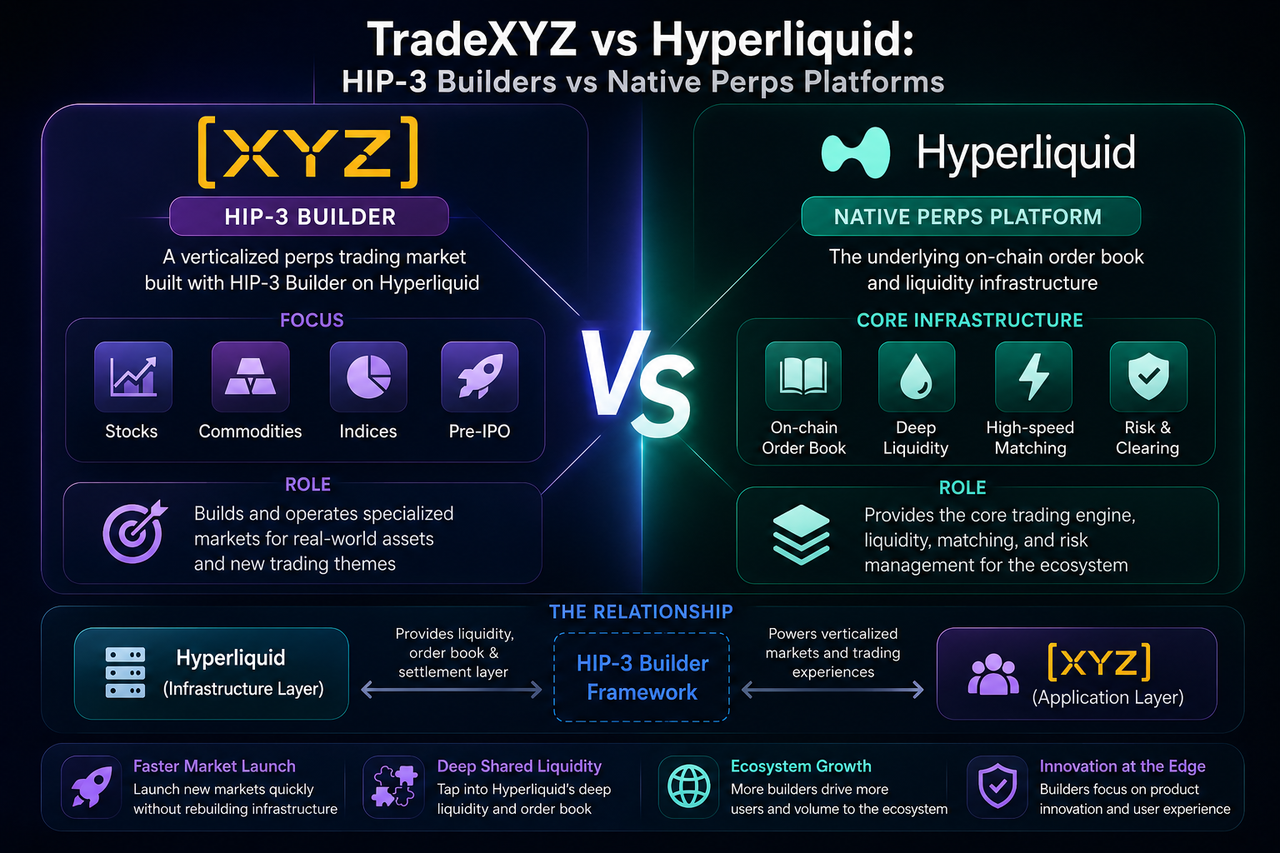
Hyperliquid operates more as an infrastructure layer, while TradeXYZ functions as an application-layer market.
Hyperliquid provides the order book, liquidity, matching system, and on-chain trading infrastructure. TradeXYZ builds specific asset markets, introduces new trading themes, crafts market narratives, and focuses on RWA and stock trading scenarios.
The relationship is comparable to:
| Layer |
Hyperliquid |
TradeXYZ |
| Ecosystem Role |
Infrastructure Layer |
Application-Layer Market |
| Core Function |
Order Book & Liquidity |
Vertical Asset Market |
| Market Direction |
General Perpetual Futures |
Stock & RWA Markets |
| User Focus |
Trading Performance |
Asset Themes & Market Scenarios |
| Technical Role |
Underlying System |
Builder Project |
Thus, TradeXYZ's growth is, to some extent, tied to the development of the Hyperliquid ecosystem.
Why the Builder Model Matters
The Builder model signals a shift in on-chain derivatives from "single-platform competition" to an "infrastructure + application ecosystem" structure.
Previously, most on-chain trading platforms had to build entire systems by themselves, creating high development and liquidity barriers.
With the HIP-3 Builder model, projects can tap into Hyperliquid's deep liquidity, order book system, clearing mechanisms, and trading infrastructure to quickly launch new markets.
This structure is somewhat similar to:
The infrastructure layer handles the network and underlying capabilities, while the application layer drives specific markets and user experiences.
Why TradeXYZ Focuses on Stocks and Pre-IPO Markets
TradeXYZ differentiates itself by concentrating on real-world asset (RWA) markets.
While most on-chain perpetual futures platforms primarily trade crypto assets like BTC and ETH, TradeXYZ prioritizes:
This strategy expands the asset frontier of on-chain derivatives.
The goal is not to replace traditional stock exchanges, but to create an on-chain risk trading market tied to real-world asset prices.
That makes TradeXYZ more of an "on-chain gateway to traditional financial markets."
How the Builder Model Shapes DeFi
The HIP-3 Builder model reflects DeFi's gradual move toward a "modular finance" stage.
In the past, a single protocol handled infrastructure, liquidity, user interface, and risk management. Now, these functions are being unbundled.
The future on-chain financial ecosystem may take this shape:
| Layer |
Primary Function |
| Infrastructure Layer |
Matching, Clearing, Liquidity |
| Builder Layer |
Market Construction & Asset Design |
| Application Layer |
User Experience & Community Operations |
This structure accelerates market innovation and lowers the entry barrier for new projects.
TradeXYZ and Hyperliquid exemplify this trend.
Are TradeXYZ and Hyperliquid Competitors?
Strictly speaking, they are not direct competitors.
Hyperliquid acts as an underlying market network, while TradeXYZ is a vertical market built on top of it.
Some user activity may overlap, but from an ecosystem perspective, they are more like partners.
As the Builder model expands, more vertical market projects similar to TradeXYZ will likely emerge.
Summary
While both TradeXYZ and Hyperliquid belong to the on-chain perpetual futures ecosystem, they differ clearly in positioning and role.
Hyperliquid leans toward on-chain order book and liquidity infrastructure, whereas TradeXYZ is a vertical asset trading market built on the HIP-3 Builder framework.
FAQs
What Is the Core Role of HIP-3 Builder?
HIP-3 Builder allows third-party projects to build their own trading markets using Hyperliquid's order book and liquidity system.
Does TradeXYZ Have Its Own Order Book?
TradeXYZ's core order book and liquidity infrastructure come primarily from the Hyperliquid ecosystem.
Why Does TradeXYZ Focus More on Stocks and Pre-IPO Markets?
Because its core positioning is to expand on-chain real-world asset (RWA) trading scenarios beyond crypto asset markets.
Why Is the Builder Model Important?
The Builder model lowers the barrier to building on-chain derivatives markets, enabling more projects to quickly launch new markets on unified infrastructure.
Are TradeXYZ and Hyperliquid Competitors?
They are more of a cooperative relationship between infrastructure and the application layer, not direct competitors.







