Unlike traditional centralized data labeling platforms constrained by cost, transparency, and participation barriers, Alaya AI represents a structural shift in how AI data is produced. Data is no longer monopolized and supplied by a handful of institutions. Instead, through on-chain incentives, community collaboration, and composable interfaces, it connects "data, models, and applications" into a verifiable, customizable open network. As AI models evolve toward vertical use cases, multimodality, and intelligent agents, high-fidelity, traceable, and compliant data has become an even scarcer competitive advantage than computing power.
From the perspective of Web3 and AI industry convergence, Alaya AI integrates data contribution, model fine-tuning funding, and governance decisions into a unified token and NFT framework, positioning AGT as the on-chain linchpin for coordinating security, permissions, and incentives. This architecture directly addresses real-world challenges—such as the difficulty small and medium-sized enterprises face in accessing enterprise-grade data services and the growing user sensitivity around data ownership and privacy. It also provides a clear analytical lens for systematically explaining the project's background, tokenomics, technical architecture, use cases, competitive differentiation, investment risks, and future potential.
What Is Alaya AI (AGT)? Project Background and Development History
 Image source: Alaya Official Website
Alaya AI (also referred to as Alaya) positions itself as a Web3-native platform for AI data collection, sampling, automated labeling, and open data exchange. The official description frames it as an open infrastructure that connects distributed data communities with a composable AI network. The project's core thesis holds that AI development depends on three pillars—data, computing power, and algorithms—with data quality being the decisive variable determining a model's ceiling. Data is the sole channel through which AI interacts with reality, and human feedback is the essential guide for machines to build accurate world models.
Launched in 2023, the project rapidly scaled its user base. Public data indicates over 3.6 million registered users, with daily on-chain transactions reaching hundreds of thousands. The network spans multiple chains, including Arbitrum, opBNB, and Polygon, to reduce friction for users across different ecosystems.
In November 2024, Alaya AI launched the Open Data Platform (ODP), expanding beyond simple labeling to include dataset trading, sharing, and social collaboration, powered by smart contracts for transparent data governance. Around the same time, the project was selected for Binance's MVB (Most Valuable Builder) Season 8, gaining ecosystem resources and exposure on BNB Chain.
On May 21, 2025, the governance token AGT was listed for AGT/USDT spot trading on KuCoin with trading bot support, significantly boosting token liquidity and global accessibility. Entering 2026, the ecosystem continues monthly events like AGT Redemption, where users exchange accumulated AIA credits for AGT, creating a closed incentive loop: "complete tasks → earn credits → redeem AGT periodically."
AGT (Alaya Governance Token) is the ecosystem's native token, serving both utility and governance functions. Its maximum supply is 5 billion tokens, with a circulating supply of approximately 2.3 billion (subject to market updates) as tracked by CoinMarketCap. AGT is used for staking, voting, premium task access, NFT upgrades, and custom data requests.
AGT Tokenomics and Ecosystem Incentive Mechanism
AGT's economic design emphasizes "contribution as incentive and staking as coordination," rather than passive yield from holding tokens. According to official documentation, AGT staking does not generate passive returns. Instead, it acts as a sunk cost and proof of equity, unlocking high-impact roles like data verification, auto-labeling model development participation, governance voting, dataset listing, and premium tasks—thereby deterring malicious labeling and free-riding.
The token distribution (total supply of 5 billion AGT) is roughly as follows (source: Tokenomics and public data):
| Category |
Percentage |
Description |
| Community |
57% |
Includes user rewards 35%, ecosystem fund 10%, marketing 7% |
| Investors |
18% |
Seed round, private placement, KOLs, etc. |
| Internal Team |
10% |
Team 8%, advisors 2% |
| Foundation |
10% |
Community treasury, liquidity |
| Public Sale |
5% |
IDO |
At TGE (Token Generation Event), approximately 28% of the supply was unlocked, with the remainder released gradually according to a vesting schedule. The unlocking pace of investor and team tokens is a key factor to monitor for secondary market supply pressure.
Key incentive scenarios include:
- Task and Activity Rewards: Completing gamified labeling tasks, knowledge challenges, and daily tasks earns AGT or AIA credits, which are then redeemed for AGT through monthly Redemption events.
- Auto-Labeling Model Staking Pools: AI model developers create AGT reward pools to attract community contributions for specific models. Stakers' returns are tied to model performance based on their contribution.
- Custom Data Requests: Projects can set up reward pools using their own tokens or AGT to source vertical data needs, serving small and medium-sized AI teams.
- Buybacks and Redistribution: The official team states that a portion of platform data service revenue will be used to buy back AGT and inject it into user reward pools to sustain the long-term incentive cycle (specific ratios and execution subject to on-chain data and official announcements).
- NFT System Integration: Alaya NFTs and Medallion NFTs determine task permissions and levels. Higher-level upgrades require consuming AGT and experience points at specific stages, forming a hierarchy of "identity → capability → returns."
Additionally, the ecosystem incorporates gamification elements like experience points and energy values, combined with Web3 social viral mechanisms (referral commissions, daily bonuses) to drive community growth.
Alaya AI's Core Technical Architecture and Data Network
Alaya AI's technical architecture can be summarized as a three-layer structure: off-chain efficient processing + on-chain incentives and auditing + human-machine collaborative quality control.
The data layer supports multimodal inputs such as text, images, video, and audio, with targeted sampling and custom preprocessing for vertical use cases (e.g., medical imaging, dialects, autonomous driving vision). The enterprise-grade high-fidelity pipeline emphasizes automated cleaning, deduplication, and zero-knowledge encryption (ZK-encryption), enabling large-scale preprocessing while preserving privacy boundaries.
The collaboration layer draws on swarm intelligence: multiple annotators participate in the same task, with consensus or majority mechanisms improving label consistency and reducing reliance on full expert reviews. Contributors' historical accuracy builds a reputation score akin to Proof of Quality, influencing task assignment and reward multipliers.
The coordination layer relies on blockchain to record key states: data package quotes, task completions, staking, and governance votes. Multi-chain deployment (Arbitrum, opBNB, etc.) balances cost and ecosystem user coverage. The Open Data Platform (ODP) provides interfaces for dataset trading, sharing, and social collaboration, giving data assets greater composability.
The official team also mentions AI model tokenization: through AGT staking pools, the community can directly fund the development and fine-tuning of specific models, transparently aligning "who contributes data, who benefits from model value."
How Alaya AI Builds a Decentralized AI Data Infrastructure
The core of a decentralized AI data infrastructure is not simply "putting Web2 labeling on-chain," but restructuring data ownership, access rights, and value distribution rules.
Alaya AI advances on four dimensions:
- Open Access: Both individuals and enterprises can participate in data collection and monetization. AI projects can initiate distributed crowdsourcing or P2P data requests through a unified platform, reducing reliance on any single data giant.
- Composable Incentives: Projects can customize reward pools (using AGT or their own tokens) and recruit contributors with specific language, professional, or regional knowledge on demand, meeting long-tail data needs such as minor languages, dialects, and niche medical fields.
- Security and Compliance: High-sensitivity data paths emphasize encryption, traceable data lineage, and audit trails, responding to tightening global AI regulation and privacy legislation.
- Human-Machine Collaborative Closed Loop: Machines handle large-scale pre-labeling and sampling, while humans handle ambiguity resolution, domain judgment, and quality arbitration, forming a self-sustaining iterative data flywheel: improved data quality → better model performance → attracting more projects and contributors.
For the AI Agent track, agents require continuously updated high-fidelity, contextual feedback data to act reliably in the real world. Alaya AI's recent public discussions position itself as the data backbone layer of the Agent revolution, supporting the reasoning and alignment of autonomous systems through high-speed data loops.
How Auto-Labeling, Data Sampling, and the AI Training System Work
Auto-labeling is a key module for Alaya AI to reduce marginal costs. Its self-developed toolchain uses a multi-layer architecture to perform algorithm-intensive steps like pre-labeling, cleaning, and deduplication on multimodal raw data, followed by manual verification and correction. For enterprise orders with extremely high quality requirements, internal expert labeling teams can be added for review, forming a hybrid pipeline of "automation throughput + expert precision."
On the data sampling side, the platform emphasizes intelligent optimization and targeted sampling: rather than blindly accumulating data volume, it selects high-information-density samples based on model goals (e.g., specialized diagnosis, regional accent recognition), alleviating the common industry problem of "large datasets, low effective signal."
Simplified training system collaboration flow:
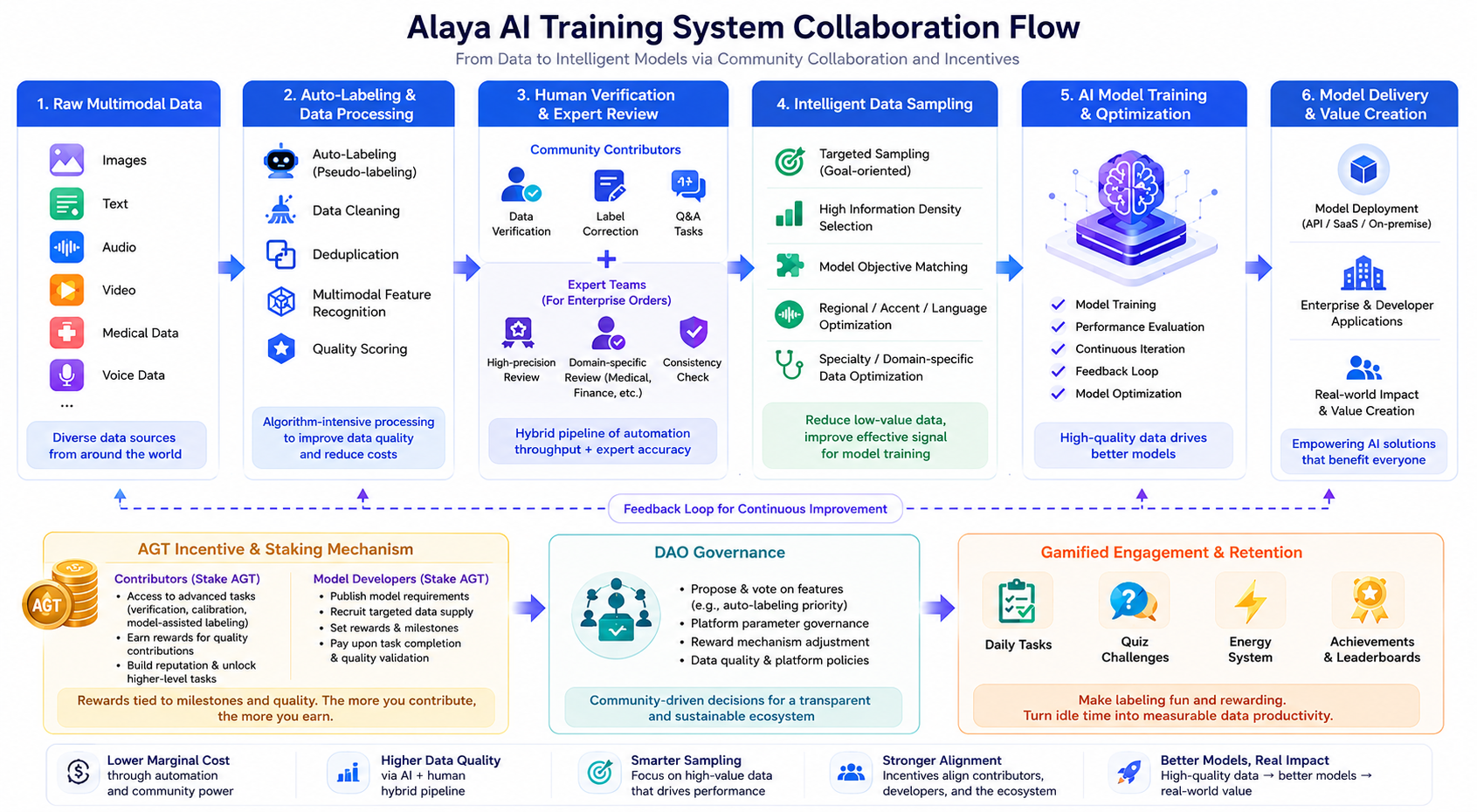
The gamified UI—daily tasks, quiz challenges, energy mechanisms—reduces churn from tedious labeling, converting fragmented idle time (commuting, breaks) into measurable data production capacity. This is a key experience differentiator from pure B2B labeling tools.
Application Scenarios of Alaya AI in Web3 and AI Ecosystems
- Small and Medium-Sized AI Startup Teams – Access vertical training sets at lower costs than traditional suppliers through custom data reward pools, ideal for NLP, CV, or multimodal projects with limited budgets but needing professional labels.
- Healthcare and Compliance-Sensitive Industries – Combine ZK encryption, lineage tracking, and expert review to serve high-risk scenarios like medical imaging and medical record structuring (compliance still requires clients to meet local regulations).
- E-Commerce and Content Recommendation – Labeled data such as product images, review texts, and visual searches accelerates recommendation and search model iteration.
- Autonomous Driving and Industrial Vision – High-cost frame-level labeling needs like dynamic visual segmentation and defect detection can be scaled through gamified crowdsourcing. Compared to players deeply tied with automotive companies like Scale AI, Alaya is still in market expansion mode.
- Web3 Native Applications – NFTs serve as carriers for task eligibility and data rights; DAO governance determines feature roadmaps; integration with DePIN, decentralized computing (e.g., Akash, Golem), and Bittensor can form an open stack vision of "data → training → model marketplace."
- AI Agents and Vertical Intelligent Agents – Provide real-time human feedback (RLHF-type data) and niche knowledge bases for agents, improving tool calling, specialized reasoning, and multi-step task success rates.
How Is Alaya AI Different from Other AI Data Protocols?
| Dimension |
Alaya AI |
Typical Web2 Platforms (e.g., Scale AI, Labelbox) |
| Data Ownership Expression |
NFTs + on-chain records, emphasizing contributor rights |
Usually defined by platform/customer contracts |
| Incentive Method |
AGT, gamification, staking to unlock premium tasks |
Primarily fiat salary |
| Participation Barrier |
Requires understanding of Web3 concepts like wallets, NFTs, staking |
Primarily enterprise procurement processes |
| Customization |
Projects can set up customized reward pools using own tokens |
Standardized contracts and service levels |
| Transparency |
On-chain tasks and governance traceable |
Centralized operations, audits rely on contracts |
Compared to other Web3 data projects, Alaya AI's differentiation lies in its combination of gamified crowdsourcing, auto-labeling toolchain, dual NFT permission system, AGT model staking pools, and the ODP open data market—rather than a single "labeling on-chain" feature. Its challenge: enterprise clients prioritize SLAs, delivery speed, and legal processes; the decentralization narrative must be proven with quality and cost data.
What Risks Should Be Considered When Investing in AGT Tokens?
AGT is a high-risk crypto asset. Potential investors should evaluate at least the following factors:
- Market Risk: Small-cap tokens are highly volatile. AGT saw significant gains after its KuCoin listing in May 2025, followed by corrections along with the broader market and unlocking pressure. Low daily trading volume can cause price slippage on large orders.
- Unlocking and Selling Pressure: Staggered unlocks for community, investors, and team may create sustained selling pressure if demand (platform revenue, buybacks) falls short of expectations.
- Disconnect Between Fundamentals and Narrative: Registered users do not equal active high-quality annotators. Real metrics like task completion volume, number of enterprise clients, and ODP transaction volume should be monitored.
- Regulatory Risk: Token-incentivized labeling may touch securities, labor, or cross-border data regulations in some jurisdictions; policy changes could affect operational regions.
- Technical and Security Risks: Smart contract vulnerabilities, design flaws in staking mechanisms, and malicious labeling attacks can harm data reputation and token value.
- Competition Risk: Giants like Scale AI have funding scale, government and enterprise clients, and vertical industry depth. Alaya's Web3 path still needs continuous validation in enterprise-grade delivery.
- Staking Expectation Management: The official team has clearly stated that AGT staking does not generate yields. If the market mistakenly believes in "passive income," it may lead to disappointment selling.
The above does not constitute investment advice. Decisions should be based on independent research of official documentation, on-chain data, and personal risk tolerance.
Future Development Directions and Market Potential of the Alaya AI Ecosystem
According to the public roadmap and ecosystem updates, Alaya AI's short- to medium-term priorities include:
- Continuously expanding ODP to attract more AI projects to the customized data marketplace
- Refining DAO governance to delegate more decisions—such as auto-labeling feature priorities and economic parameters—to the community
- Multi-chain deployment (BNB Chain, Optimism, etc.) to expand user reach
- Integrating with DePIN and decentralized computing protocols to explore a one-stop open stack for labeling, training, and deployment
- Consolidating periodic activities like AGT Redemption to maintain contributor retention and data supply speed
From a market perspective, the global AI data labeling market is projected to grow from approximately $2.3 billion in 2025 to nearly $18.2 billion by 2035 (Precedence Research). If Alaya can convert its 3.6 million+ user base into stable high-quality production capacity and sign more enterprise-level ODP clients, it could occupy a niche at the intersection of long-tail vertical data and Web3-native AI applications.
Long-term potential depends on: (1) whether the high-fidelity data pipeline can meet enterprise SLAs; (2) whether AGT buybacks and incentives are sustainable; (3) whether ecosystem synergies with computing power and model market protocols can be realized. The explosion of AI Agents and vertical small models will amplify demand for human feedback and contextual data, providing a macro tailwind for Alaya's core narrative. But success will ultimately depend on execution, not concepts.
Summary
Alaya AI positions itself as an open, composable Web3 AI data network, integrating distributed communities, auto-labeling, gamified incentives, and the AGT governance economy. It aims to solve structural problems of the AI era: scarcity of high-quality data, high labeling costs, and unclear data rights. AGT serves as the central hub for coordination, staking, governance, and value circulation—not as a traditional deposit-bearing asset.
For data contributors, the platform offers a way to convert fragmented time into token rewards. For AI projects, custom reward pools and ODP lower the barrier to accessing vertical data. For investors, it is essential to clearly recognize risks such as small-cap volatility, token unlocks, regulation, and competition.
Under the major trend of deep Web3 and AI integration, Alaya AI represents an experimental path toward democratizing data production, making it an asset, and incorporating on-chain governance. Whether it can transition from a "user scale narrative" to an "enterprise revenue and data quality narrative" will be the key yardstick for AGT's long-term value.
FAQs
What is the relationship between Alaya AI and AGT?
Alaya AI is the platform and network; AGT (Alaya Governance Token) is its native governance and utility token, used for staking, voting, premium tasks, and ecosystem incentives.
What is the total supply of AGT? How much is currently in circulation?
The maximum supply is 5 billion tokens. Circulating supply changes with unlock and redemption events; check real-time data on CoinMarketCap and other market trackers.
Can I earn passive income by staking AGT?
According to the official team, staking AGT does not generate passive returns. It is mainly used to unlock premium tasks, governance access, and security features, allowing users to earn rewards through higher contributions.
How do I earn money from data labeling tasks on Alaya AI?
Users earn AGT or AIA credits by completing labeling tasks, quizzes, and daily tasks. Credits can be used in monthly AGT Redemption events to exchange for AGT.
What is the difference between Alaya AI and Scale AI?
Scale AI is primarily a centralized enterprise service. Alaya AI emphasizes Web3 incentives, NFT permissions, on-chain transparency, and community crowdsourcing. It is better suited for long-tail customization and crypto-native projects, but still needs to build case studies for traditional enterprise SLAs.
Is investing in AGT safe?
Cryptocurrency investments carry high risk, and prices may fluctuate significantly. Conduct your own research on project fundamentals, token unlocks, and the regulatory environment. Do not invest money you cannot afford to lose.
What types of data does Alaya AI support?
It supports multimodal data including text, images, video, and audio, with customized sampling and labeling workflows for vertical scenarios such as healthcare, autonomous driving, and e-commerce.