As the blockchain gaming industry gradually moves away from the early Play-to-Earn model toward a more sustainable open economic system, developers are paying closer attention to issues such as asset ownership, on-chain economic stability, and cross-game interoperability.
Against the backdrop of continued growth in GameFi, NFTs, and on-chain digital identity, more gaming blockchains are adopting a “games-first” development approach. In addition to supporting NFTs and on-chain transactions, CROSS provides developer SDKs, wallet systems, and open protocols. Its goal is to lower the technical barrier for traditional game studios entering Web3, while building a more open economic model for players.
The Origins and Development Background of CROSS
CROSS is developed under the leadership of the OpenGame Foundation (OGF), with the goal of building a more transparent, open, and community-driven Web3 gaming economy. OGF positions CROSS as “player-owned” gaming infrastructure, aiming to change the traditional model in which game assets are controlled by platforms.
The traditional gaming industry has long faced a fundamental problem: players can buy in-game items, skins, or characters, but these assets usually exist only within a single gaming platform. Players do not truly own them, nor can they freely trade them.
At the same time, the Web3 gaming industry has revealed its own challenges, including high Gas fees, complicated wallet operations, and friction between gameplay experience and on-chain mechanisms. CROSS is not positioned as a network that simply provides financial functions. Instead, it builds core infrastructure around gaming scenarios, including wallets, NFTs, DEXs, developer tools, and a broader ecosystem.
How CROSS’s Technical Architecture Works
CROSS uses an EVM (Ethereum Virtual Machine) compatible architecture, which means developers can use Ethereum ecosystem tools such as Solidity to build smart contracts and on-chain applications. EVM compatibility lowers the development barrier, making it easier for teams with existing Ethereum development experience to migrate to the CROSS network.
At the technical level, CROSS not only supports smart contracts, but also provides developer SDKs designed for gaming use cases. Through these SDKs, developers can integrate NFTs, on-chain asset systems, wallet login, and in-game payment functions, reducing the cost of repeated development.
Because it adopts an EVM compatible mechanism, CROSS also has a degree of cross-chain scalability. EVM networks are generally better suited for wallet compatibility, asset bridging, and smart contract migration, which is why many Web3 gaming infrastructure projects prioritize the EVM architecture.
The Role of $CROSS and Its Token Economy
$CROSS is the native token of the CROSS Protocol. It is used to pay network Gas fees, participate in governance, and support the operation of the on-chain gaming economy.
In blockchain networks, Gas is usually used to pay for transaction execution and smart contract calls. For GameFi networks, Gas costs directly affect the user experience. If transaction costs are too high, frequent on-chain operations can noticeably disrupt gameplay. For this reason, many gaming blockchains try to optimize transaction fees and confirmation speed.
Beyond transaction functions, CROSS builds in-game economic systems that allow tokens to circulate across different applications.
How CROSS Differs from Other GameFi Blockchains
In recent years, more blockchains built specifically for gaming have emerged, including Ronin, Immutable, Oasys, and GUNZ. These networks typically emphasize low Gas fees, high performance, and developer friendliness for games.
Compared with some gaming networks that use sidechains or dedicated subnet structures, CROSS places greater emphasis on an open ecosystem and EVM compatibility. For developers, EVM compatibility means existing tools and smart contracts can be migrated more easily, while integration with existing Web3 infrastructure also becomes more straightforward.
In addition, some gaming blockchains lean more toward a “single-game ecosystem.” For example, Ronin was built in its early stages mainly around Axie Infinity. CROSS, by contrast, aims to form an open gaming network where multiple projects can share asset and economic infrastructure.
Core Applications and Projects in the CROSS Ecosystem
At present, the CROSS ecosystem has begun expanding around wallets, DEXs, games, and AI entertainment systems.
Among them, CROSSx is the official non-custodial wallet, supporting token management, NFT storage, and Web3 login. For blockchain game users, a wallet is not only an asset management tool, but also an important gateway into the gaming ecosystem.
The CROSS ecosystem also includes on-chain trading and asset circulation modules, such as GameToken DEX. Systems of this kind can support trading and swaps between assets from different games, helping create a unified gaming economy network.
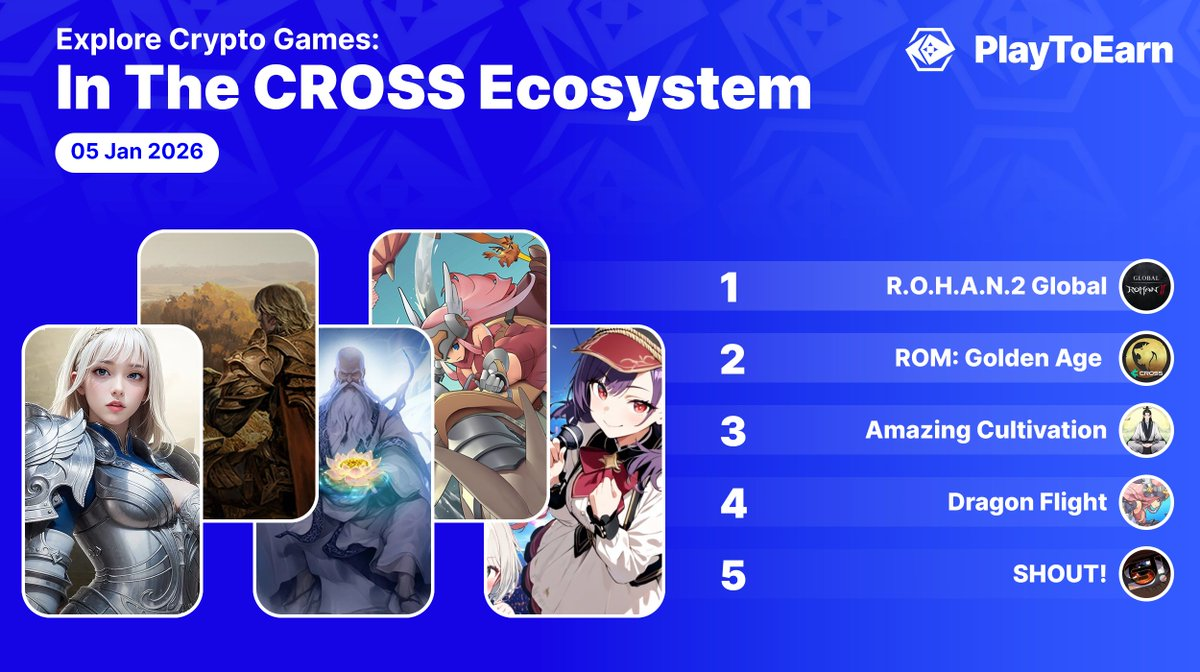
At the game level, projects such as Ragnarok: Monster World are also seen as important examples within the CROSS ecosystem. MMORPGs and strategy-based blockchain games of this kind are generally well suited to NFT and on-chain asset systems, because their players already tend to have long-term progression and trading needs.
In addition, CROSS has also expanded into Agentverse and other AI Agent entertainment ecosystems, aiming to combine AI Agents, on-chain interaction, and digital asset systems. As AI and Web3 entertainment become increasingly intertwined, AI-driven games are gradually becoming a new area of exploration.
CROSS’s Advantages and Potential Challenges
CROSS’s main advantage lies in its “games-first” infrastructure positioning. Compared with general-purpose blockchains, gaming blockchains usually pay closer attention to low latency, asset circulation, and user experience.
At the same time, EVM compatibility lowers the migration barrier for developers, making it easier to reuse Ethereum ecosystem tools. For traditional game studios that want to enter Web3 quickly, this compatibility can be quite appealing.
However, the Web3 gaming industry still faces several challenges.
First, many blockchain games still struggle to balance “gameplay” and “financialization.” Some early GameFi projects relied too heavily on token rewards, making it difficult to sustain user growth and economic systems over the long term.
Second, regulation around NFTs and gaming assets remains uncertain. Different regions have different regulatory policies for digital assets, on-chain transactions, and virtual economies, which may affect the expansion of blockchain gaming ecosystems.
In addition, competition in the GameFi industry is intense. Beyond CROSS, Immutable, Ronin, Oasys, and Avalanche gaming subnets are all competing for developers and players.
Conclusion
CROSS is an EVM compatible blockchain network built around the Web3 gaming ecosystem. Through NFTs, on-chain assets, and open economic systems, it seeks to establish a player-owned gaming infrastructure. Its core focus areas include game asset ownership, developer tools, cross-game economies, and on-chain governance.
As blockchain gaming gradually moves away from a purely Play-to-Earn model toward a more sustainable open economic system, the importance of gaming blockchains is also increasing. The “Games-first Blockchain” model represented by CROSS reflects the Web3 gaming industry’s shift from financial incentives toward ecosystem-driven development.
That said, the blockchain gaming industry is still in its early stages. User growth, game quality, and economic sustainability will remain key variables shaping its future development.
FAQs
What Is the CROSS Token Used For?
$CROSS is used to pay Gas fees, participate in governance, support gaming economic systems, and provide player rewards.
Is CROSS Compatible with Ethereum?
Yes. CROSS uses an EVM compatible architecture, so it can support Ethereum development tools and Solidity smart contracts.
How Can Players Own Game Assets on CROSS?
Game assets are usually recorded in a player’s wallet address through NFTs or on-chain tokens, thereby confirming asset ownership.
CROSS places greater emphasis on open gaming economies, player asset ownership, and an EVM compatible developer ecosystem, rather than functioning only as a single game publishing platform.
Does CROSS Support NFT Trading?
Yes. The CROSS ecosystem includes NFT and on-chain asset circulation functions, which can be used for trading and managing game assets.







