In traditional blockchain systems, users need to hold native tokens to pay Gas fees. While this mechanism helps keep the network running, it also raises the barrier to entry. As Web3 applications expand toward a broader user base, reducing transaction costs and complexity has become an important challenge.
As AI Agents gradually participate in on-chain activity, payment mechanisms need to adapt to automated execution scenarios. The x402b protocol introduced by Pieverse was developed in response to this trend. By separating Gas payment logic from the user side, it allows Agents to complete transaction flows independently, improving the usability and scalability of the overall system.
Basic Concept of the x402b Protocol
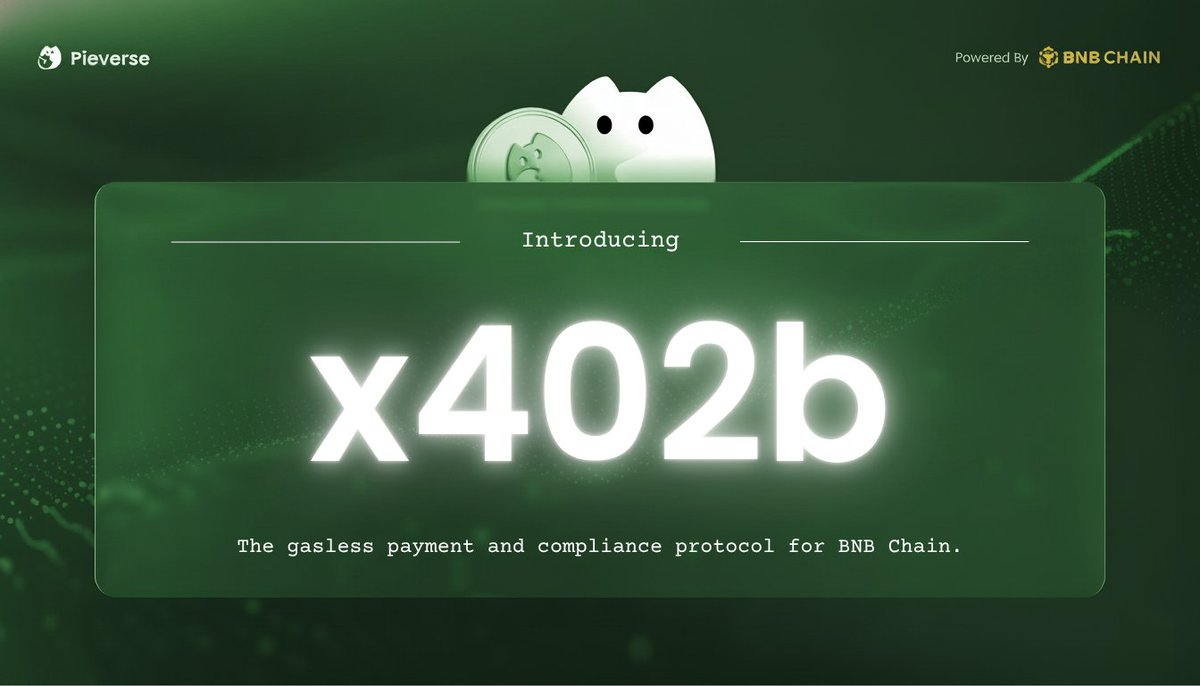
As a payment mechanism in Pieverse that supports gasless transactions, x402b can be viewed as an upgraded version of the AI Agent automated payment protocol x402. Its core function is to abstract the transaction fee handling process, so users or callers do not need to participate directly in Gas payment.
The protocol does not remove Gas itself. Instead, it changes how Gas is paid. The fee still exists within the system, but it is borne or settled collectively by a third party, the protocol layer, or a service provider.
Why a Gasless Payment Mechanism Is Needed
Traditional on-chain interaction usually requires users to meet several conditions: they need a wallet, they need to hold native tokens, and they need to understand how Gas fees work.
This structure was common among early Web3 users, but for newcomers or nontechnical users, the operational cost is high. This is especially true when AI Agents are executing tasks, as frequent Gas payments can disrupt the continuity of automated workflows.
Introducing a gasless mechanism allows transactions to be completed without relying on real time user authorization, improving interaction efficiency.
How x402b Executes Transactions
In the x402b model, a transaction usually involves several key steps:
First, the user or system sends an instruction to the AI Agent.
The Agent then parses the instruction and determines which on-chain operation needs to be executed.
During execution, the protocol layer handles the Gas fee, rather than having the user pay it directly.
Finally, the transaction result is recorded on-chain with the relevant timestamp information.
This process creates a closed loop for transaction execution while preserving the verifiability of on-chain data.
How x402b Differs from Traditional on-chain Payments
In the traditional model, transaction execution and fee payment are tightly bound together. Users must complete signing and payment at every step.
By contrast, x402b separates fee handling from execution logic, making the transaction process feel closer to the experience of using a Web2 application. The user only needs to provide intent, while the system handles execution.
This difference is especially clear in automated scenarios, where Agents can execute multiple transactions continuously without interrupting the workflow for fee confirmation.
What x402b Means for AI Agents
The core value of AI Agents lies in automated execution, and frequent human intervention weakens that capability.
With x402b, Agents can complete payments and transactions without user involvement, enabling more complex task flows such as batch operations or strategy execution.
At the same time, this mechanism allows Agents to participate in higher frequency economic activity, improving the efficiency of the overall system.

Potential Limitations and Risks
Although a gasless mechanism lowers the barrier to entry, its operation depends on the stability of the party covering the fees. If fees are provided by a third party, sustainability and trust need to be considered.
In addition, automated execution may introduce risks, such as incorrect instructions being executed repeatedly or insufficient permission controls. For this reason, system design usually needs to combine limits with audit mechanisms to ensure security.
Conclusion
Through fee abstraction and an agent execution model, the x402b protocol enables AI Agents to complete on-chain transactions without requiring users to pay Gas directly. This mechanism lowers the barrier to Web3 adoption while strengthening automated execution capabilities, providing foundational support for an Agent driven on-chain economy.
FAQs
Does x402b completely eliminate Gas fees?
No. It does not eliminate Gas fees. It changes the payment method by shifting the cost from the user side to the protocol or service layer.
Who covers the Gas cost in a transaction?
It is usually covered by the protocol provider, service provider, or a specific fee model, depending on the system design.
Is x402b applicable to all blockchains?
The mechanism depends on the specific system implementation. Adaptation may vary across different blockchain environments.
Are gasless transactions safer?
A gasless mechanism mainly improves user experience. It is not directly equivalent to stronger security, which still depends on the system’s permission and audit design.
How does x402b support automated execution by AI Agents?
By decoupling payment from execution, Agents can complete transaction tasks continuously without human intervention.







