In the AI GameFi and social casual gaming crossover, creators need to lower content production barriers, while players need clear progress, bonuses, and tradable assets. Adodo / AKEDOG streamlines the experience by linking “pet raising—card unlocking—mining or gameplay boosts,” bridging the gap between social interaction and on-chain asset understanding.
From a digital asset standpoint, Adodo nodes and AKEDOG Cards / NFTs are configurable assets within the ecosystem: Adodo nodes focus on points, hashrate, and performance boosts, while Cards / NFTs are for unlocking and reward eligibility. Both support the create—play—incentivize cycle, but are distinct from the utility tokens described in $AKE Tokenomics.
What Is Adodo?
Adodo serves two roles: as a pet image for community recognition, interactive content, and storytelling; and as Adodo Nodes—limited-supply node assets that connect point accumulation, in-game advantages, and hashrate contributions. To understand Adodo, distinguish between its “image layer” and “node asset layer,” and see how both support gameplay and incentives.
The Adodo Node supply, as outlined in the whitepaper, is split into four tiers: Legendary (2,048), Epic (32,768), Rare (60,153), and Common (554,048). Node holders earn AKE Points, which can be converted into in-game advantages or exchanged for more AKE. Node operators can also connect computing devices to the AKEDO network, providing hashrate for AI processing and earning additional mining rewards. These mechanisms are for system design and do not guarantee returns.
| Form |
Main Role |
User Relationship |
| Adodo Pet Image |
Community recognition, nurturing, storytelling |
Lowers entry barriers, carries gameplay narrative |
| Adodo Nodes |
Points, bonuses, hashrate contribution |
Configurable asset, connects Points/mining |
| $AKE / Points |
Settlement and incentive medium |
Points can be exchanged or enhanced; $AKE is a utility token |
The pet image addresses “why participate” by providing narrative, while nodes address “how abilities are quantified and enhanced.” Together, they define Adodo’s ecosystem role, not as a mere gold-farming tool.
What Role Do AKEDOG Cards / NFTs Play?
AKEDOG Cards / NFTs are tradable or ownable gameplay assets: they unlock game content, reward eligibility, or combat and nurturing abilities, binding “ownership” to “playable permissions.” Unlike pet images used only as avatars, Cards / NFTs focus on unlocking and progression rules, enabling collection, synthesis, and battle cycles.
In early Telegram-based games (e.g., Akedog Mini Games), players could collect, merge, nurture, and trade pet NFTs, then use them for battles or upgrades. Access is via instant messaging, with asset attributes defined by on-chain or platform rules. AKEDOG assets enable game and reward unlocking, and are not equivalent to Creation Engine authoring rights or Launchpad game tokens. Always verify authenticity via contract addresses, official sites, and whitepapers.
How Do Mining Bonuses and $AKE Airdrops Relate?
The mining and bonus process is: Hold Adodo Nodes → Accumulate $AKE Points → Exchange or boost in-game performance → If eligible, participate in AKE distribution or airdrop events. Nodes can also contribute hashrate to the computing network, providing two parallel channels: “holding bonuses” and “hashrate contribution.”
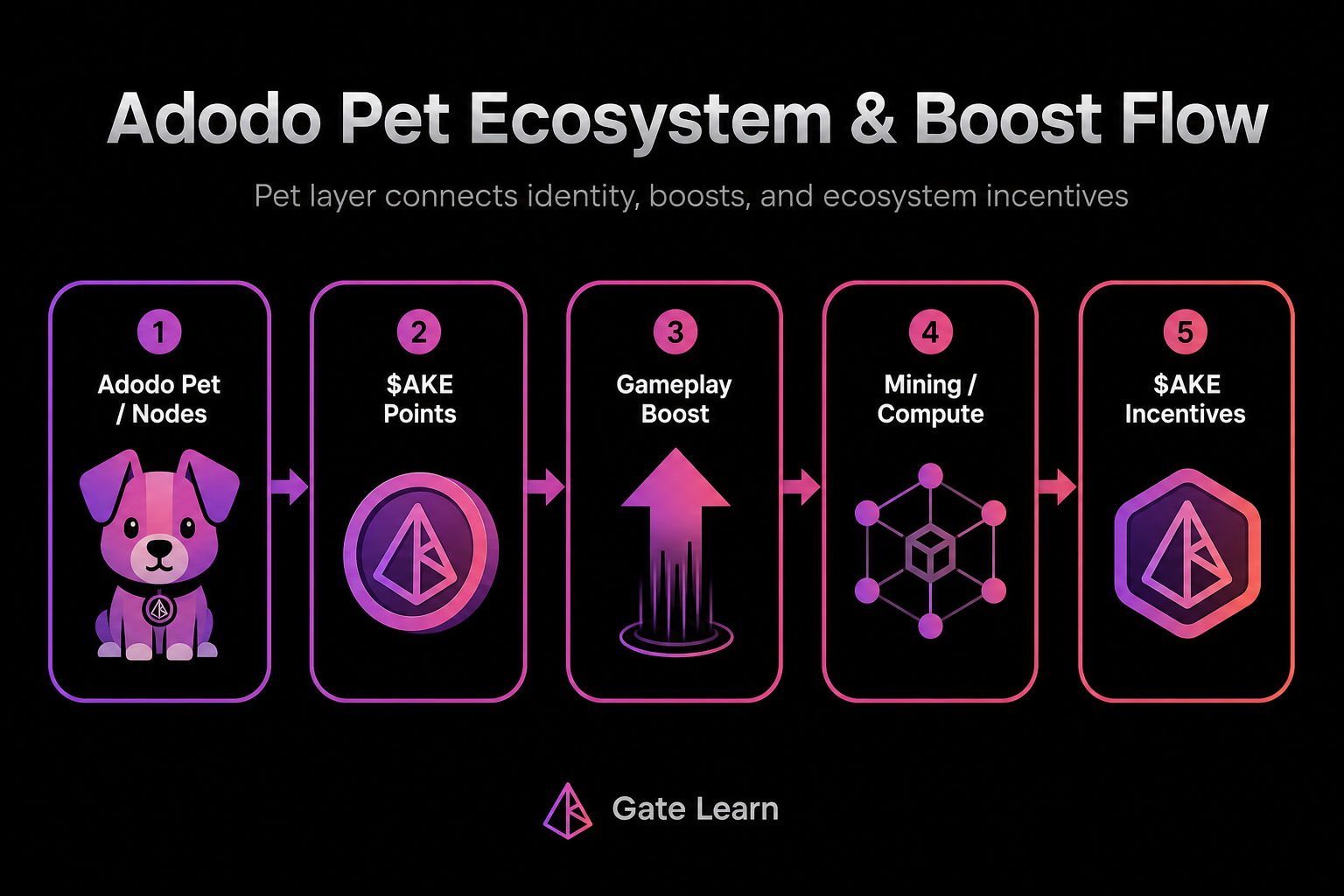 Figure 1. The Adodo pet/node layer connects gameplay boosts, hashrate mining, and $AKE incentives through $AKE Points.
$AKE is the ecosystem’s utility token, used for AI creation and publishing payments, staking revenue sharing, and new game token liquidity pairing. Points and mining rewards on the Adodo side are an entry into the token economy, but not its sole use. Airdrops or incentive events, if available, are typically tied to community contribution, node holdings, or gameplay participation. Eligibility, ratios, and unlocking are governed by platform rules—mechanism descriptions do not guarantee returns.
| Path |
Trigger Condition (Mechanism) |
Possible Outcome |
Note |
| Points Accumulation |
Hold Adodo Nodes |
In-game boosts, performance upgrades, exchange for $AKE |
Rules and exchange rates may change |
| Hashrate Mining |
Device connects to computing network |
Additional mining rewards |
Depends on device and network availability |
| Incentive / Airdrop |
Meet public activity eligibility |
May receive $AKE distribution |
Eligibility and details per platform rules |
The three paths can coexist, but with different requirements; NFT ownership, Points, and airdrops should not be conflated.
How Do Telegram / TON Game Entrances Work?
AKEDO initially reached users via Telegram Mini Games / TON, lowering installation and onboarding barriers. Lightweight games like Akedog attract users with quick loops—clicking, nurturing, battling—embedding pet/NFT collection in instant messaging. TON focuses on social distribution and lightweight asset interaction; BNB Smart Chain handles $AKE utility token settlement, staking, and liquidity.
Dual entry points do not mean dual mainnet settlement: social channels drive user acquisition and engagement, while BSC manages token and protocol economics. After entering via Telegram, users must understand BSC asset rules and contract verification for $AKE payments, staking, or LP. “Playable on Telegram” does not mean all assets settle on TON.
How Are Adodo and AKEDO Ecosystem Products Layered?
The AKEDO stack consists of “creation—distribution—consumption—assets—agents.” The Creation Engine uses natural language to drive multi-agent content generation; Creator Launchpad provides publishing and game tokenization tools; AKEDO Games handles gameplay and distribution; Adodo / AKEDOG are at the asset and identity layer; ADODO AI Agent supports interactive creation and agent experiences on social channels like X. Adodo enhances retention and assetization, layering on top of the engine and games.
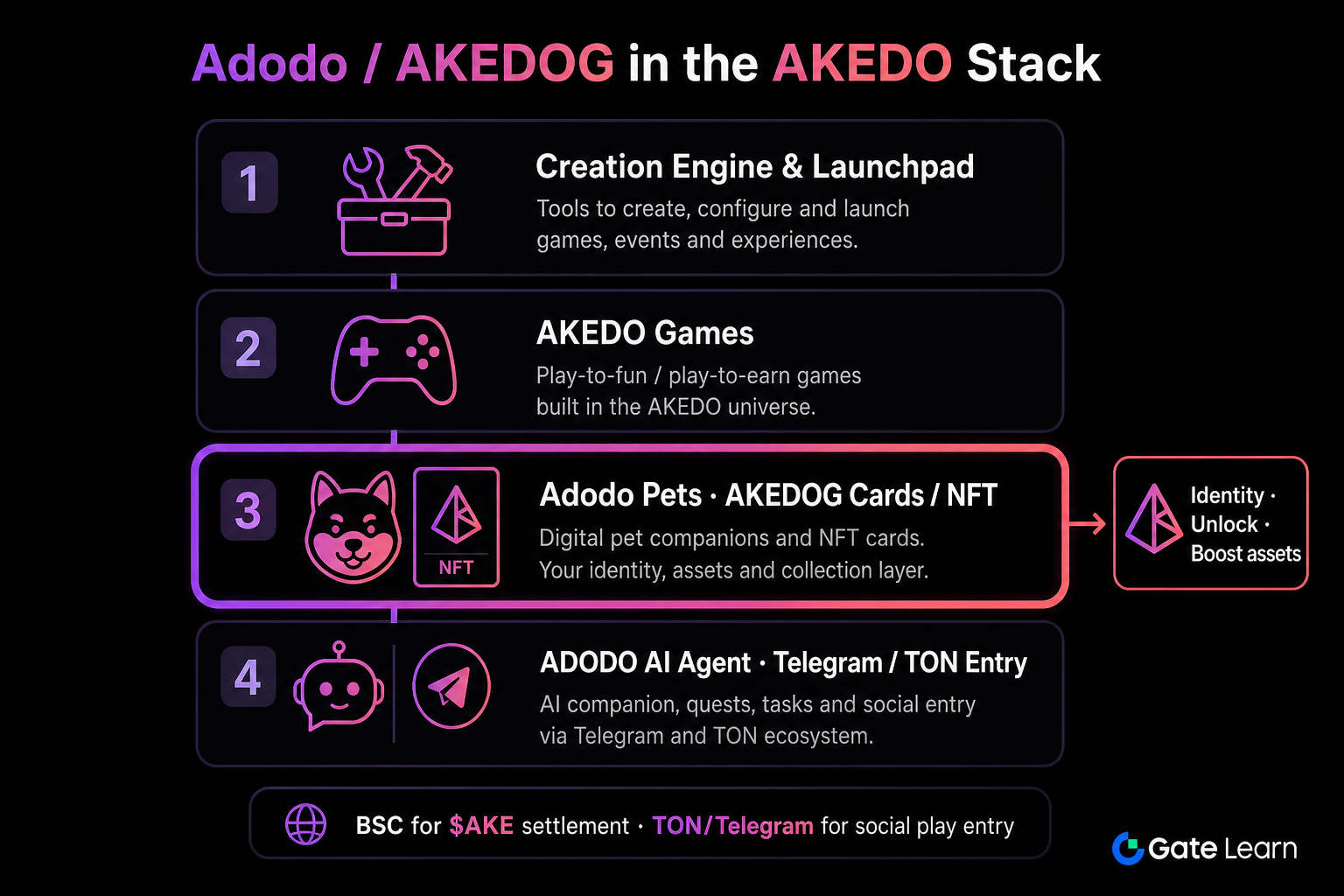 Figure 2. Adodo / AKEDOG’s position in the Creation Engine, Launchpad, Games, and ADODO AI Agent stack.
Creators monetize primarily through ad revenue sharing, protocol income sharing, and $AKE incentives (see AKEDO Creator Monetization Mechanism). Compared to AKEDO vs Traditional GameFi—which features long development cycles and single gold-farming loops—the Adodo / NFT layer focuses on lightweight entry, configurable boosts, and social reach. The key differences are in asset form and user acquisition, not simply replacing traditional GameFi.
What Risks Are Associated with Adodo and AKEDOG NFTs?
NFTs and pet assets face liquidity risks: secondary market spreads, order book depth, and trading activity may make it hard to realize assets at expected prices. Scarce tiers (e.g., Legendary nodes) are limited in supply but not guaranteed demand; changes to bonus and Points rules can affect the holding experience.
Counterfeit risk is also significant: similarly named tokens, cards, or sites may misuse Adodo / AKEDOG branding. Always verify contracts and entry points on official sites and whitepapers before participating. Smart contract bugs, private key leaks, and cross-chain confusion can also increase losses. Risk descriptions reflect mechanism uncertainty, not investment advice.
Summary
Adodo integrates into AKEDO as both a pet image (for community and narrative) and nodes (connecting $AKE Points, gameplay boosts, and hashrate mining); AKEDOG Cards / NFTs focus on unlocking games and rewards. Telegram / TON serve as early social entry points, while BSC handles AKE settlement. The Creation Engine, Launchpad, Games, and ADODO AI Agent work in layers, with the pet layer at the asset and identity level. Understanding the layers, verifying contracts and disclosures, and distinguishing Points, NFTs, and utility tokens are key to mastering this topic.
FAQ
What Is Adodo?
Adodo is the pet image and node asset layer in the AKEDO ecosystem: the image serves community recognition and storytelling, while Adodo Nodes accumulate $AKE Points in limited tiers and can be linked to in-game boosts and hashrate contributions. Adodo enhances identity, gameplay, and incentives, but does not replace the Creation Engine.
What Is AKEDO?
AKEDO is a multi-agent AI framework for autonomous content creation, offering a game/content creation engine and launchpad. Creators use natural language prompts to drive agents that generate playable content; Adodo / AKEDOG are the pet and NFT asset layer in this ecosystem.
What Is the Use of the $AKE Token?
AKE is used for AI creation and publishing payments, staking revenue sharing, and liquidity pairing with new game tokens. AKE Points and mining incentives on the Adodo side connect to the AKE economy, but Points, NFTs, and utility tokens are not interchangeable.
What Do AKEDOG Cards / NFTs Do?
AKEDOG Cards / NFTs are gameplay assets for unlocking game content, reward eligibility, or nurturing and combat abilities, and may support collection, merging, and trading. The card layer focuses on unlocking and progression, unlike pet images, and is not automatically equivalent to Launchpad-issued game tokens.
How Does AKEDO Divide Functions Between BSC and TON / Telegram?
Telegram / TON focus on social reach and lightweight Mini Games (e.g., early Akedog), while BNB Smart Chain handles $AKE settlement, staking, and liquidity. Dual entry points address user acquisition and asset settlement, but “playable on Telegram” does not mean all assets are settled on TON.
What Are the Main Risks of Participating in Adodo or Purchasing AKEDOG NFTs?
Main risks include insufficient NFT liquidity or widening price spreads, changes to node/card rules affecting expected bonuses, and counterfeit contracts or phishing sites. Also consider smart contract and key security, and do not confuse TON gameplay assets with $AKE on BSC. These risks stem from mechanisms and market structure, and do not constitute investment advice.