BGB vs BNB vs GT: Comparing Major Exchange Ecosystem Tokens

Last Updated 2026-05-12 04:05:22
Reading Time: 5m
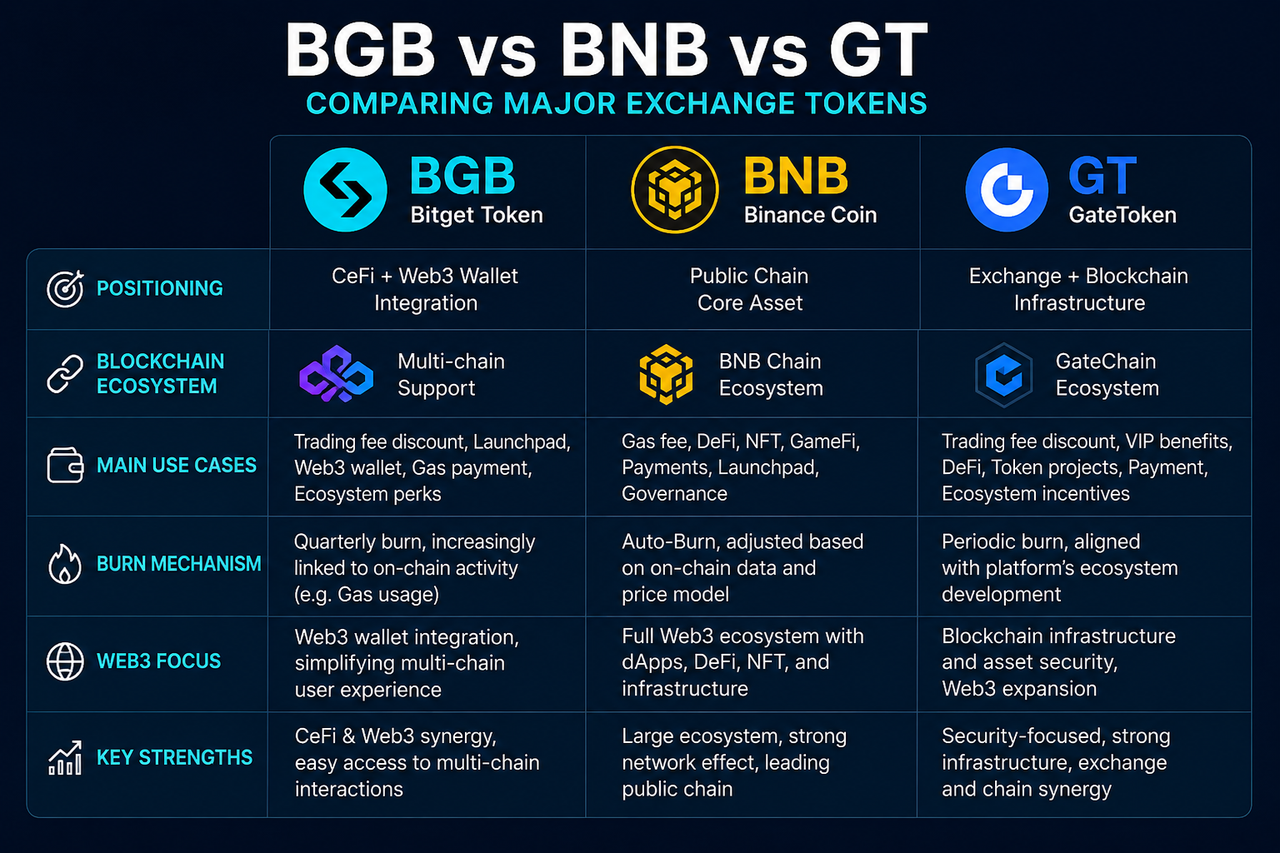
BGB, BNB, and GT are all platform tokens within crypto exchange ecosystems, which is why users often compare them. While all three support trading fee discounts, ecosystem benefits, platform incentives, and similar functions, they differ clearly in their underlying structures, onchain ecosystems, burn mechanisms, and Web3 expansion strategies.

Platform tokens were originally used mainly for trading fee discounts and user incentives, making them an important part of crypto exchange ecosystems. As the crypto industry has gradually expanded from centralized trading into Web3 ecosystems, platform tokens have also evolved from single purpose trading tools into core assets that connect onchain services, wallet systems, and ecosystem applications.

Today, competition among platform tokens is no longer limited to trading scenarios. It increasingly revolves around onchain infrastructure, multi-chain ecosystems, and Web3 user entry points. BGB, BNB, and GT each represent a different development path for platform ecosystems. Their differences are not only reflected in functional design, but also show how different exchanges are approaching their long term Web3 ecosystem strategies.

A Brief Overview of BGB, BNB, and GT

As the platform token of the Bitget ecosystem, BGB is mainly used for trading fee discounts, Launchpad participation, onchain gas payments, and ecosystem benefits. As Bitget gradually expands its Web3 wallet and onchain product system, BGB’s use cases have also extended beyond traditional exchange functions into onchain interaction and multi-chain ecosystems.

As the core platform token of the Binance ecosystem, BNB was also initially used for trading fee discounts. With the development of BNB Chain, however, its role has grown far beyond that of a traditional platform token. Today, BNB is widely used across onchain gas fees, DeFi, NFTs, GameFi, onchain governance, and several other areas.

As the platform token of the Gate ecosystem, GT is mainly used for trading fee discounts, VIP benefits, onchain ecosystem functions, and platform incentives.

BGB vs BNB vs GT

How Do BGB, BNB, and GT Differ in Ecosystem Positioning?

Although BGB, BNB, and GT are all platform tokens, their ecosystem development directions are clearly different.

BNB’s core strength lies in its complete public chain ecosystem. As BNB Chain continues to expand, BNB has become a foundational asset within an independent blockchain network. Its applications span DeFi, NFTs, blockchain games, multi-chain infrastructure, and other areas.

GT leans more toward a coordination model between an exchange platform and onchain infrastructure. GateChain’s asset security and onchain management framework gives GT a strong connection between the platform ecosystem and underlying technology.

By comparison, BGB’s current development focus is more concentrated on the integration of CeFi and Web3 Wallet. Beyond exchange platform functions, its onchain payment and wallet ecosystem capabilities are gradually becoming stronger.

From an overall structural perspective, the three represent three typical paths within platform token ecosystems: public chain based, infrastructure coordinated, and wallet integrated.

How Do BGB, BNB, and GT Differ in Onchain Utility?

Whether a platform token has strong onchain capabilities has become an important direction in today’s ecosystem competition.

BNB has the broadest onchain utility because it is the core gas token of BNB Chain. Users need BNB to pay gas fees when transferring assets onchain, participating in DeFi, or using NFT applications. As a result, BNB has become a foundational asset within a complete onchain ecosystem.

GT’s onchain capabilities are built more around GateChain, including onchain asset management, certain DeFi applications, and ecosystem coordination. Its focus is not only gas payments, but also onchain infrastructure and asset security systems.

BGB’s current onchain scenarios are more focused on Web3 Wallet and multi-chain payments. For example, in certain onchain interaction processes, users can use BGB directly to pay gas fees without separately holding the native token of the corresponding public chain.

How Do the Burn Mechanisms of BGB, BNB, and GT Differ?

Burn mechanisms are an important part of platform token tokenomics. Their core goal is usually to reduce circulating supply and establish a long term deflationary structure.

BNB uses an Auto-Burn mechanism, where the burn amount is automatically adjusted based on onchain data and a predetermined formula. This approach emphasizes automation and onchain transparency, and it has a degree of connection to overall ecosystem activity.

GT uses a regular burn model, with logic that is more focused on platform ecosystem development and long term supply management.

BGB is gradually incorporating onchain activity into its burn logic. For example, certain onchain gas usage data has already begun to connect with the burn mechanism. This model suggests that changes in a platform token’s supply no longer depend only on trading data, but are gradually becoming linked to Web3 use cases.

Conclusion

BGB, BNB, and GT are all platform tokens within major exchange ecosystems, but their development paths and ecosystem priorities are not the same.

BNB has evolved from a platform token into a core asset within a complete public chain ecosystem. GT places more emphasis on coordination between an exchange platform and onchain infrastructure. BGB, meanwhile, is gradually expanding toward the integration of CeFi and Web3 Wallet.

FAQs

Why Is BNB’s Onchain Ecosystem Larger?

Because BNB is deeply integrated into the BNB Chain public chain ecosystem and is widely used for onchain gas fees, DeFi, NFTs, blockchain games, and other scenarios.

What Is BGB’s Main Feature?

BGB places greater emphasis on the integration of an exchange platform and Web3 Wallet, and it is gradually entering onchain payment and multi-chain interaction scenarios.

What Is the Biggest Difference Between GT and Other Platform Tokens?

GT leans more toward a coordination model between an exchange platform and onchain infrastructure, and its ecosystem has a strong connection with GateChain’s asset security system.

Why Are Burn Mechanisms Important for Platform Tokens?

Burn mechanisms are usually used to adjust supply structure and build a long term deflationary model. They are one of the core components of platform token tokenomics.

Can Platform Tokens Only Be Used for Trading Fees?

No. Today’s major platform tokens are already widely used across onchain payments, DeFi, wallet ecosystems, Launchpads, Web3 interactions, and many other areas.

Author: Jayne
Translator: Jared
Disclaimer
* The information is not intended to be and does not constitute financial advice or any other recommendation of any sort offered or endorsed by Gate.
* This article may not be reproduced, transmitted or copied without referencing Gate. Contravention is an infringement of Copyright Act and may be subject to legal action.

Related Articles

In-depth Explanation of Yala: Building a Modular DeFi Yield Aggregator with $YU Stablecoin as a Medium
Beginner

In-depth Explanation of Yala: Building a Modular DeFi Yield Aggregator with $YU Stablecoin as a Medium

Yala inherits the security and decentralization of Bitcoin while using a modular protocol framework with the $YU stablecoin as a medium of exchange and store of value. It seamlessly connects Bitcoin with major ecosystems, allowing Bitcoin holders to earn yield from various DeFi protocols.
2026-03-24 11:55:44
Exploring 8 Major DEX Aggregators: Engines Driving Efficiency and Liquidity in the Crypto Market
Beginner

Exploring 8 Major DEX Aggregators: Engines Driving Efficiency and Liquidity in the Crypto Market

DEX aggregators integrate order data, price information, and liquidity pools from multiple decentralized exchanges, helping users find the optimal trading path in the shortest time. This article delves into 8 commonly used DEX aggregators, highlighting their unique features and routing algorithms.
2026-04-05 18:15:50
Sui: How are users leveraging its speed, security, & scalability?
Intermediate

Sui: How are users leveraging its speed, security, & scalability?

Sui is a PoS L1 blockchain with a novel architecture whose object-centric model enables parallelization of transactions through verifier level scaling. In this research paper the unique features of the Sui blockchain will be introduced, the economic prospects of SUI tokens will be presented, and it will be explained how investors can learn about which dApps are driving the use of the chain through the Sui application campaign.
2026-04-07 01:11:45
What Is Copy Trading And How To Use It?
Beginner

What Is Copy Trading And How To Use It?

Copy Trading, as the most profitable trading model, not only saves time but also effectively reduces losses and avoids man-made oversights.
2026-04-09 06:04:24
What Is Technical Analysis?
Beginner

What Is Technical Analysis?

Learn from the past - To explore the law of price movements and the wealth code in the ever-changing market.
2026-04-09 10:30:57
How to Do Your Own Research (DYOR)?
Beginner

How to Do Your Own Research (DYOR)?

"Research means that you don’t know, but are willing to find out." - Charles F. Kettering.
2026-04-09 10:20:26