As DeFi expands from a niche tech enthusiast market to mainstream users, user experience has become a key competitive battleground. In the past, most users had to juggle wallets, cross-chain bridges, DEX aggregators, and yield protocols to complete on-chain operations. Defi App seeks to integrate these functions through a super-app model, while MetaMask continues to represent the traditional wallet evolution path.
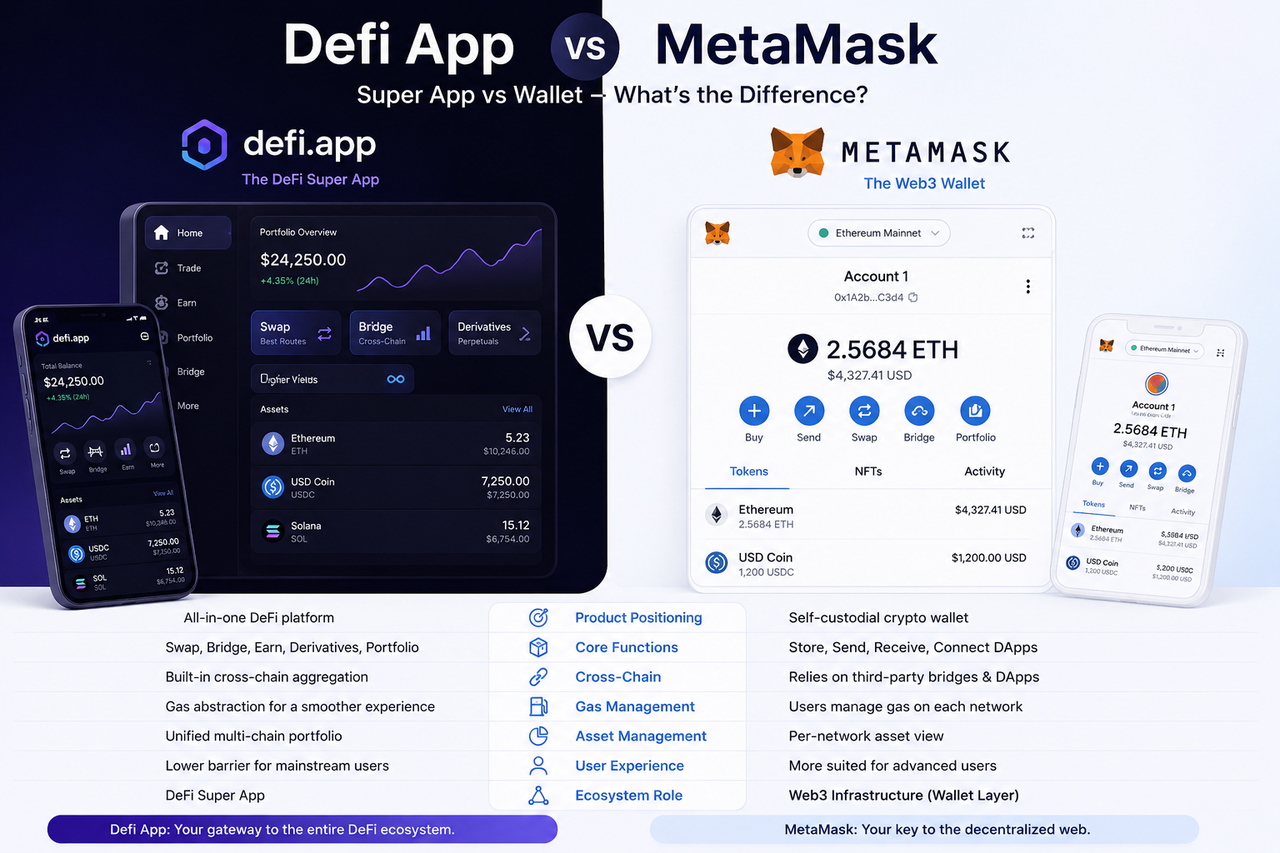
What Is Defi App?
Defi App is a DeFi super-app designed for the multi-chain ecosystem. By leveraging account abstraction, Automático routing, and gas optimization, it brings asset management, cross-chain trading, yield generation, and on-chain interactions together into a single unified platform.
Defi App's design goal is to reduce the need for users to switch between different protocols. Users can swap assets, perform cross-chain operations, and manage funds—all from one interface—without visiting multiple DeFi platforms individually.
From a product perspective, Defi App functions more like an "on-chain financial operating system," with a focus on simplifying the inherently complex on-chain experience.
MetaMask is one of the most widely used self-custodial crypto wallets. Originally built for the Ethereum ecosystem, it has gradually expanded to support multiple EVM-compatible blockchain networks.
MetaMask's core features include account management, private key control, asset storage, and connectivity to decentralized applications (DApps). Through MetaMask, users can access decentralized exchanges, NFT marketplaces, lending protocols, and other Web3 services.
At its core, MetaMask is wallet infrastructure—not a full-fledged DeFi platform.
The biggest difference between Defi App and MetaMask lies in their product positioning.
MetaMask primarily addresses the question of "how to enter a blockchain network". Users create wallets, manage accounts, and authorize on-chain operations through MetaMask.
Defi App, on the other hand, focuses on "how to use DeFi services". The platform provides wallet functionality but also integrates trade execution, liquidity routing, and asset management into a seamless experience.
Think of it this way:
- MetaMask is a digital asset wallet.
- Defi App is an on-chain financial application platform.
This difference dictates the distinct directions of their feature designs.
User experience is one of the most obvious differences between Defi App and MetaMask.
MetaMask follows the traditional Web3 tool model: users must manually add networks, manage gas tokens, connect protocols, and understand on-chain interactions.
Defi App hides much of that complexity through account abstraction and Automático execution.
Wallet Management Experience
MetaMask emphasizes self-custody.
Users need to understand seed phrases, private key management, and network configuration.
Defi App focuses on lowering barriers, making the experience closer to that of a traditional internet product.
Operational Flow Experience
With MetaMask, a complex cross-chain transaction may involve multiple protocols and several signature confirmations.
With Defi App, the same process can be consolidated into a single operation.
As a result, the two products serve somewhat different user groups.
Cross-chain capability is a key differentiator.
MetaMask itself does not provide a complete cross-chain execution system.
While MetaMask can connect to cross-chain bridges and third-party protocols, users must perform the bridging steps themselves.
Defi App makes cross-chain capability a core feature.
When a user initiates a cross-chain transaction, the system automáticamente finds liquidity sources, executes the bridging steps, and completes delivery on the target chain.
This difference positions Defi App as a cross-chain financial gateway, while MetaMask remains closer to an access tool.
Gas management has always been a major pain point in the DeFi user experience.
MetaMask follows the traditional blockchain model: users must hold the native gas token of each chain to complete transactions.
For example:
| Network |
Required Gas |
| Ethereum |
ETH |
| Base |
ETH |
| Polygon |
MATIC |
| BNB Chain |
BNB |
If the required gas asset is missing, the transaction typically cannot go through.
Defi App optimizes this process with gas abstraction and backend settlement.
Users no longer need to manually prepare gas assets on different chains, significantly reducing friction in a multi-chain environment.
MetaMask's primary function is as a wallet.
Users typically need to pair it with other protocols to perform:
- Asset swaps
- Yield management
- Cross-chain operations
- Lending
- Derivatives trading
Defi App integrates all these functions into a single ecosystem.
From a product standpoint, MetaMask sits at the infrastructure layer, while Defi App operates at the application layer.
The difference is similar to that between a browser and an internet platform.
Both Defi App and MetaMask use a self-custodial model, meaning users generally retain control of their assets.
However, their risk structures differ.
MetaMask's main risks include:
- Private key management
- Phishing attacks
- Malicious signature authorization
In addition to these, Defi App also involves:
- Aggregation protocol risk
- Automático routing risk
- Third-party liquidity dependency risk
- Cross-chain infrastructure risk
So while both fall under the self-custodial umbrella, the range of technical risks they face is not identical.
Which Users Are Better Suited for Defi App?
Defi App is ideal for:
Users Who Want to Simplify DeFi
Defi App reduces the complexity of managing multiple protocols.
Users Who Frequently Perform Cross-Chain Transactions
Automático routing and cross-chain execution boost efficiency.
Users Who Want a Unified Asset View
Multi-chain assets can be viewed and managed from a single dashboard.
MetaMask is better for:
Users Who Want Full Control Over Wallet Configuration
MetaMask offers high flexibility and self-custody.
Users Who Frequently Use Different DApps
MetaMask is the standard connection tool for many Web3 applications.
Users Who Need Broad Ecosystem Compatibility
A large number of blockchain protocols natively support MetaMask integration.
| Comparison Dimension |
Defi App |
MetaMask |
| Product Positioning |
DeFi Super-App |
Self-Custodial Wallet |
| Primary Goal |
Unified On-Chain Financial Gateway |
Wallet & Account Management |
| Cross-Chain Capability |
Built-in Automático Cross-Chain |
Depends on Third-Party Protocols |
| Gas Management |
Gas Abstraction Optimization |
User Must Prepare Gas |
| Asset Management |
Multi-Chain Unified View |
Wallet View |
| Functional Scope |
Trading, Yield, Cross-Chain, etc. |
Wallet Connection & Authorization |
| User Barrier |
Relatively Low |
Relatively High |
| Ecosystem Role |
Application Layer Platform |
Infrastructure Tool |
Summary
Defi App and MetaMask are not direct competitors—they represent two distinct product paths in the Web3 ecosystem. MetaMask focuses on wallet infrastructure, giving users asset management and on-chain connectivity. Defi App seeks to integrate wallets, trading, cross-chain operations, and asset management into a single platform.
At its core, MetaMask solves "how to enter the blockchain," while Defi App solves "how to use blockchain financial services more conveniently."
FAQs
Does MetaMask support cross-chain transactions?
MetaMask can connect to third-party cross-chain bridges and DeFi protocols for cross-chain transactions, but users typically need to perform the steps themselves.
Why is Defi App called a DeFi super-app?
Defi App is called a DeFi super-app because it integrates wallets, cross-chain functionality, asset swaps, yield management, and on-chain interactions into one platform.
What does the Gas-Free experience in Defi App mean?
Gas-Free means users don't need to manage gas tokens across multiple blockchains themselves—the system handles gas payment and settlement through backend mechanisms.
Which is more secure, Defi App or MetaMask?
Both Defi App and MetaMask use a self-custodial model where users retain control of their assets. They face different types of risks, and security ultimately depends on user habits, protocol design, and risk management practices.







