When discussing the application value of House Party Protocol (HPP), the key question is not only what the protocol can do, but also how its different modules handle specific tasks such as computing, verification, strategy execution, data sourcing, and asset analysis.
This topic usually involves five layers: Noösphere, ArenAI, Booost, Alpha Quark, and multi module collaboration. Together, they form HPP's foundation for AI and Web3 applications.
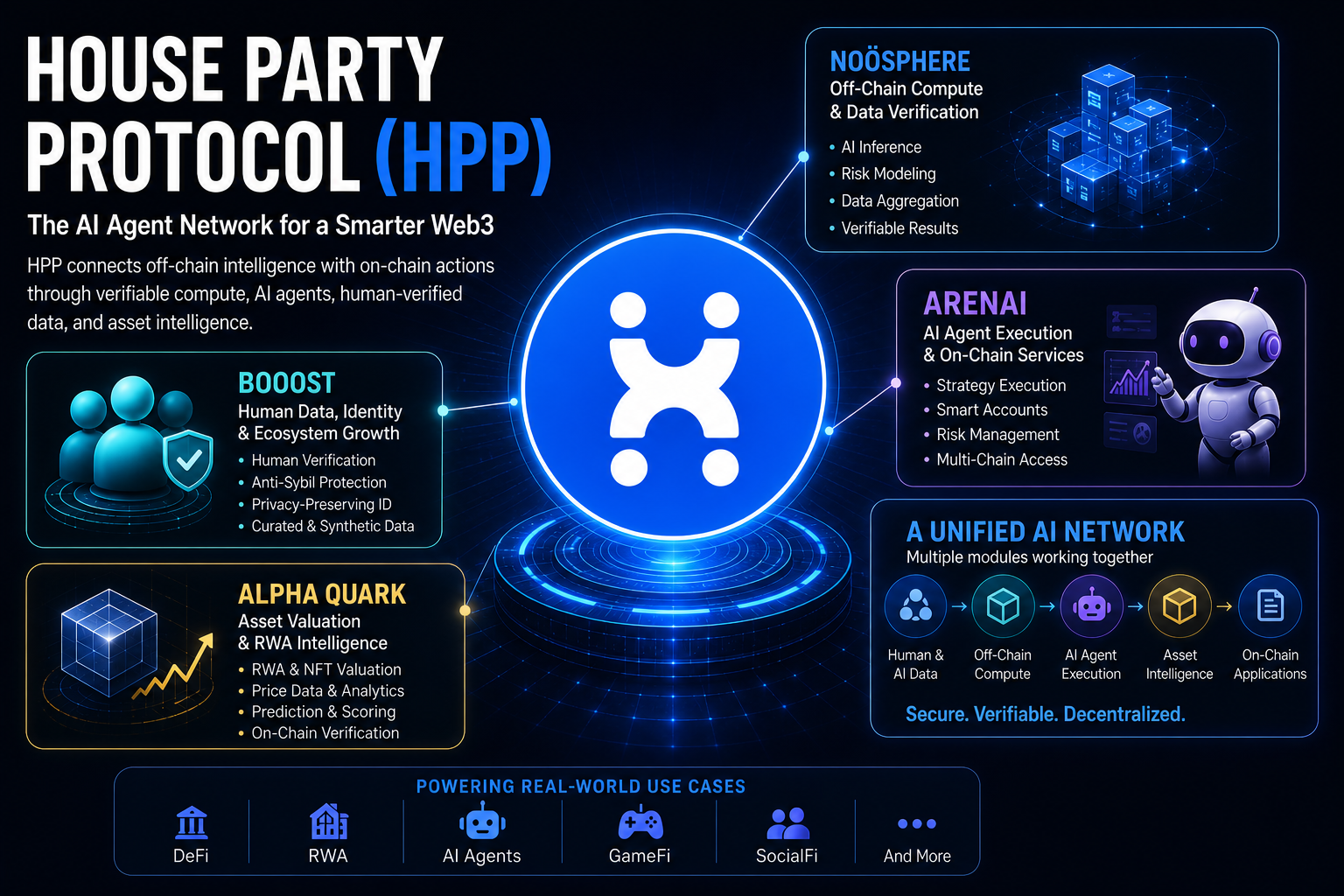
Overview of HPP Application Scenarios and Overall Architecture
HPP's application scenarios can be understood as a modular network built around AI services, data verification, and on chain execution. Its core purpose is to integrate off-chain computing, intelligent agents, identity verification, and asset analysis into a single AI native infrastructure.
Structurally, Noösphere is responsible for off-chain intelligent computing and verifiable data paths, ArenAI handles AI Agent strategy execution, Booost provides the human data and synthetic data layer, and Alpha Quark focuses on intelligent asset analysis for RWA, NFTs, and related assets. The official white paper describes HPP as an AI first data and blockchain ecosystem that connects enterprise level systems with decentralized technologies.
First, users or developers submit task requirements, such as calling AI inference, verifying data, or executing an on chain strategy. The system then calls the corresponding module based on the task type. Next, different modules complete computation, verification, or execution. Finally, the results can enter on chain applications, data markets, or asset analysis scenarios.
| Official Module |
Core Function |
Typical Application |
| Noösphere |
off-chain computing and verification |
AI inference, risk scoring, data aggregation |
| ArenAI |
AI Agent execution |
Automated strategies, on chain financial services |
| Booost |
Data and identity layer |
Human verification, synthetic data, anti Sybil |
| Alpha Quark |
Asset intelligence |
RWA valuation, NFT valuation, risk analysis |
This table shows that HPP's applications are not a single product, but an application network jointly supported by multiple official modules.
Off-Chain Computing and Data Verification Applications Supported by Noösphere
Noösphere is HPP's off-chain intelligence framework, designed to connect the deterministic blockchain environment with dynamic real world computing tasks. Its core purpose is to allow smart contracts to request and verify off-chain tasks such as AI inference, risk modeling, and multi source data aggregation.
In practice, a user or smart contract first initiates an off-chain computation request, such as risk scoring or model inference. Noösphere then executes the task through decentralized Agents. Next, the system returns results through a verifiable path and integrates the output into an EVM compatible environment. Finally, on chain applications can use verified off-chain intelligence results.
The impact of this mechanism is that Noösphere gives static smart contracts stronger data interpretation and computing capabilities. For DeFi, DeSci, RWA intelligent analysis, and inference markets, this kind of off-chain computing capability can reduce the cost and latency of executing complex AI tasks directly on a blockchain.
AI Agent Strategy Execution and On Chain Services Driven by ArenAI
ArenAI is HPP's intelligent execution layer. It is mainly used to help users run on chain strategies and risk management tasks through AI Agents. In other words, ArenAI packages AI strategy execution capabilities into on chain services that users can access.
Mechanically, users first select or configure an AI Agent and manage it through smart accounts and session permissions. The Agent then executes tasks based on market data, strategy rules, and risk parameters. Next, the system maintains transparency, verifiability, and user control on chain. Finally, users can use automated strategy services without writing code. According to official descriptions, ArenAI supports user access to AI driven trading strategies and allows strategy providers to publish their strategies as AI Agents.
The significance of this application is that AI Agents are no longer just off-chain analysis tools. They can become execution units that interact with on chain accounts, DEXs, CEXs, and multi chain liquidity layers.
Booost's Role in User Incentives and Ecosystem Growth
Booost serves as the human data and synthetic data layer within the HPP ecosystem. It focuses on identity verification, anti Sybil systems, privacy preserving identity tools, and human curated datasets. Its core purpose is to provide more trustworthy data sources and a stronger user interaction foundation for the AI network.
In the operating process, users first enter ecosystem interaction scenarios through identity or behavior verification. The system then uses Booost's verification capabilities to identify real users and reduce the risk of Sybil attacks. Next, curated human data or synthetic data can be used for AI training and application optimization. Finally, the ecosystem can obtain more reliable user participation data in social, gaming, metaverse, or governance scenarios.
The impact of this design is that HPP's AI applications do not rely only on model computation. They also depend on trusted data entry points. For applications that require real user participation, Booost can improve identity credibility, data quality, and ecosystem growth efficiency.
Alpha Quark Applications for Asset Valuation and RWA
Alpha Quark focuses on asset intelligence within HPP, mainly covering RWA, NFTs, on chain valuation tools, price data, and predictive analytics. Its core purpose is to use AI models to improve the pricing, verification, and financialization of on chain assets.
Structurally, a user or application first submits asset related data, such as NFTs, tokenized real estate, collectibles, or financial instruments. Alpha Quark then combines AI valuation models, on chain verification, and real time price data for analysis. Next, the system outputs asset valuations, risk scores, or predictive analytics results. Finally, these results can be used in lending, staking, insurance, or market pricing scenarios. Official public materials clearly state that Alpha Quark supports AI driven RWA and NFT valuation, on chain verification, and financialization tools.
The importance of this application lies in the fact that the core challenges of RWA and NFTs are often opaque valuation, hard to quantify risk, and difficult to verify off-chain data. Alpha Quark provides a more structured intelligent analysis path for these types of assets.
AI Application Network Structure Through Multi Module Collaboration
Multi module collaboration is the defining feature of HPP's application network. In essence, different modules separately handle computing, execution, data, identity, and asset analysis, then use a unified protocol to form a complete application flow.
A typical process can be understood this way: first, a user submits an AI service request through an application. Noösphere then handles off-chain computing or data verification, while ArenAI executes strategies or on chain operations. Next, Booost provides identity and data trust support, and Alpha Quark provides asset valuation or risk analysis. Finally, the system feeds results back to on chain applications, enterprise systems, or decentralized markets.
The impact of this structure is that HPP can cover the full path from data generation, verification, computation, and execution to application commercialization. Official materials also divide its business model into four categories: data as a service, computation and AI deployment, verification as a service, and AI driven asset intelligence.
Key Limitations Facing HPP Application Implementation
The key limitations facing HPP application implementation mainly come from the complexity of off-chain computing, data verification costs, Agent execution risks, and the difficulty of coordinating multiple modules. In practice, the more complete HPP's modular system becomes, the higher the requirements for system coordination, verification efficiency, and user understanding.
In the application process, users first need to define the task type and permission scope. The system then needs to match resources and verify results across different modules. Next, the application must also handle data sources, model reliability, execution permissions, and on chain records. Finally, only when computation results, user control, and economic incentives remain aligned can the AI Agent network have a stable operating foundation.
These limitations do not negate the application's value. Rather, they show that HPP's implementation depends on engineering execution, data quality, verification mechanisms, and continuous collaboration among ecosystem participants.
Summary
House Party Protocol's application scenarios revolve around official modules such as Noösphere, ArenAI, Booost, and Alpha Quark. Noösphere is responsible for off-chain computing and data verification, ArenAI handles AI Agent strategy execution, Booost provides the identity and data layer, and Alpha Quark focuses on intelligent analysis of RWA and NFT assets.
From a process perspective, HPP's implementation path includes users initiating requests, the system calling modules, computation or verification being executed, and results being output to serve on chain applications. Its application value comes from multi module collaboration, while its key limitations are concentrated in computing costs, verification efficiency, data quality, and execution risks.
FAQ
What Are the Application Scenarios of House Party Protocol?
House Party Protocol's application scenarios include off-chain AI inference, data verification, AI Agent strategy execution, user identity verification, synthetic data, RWA valuation, NFT valuation, and on chain asset analysis.
What Role Does Noösphere Play in HPP?
Noösphere is responsible for off-chain computing and data verification. It allows smart contracts to call AI inference, risk scoring, and multi source data aggregation, then connects the results to on chain applications through a verifiable path.
How Does ArenAI Support AI Agent Applications?
ArenAI allows users to manage AI Agents through smart accounts and session permissions, enabling them to execute automated strategies, risk management, and on chain operations while preserving transparency and user control.
What Is the Relationship Between Booost and HPP Applications?
Booost provides HPP with human data, synthetic data, identity verification, and anti Sybil capabilities. It can be used to improve the quality of user interaction, data credibility, and ecosystem growth efficiency.
What Is Alpha Quark Mainly Used For?
Alpha Quark is mainly used for intelligent valuation, on chain verification, price analysis, and risk scoring of RWA, NFTs, and other tokenized assets, helping assets enter scenarios such as DeFi, lending, and insurance.







