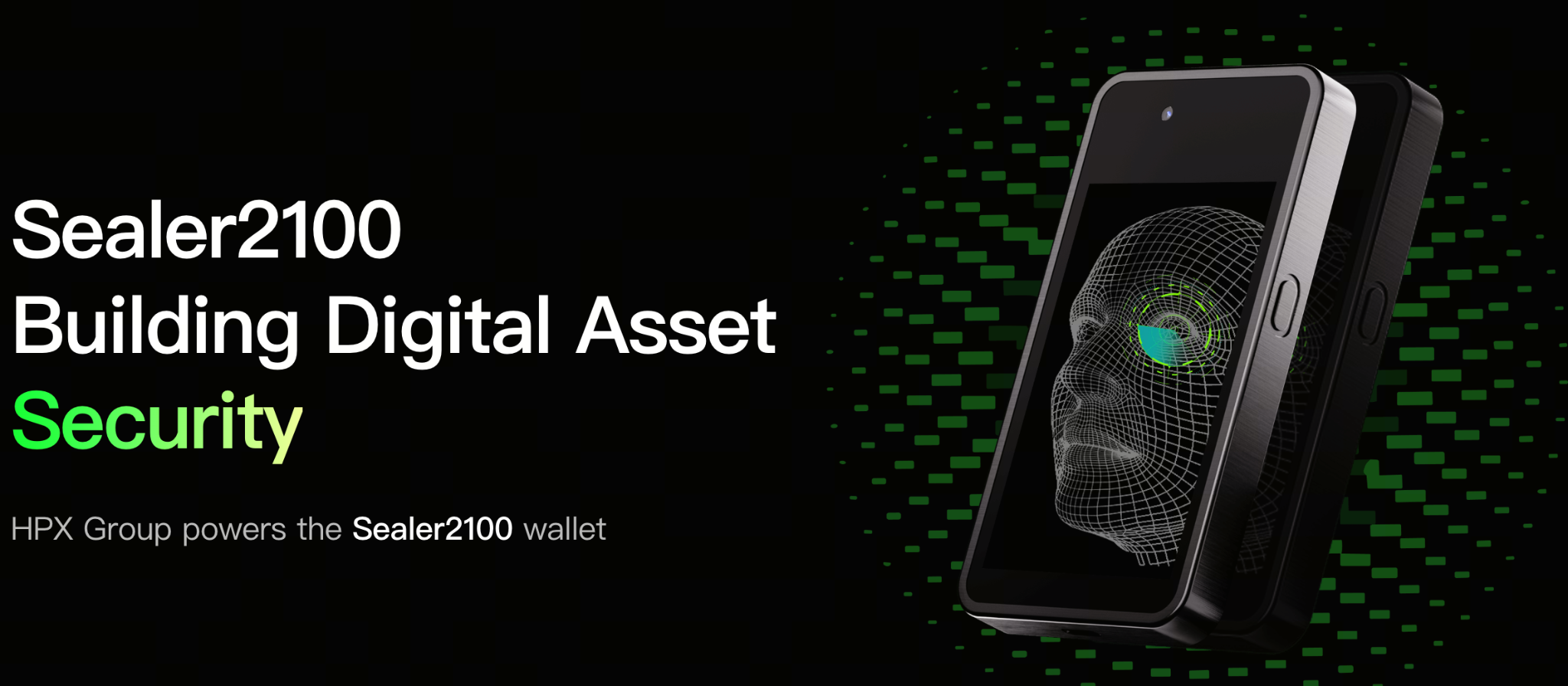
As cryptocurrencies become increasingly integral to long-term asset allocation, the demand for robust hardware wallet security is rising. Traditional solutions often rely on PIN codes, passwords, or fingerprints for authentication, but these methods are vulnerable to risks such as forgetting credentials, being observed, or brute-force attacks. Sealer2100 introduces a comprehensive digital asset protection framework utilizing iris recognition, secure chips, and AirGap offline signing.
Why Do Hardware Wallets Need New Authentication Methods?
 (Source: sealer2100)
The primary function of a hardware wallet is to safeguard private keys from unauthorized access. Despite this, many traditional hardware wallets still depend on PIN codes or passwords, requiring users to remember and input sensitive information. This common approach presents several challenges: PIN codes can be observed or recorded, passwords may be forgotten after periods of inactivity, and simple configurations increase the risk of brute-force attacks. As a result, the industry is seeking authentication methods that are both difficult to replicate and user-friendly. Sealer2100 adopts iris recognition as its core authentication mechanism to mitigate risks associated with traditional password management and enhance private key security.
How Does Iris Recognition Work?
The iris, located around the pupil, features highly unique patterns—even identical twins have distinct irises. Compared to fingerprints, the iris offers greater stability and is less susceptible to change due to wear. Sealer2100 employs infrared live detection technology to analyze the pupil’s dynamic response during scanning, confirming the presence of a real human eye rather than a photograph or counterfeit image. The system captures numerous encrypted iris feature points for subsequent identity verification. Unlike conventional facial recognition, Sealer2100 focuses on detailed iris characteristics to improve authentication reliability.
What Is Sealer2100’s Authentication Process?
When users first set up the device, the system creates a unique iris template—encrypted biometric data rather than a full eye image. Each time the wallet is unlocked, the device rescans the user’s iris and compares it to the template stored within the secure chip. If the features match, access to the private key and related functions is granted; failed authentication prevents transaction operations. Critically, iris data remains within the device and is never uploaded to the cloud or external servers, ensuring that biometric information is not managed by third parties and reducing the risk of data leakage.
How Does the Secure Chip Protect Private Keys?
In hardware wallets, the most valuable asset is the private key that controls cryptocurrency holdings. Sealer2100 stores both the private key and iris template in a dedicated secure chip, not standard storage. According to official documentation, this secure element is certified at CC EAL6+, a high-security hardware standard. Secure chips typically include multiple protection layers—preventing physical tampering, mitigating side-channel attacks, and restricting direct access to sensitive data. Even if the device is physically acquired, extracting the private key from the chip is extremely difficult. In essence, iris recognition determines “who can use the wallet,” while the secure chip ensures “the private key cannot be easily extracted.”
How Does AirGap Offline Signing Work?
Beyond authentication, transaction signing is a critical security component. Many attacks target transaction authorization processes through network connections, malicious software, or device vulnerabilities rather than directly attacking private keys. To minimize these risks, Sealer2100 utilizes an AirGap architecture.
In AirGap mode, the hardware wallet does not transmit transaction data via Bluetooth, Wi‑Fi, or USB. Instead, it uses QR Codes for information exchange. The typical workflow is:
- The mobile app creates an unsigned transaction
- Transaction details are displayed as a QR Code
- Sealer2100 scans the QR Code and signs the transaction offline
- The hardware wallet generates a new signed QR Code
- The mobile device scans the signed QR Code and broadcasts the transaction to the blockchain
By keeping the private key within the offline device, the risk of remote hackers accessing it via the network is significantly reduced.
Why Are Open Source and Third-Party Audits Critical?
Hardware wallet security cannot rely solely on vendor claims. The industry increasingly values “verifiable” security frameworks. Sealer2100 is open-source, allowing developers and security researchers to review the code for vulnerabilities or improper design. HPX also engages third-party security organizations for independent audits, ensuring that product security is externally validated rather than solely dependent on brand assurances.
Sealer2100’s Comprehensive Security Architecture
Sealer2100’s design leverages multiple technologies to protect assets, rather than relying on a single solution.
Sealer2100’s multi-layer security architecture:
- First layer: Iris recognition for user authentication
- Second layer: Secure chip for protecting private keys and biometric templates
- Third layer: AirGap offline signing to isolate network risks
- Fourth layer: Open source and third-party audits for external validation
This multi-layered approach integrates identity, biometric features, hardware protection, and transparent verification, offering more robust security than traditional PIN-based hardware wallets.
What Problem Is Sealer2100 Designed to Solve?
Sealer2100 is not focused on expanding DeFi features or trading tools. Its primary goal is to enable long-term holders to securely manage private keys. By replacing PIN authentication with iris recognition, employing AirGap architecture to reduce remote attack risks, and implementing high-level secure chips alongside public security verification, HPX aims to establish a verifiable hardware wallet security framework. For users treating cryptocurrencies as long-term assets, authentication and private key protection are paramount, and Sealer2100’s design is tailored to address these needs.
Summary
Sealer2100 represents a new paradigm in hardware wallet security, moving beyond passwords and fingerprints to employ iris recognition, secure chips, and AirGap offline signing as integrated, multi-layer protections. As cryptocurrencies become central to long-term asset strategies, demands for private key security and authentication are intensifying. Sealer2100 is not merely adding a biometric feature; it is fundamentally rethinking the security architecture of hardware wallets across authentication, data protection, and transaction authorization.
FAQ
Q1: Does Sealer2100 Upload Iris Data to the Cloud?
No. The iris template is stored within the device’s secure chip and is never transmitted to external servers.
Q2: What Are the Advantages of AirGap Offline Signing?
AirGap uses QR Codes to exchange transaction information, avoiding Bluetooth, Wi‑Fi, or USB transmission and reducing remote attack risks.
Q3: What Is the Biggest Difference Between Sealer2100 and Traditional Hardware Wallets?
The core distinction is Sealer2100’s use of iris recognition for authentication, combined with high-level secure chips and AirGap architecture, creating a multi-layer digital asset protection system.







