For a long time, global internet infrastructure has been dominated by large ISPs (Internet Service Providers) and telecom companies. While this model drove internet adoption, it also introduced problems like network monopolies, uneven regional coverage, and communication censorship. As Web3 expands into real-world infrastructure, a growing number of projects are leveraging the DePIN model to reshape communication networks. Spacecoin stands out as a key example in satellite internet.
Unlike traditional internet systems, Spacecoin prioritizes network openness, on-chain coordination, and global accessibility. As such, it is not merely a satellite communication project but an experiment in decentralized internet infrastructure.
Why Is the Traditional Internet Centralized?
Though the internet itself is a global network, its underlying infrastructure is heavily reliant on centralized operation.
Most internet traffic flows through major telecom carriers, data centers, and regional ISPs. This means network access, bandwidth allocation, and infrastructure deployment are largely controlled by a handful of companies.
In remote areas, the high cost of deploying fiber optics and communication towers results in inadequate coverage. In certain cases, centralized networks can also face human-imposed restrictions, service outages, or censorship.
Consequently, the blockchain industry is increasingly exploring a "decentralized internet" to reduce the risk of single points of control through open infrastructure.
Why Does Spacecoin Choose Satellite Internet?
A core strategy for Spacecoin to achieve a decentralized internet is establishing global communication coverage using Low Earth Orbit (LEO) satellites.
Traditional internet depends heavily on ground-based infrastructure like fiber, cables, and towers. Satellite internet can bypass some of these limitations, enabling broader network access.
This is especially valuable in remote regions, oceanic areas, or emerging markets with poor infrastructure, where satellite communication significantly lowers deployment hurdles.
Spacecoin opts for LEO satellites rather than traditional high-orbit ones because LEO networks offer lower latency and higher efficiency—crucial for modern internet use.
What Components Make Up Spacecoin's Decentralized Structure?
Spacecoin's network consists of four key components:
| Network Component |
Function |
| LEO Satellite Network |
Provides global internet coverage |
| Ground Terminal Devices |
Enables user internet access |
| Blockchain System |
Handles payment, settlement, and governance |
| DePIN Node Network |
Coordinates network and maintains resources |
Satellites handle communication transmission, while the blockchain coordinates economic systems and resource distribution. The node network takes on verification, routing, and governance roles.
This structure means internet services are no longer fully dependent on a single company but are operated collectively by distributed participants.
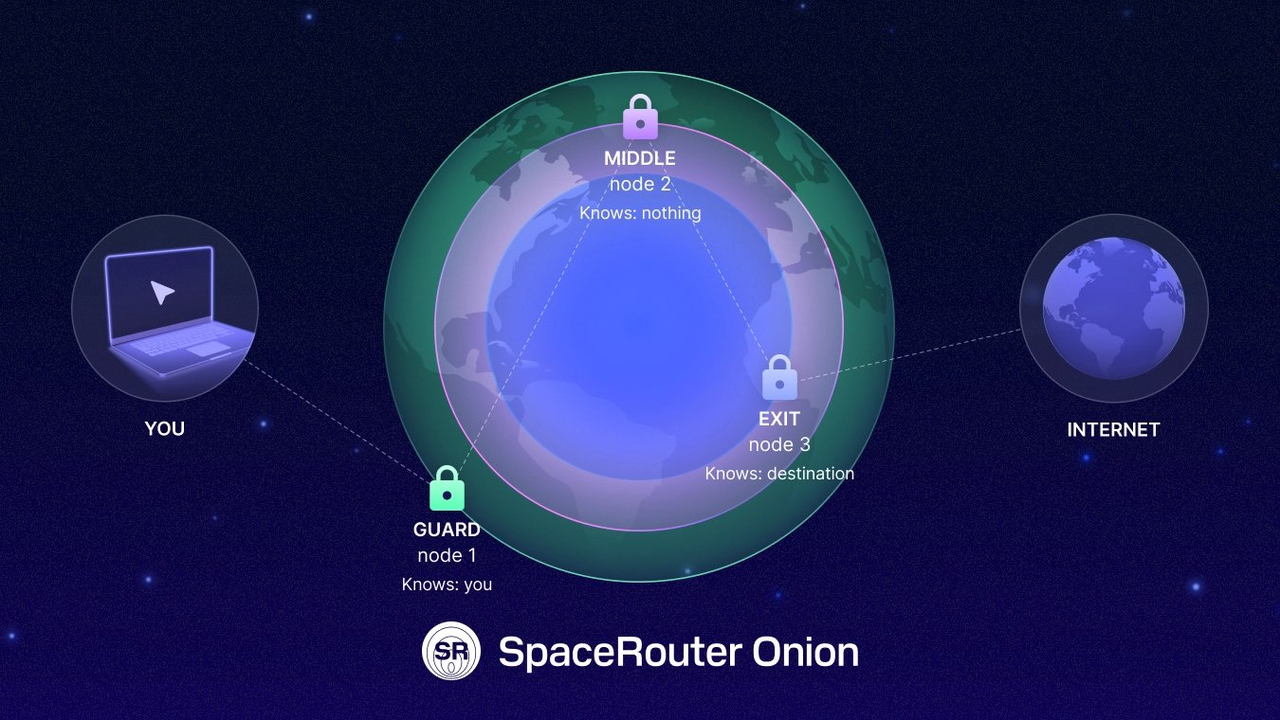
How Does Spacecoin Achieve an Open Network Through DePIN?
DePIN (Decentralized Physical Infrastructure Networks) is a major Web3 infrastructure trend. Its core concept is using blockchain to coordinate real-world infrastructure resources.
Within the Spacecoin network, node participants earn SPACE token rewards by providing network resources, maintaining infrastructure, or supporting communication services.
The key difference from traditional ISPs:
Traditional internet is built and run centrally by companies. In contrast, a DePIN network uses token economics to attract global participants who collectively expand the network.
Thus, Spacecoin is not just a communication protocol—it's an on-chain-driven internet economic model.
How Does Spacecoin's On-Chain Payment System Support a Decentralized Internet?
Internet services typically require payment mechanisms. Traditional ISPs rely on banking systems and fiat subscriptions.
Spacecoin moves payment and resource settlement onto the blockchain. Users pay for bandwidth, data services, and other network resources using SPACE tokens.
The significance of on-chain payments:
First, they lower barriers for cross-border payments and financial access. Second, they enable automatic allocation and settlement of internet resources via Smart Contracts. Third, they integrate with Web3 wallets, digital identities, and on-chain financial systems.
This model is especially suited for emerging markets with limited traditional financial infrastructure.
How Does Spacecoin Reduce the Risk of Centralized Control?
A major risk of a centralized internet is excessive reliance on a few companies for services and infrastructure.
Spacecoin addresses this through several approaches:
First, the satellite network reduces dependence on single-region communication facilities. Second, on-chain payments lessen restrictions from traditional financial systems. Third, the DePIN model allows more participants to share network maintenance, rather than a single operator.
While Spacecoin still requires some real-world infrastructure, its overall architecture emphasizes openness and distributed coordination far more than traditional internet models.
What Are the Differences Between Spacecoin and Traditional ISPs?
Both provide internet access, but their underlying principles are fundamentally different.
| Comparison Dimension |
Spacecoin |
Traditional ISP |
| Network Model |
Decentralized satellite network |
Centralized operation |
| Infrastructure |
LEO satellites + Nodes |
Fiber optics and base stations |
| Payment Method |
On-chain payment |
Fiat subscription |
| Network Governance |
Community & on-chain mechanisms |
Corporate control |
| Coverage Logic |
Global satellite coverage |
Regional network coverage |
These differences mean Spacecoin is better suited for open internet and global communication, while traditional ISPs depend on localized infrastructure.
What Challenges Does Spacecoin Face?
Despite the rapid growth of the decentralized internet concept, Spacecoin faces real-world hurdles.
First, satellite deployment is capital-intensive, requiring significant resources for hardware, launch, and long-term maintenance. Second, global satellite communication involves complex regulations and spectrum licensing.
Additionally, balancing openness with stability in a decentralized network is a long-term challenge for the entire DePIN sector.
Therefore, Spacecoin is more of a long-term infrastructure experiment than a short-term replacement for traditional internet.
Summary
Spacecoin aims to build a more open, decentralized internet using LEO satellites, blockchain payments, and DePIN architecture.
Compared to traditional ISPs, Spacecoin emphasizes global coverage, on-chain coordination, and open infrastructure participation. Its core significance is not just providing satellite internet but exploring the transition from centralized to open network structures.
FAQs
What is a decentralized internet?
A decentralized internet is a network structure not fully controlled by any single company or operator, with infrastructure and resources maintained by multiple participants.
Why does Spacecoin use satellite internet?
Satellite internet reduces reliance on ground-based communication infrastructure and improves coverage in remote areas and globally.
How does Spacecoin achieve decentralization?
Spacecoin achieves open internet infrastructure through satellite communication, an on-chain payment system, and DePIN node collaboration.
What is the role of the SPACE token?
SPACE is used to pay for internet services, incentivize node participation, and support future network governance.