Zero-Knowledge Proofs (ZKPs) were initially developed for privacy protection, but as the need for blockchain scalability has grown, zk technology has become a foundational component in Layer2 solutions and modular architectures. In recent years, innovations like zkRollup, zkVM, and verifiable computation have rapidly expanded zk technology’s role beyond transaction privacy into high-performance computing, AI inference, and on-chain finance.
Within the zk landscape, zkSync and Nexus represent two distinct directions. zkSync is focused on scaling Ethereum and supporting the EVM-compatible ecosystem, while Nexus is dedicated to verifiable computation and proving networks, aiming to enable more complex on-chain computation scenarios through zkVM and modular architecture. Understanding the distinction between these two projects offers clearer insight into the future trajectory of zk technology.
Overview of Nexus and zkSync
Nexus is a Layer1 network purpose-built for verifiable computation, with the primary objective of enabling large-scale verifiable computing through zkVM, a modular proving network, and a distributed verification architecture.
Whereas traditional public chains focus on transaction throughput, Nexus prioritizes “how to verify complex computation.” Its architecture centers on zkVM, proof generation, and the proving network, targeting Verifiable Finance, Verifiable AI, and high-frequency on-chain computation.
zkSync, by contrast, is a zkRollup network built on Ethereum, designed to increase Ethereum’s transaction throughput and reduce Gas costs.
How Do Nexus and zkSync Differ in Core Positioning?
While both Nexus and zkSync utilize zk proofs, they tackle different problems.
zkSync’s primary goal is to “scale Ethereum,” addressing high Gas costs and limited transaction speeds on Ethereum. Its core approach is a Layer2 Rollup.
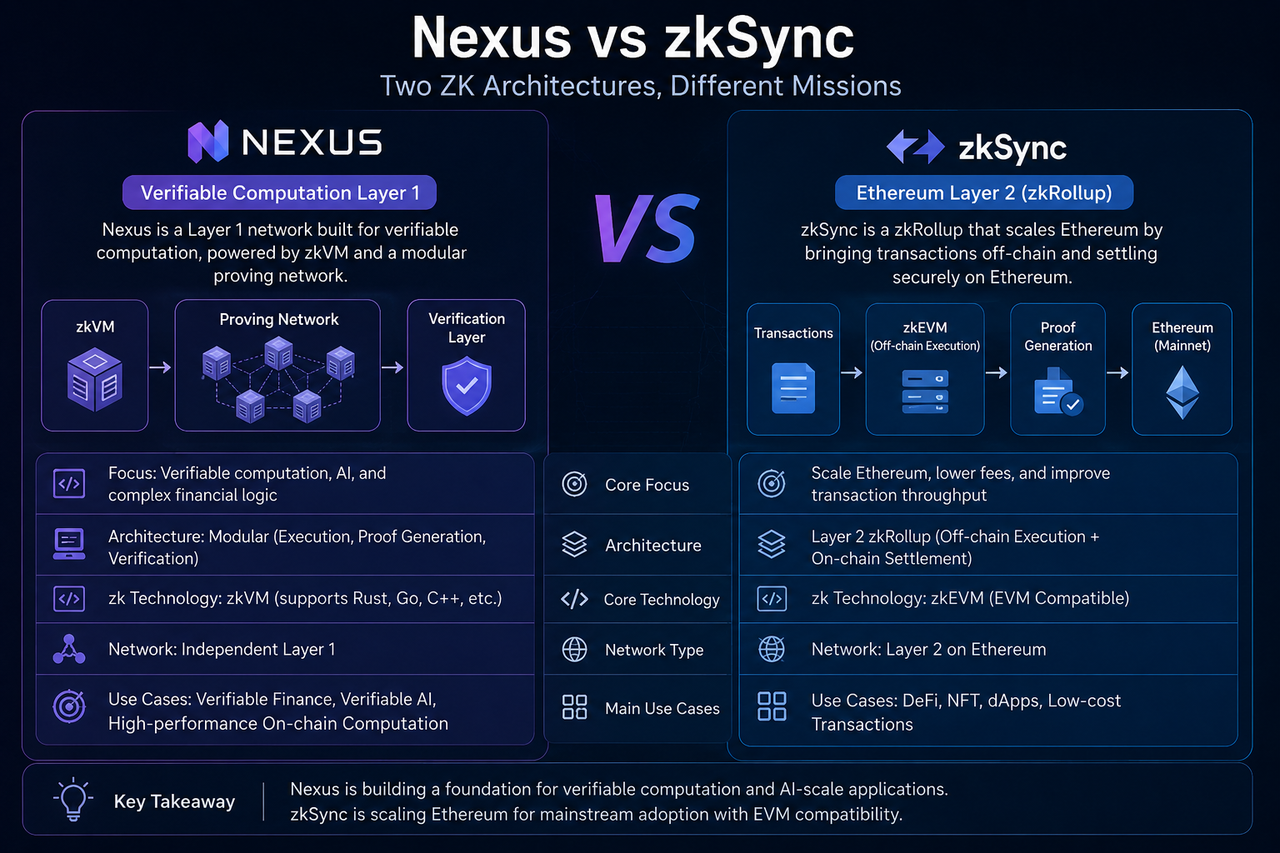
Nexus, on the other hand, is focused on “verifying complex computation.” The project is dedicated to enabling low-cost verification for AI inference, automation, and sophisticated financial logic.
In essence, zkSync is a transaction scalability infrastructure, while Nexus is an infrastructure for verifiable computation. This fundamental difference shapes their architecture, development focus, and ecosystem positioning.
What Architectural Differences Exist Between Nexus and zkSync?
zkSync adopts a standard zkRollup architecture: transactions are executed on a Layer2 network, and state updates are submitted to Ethereum using zk proofs.
This approach inherits Ethereum’s security while significantly increasing throughput.
Nexus, by contrast, features a modular design. Its network separates execution, proving, and verification into distinct layers, leveraging a proving network for proof generation.
In summary:
- zkSync functions as an “Ethereum scalability layer”
- Nexus operates as a “Layer1 built around a proving system”
Both depend on zk proofs, but their system design objectives are fundamentally different.
How Does Nexus zkVM Differ from zkSync zkEVM?
A key technology for zkSync is zkEVM, which aims for compatibility with the Ethereum Virtual Machine ecosystem. Developers can continue using Solidity and the established EVM toolchain.
Nexus zkVM emphasizes general-purpose computing. It supports Rust, Go, C++, and other mainstream programming languages, with a focus on verifying complex programs.
zkEVM is centered on compatibility, while zkVM is focused on verifiable computation.
This distinction means:
- zkEVM is best for migrating traditional DeFi and EVM applications
- zkVM is ideal for AI, complex financial logic, and automation
As on-chain computation needs rise, zkVM is increasingly viewed as a foundation for next-generation trusted computing environments.
What Are the Distinct Application Scenarios for Nexus and zkSync?
zkSync’s main use cases are DeFi, NFT, Ethereum dApp scaling, low-cost transactions, and EVM ecosystem migration. Its core mission is to lower operational costs for Ethereum applications.
Nexus, on the other hand, is focused on Verifiable Finance, Verifiable AI, proving networks, high-performance on-chain computation, and AI inference verification. As a result, Nexus is better suited for scenarios requiring complex computation and proof generation, not just transaction scalability.
zkSync’s scalability strategy centers on transaction throughput and Gas optimization, with performance gains primarily from Rollup aggregation.
Nexus places greater emphasis on proving efficiency and parallel verification. Its distributed proving network can assign proving tasks to different nodes, boosting the processing power for complex computations.
Their scalability logic breaks down as follows:
| Comparison Dimension |
Nexus |
zkSync |
| Core Positioning |
Verifiable Computation |
Ethereum Layer2 |
| Network Type |
Layer1 |
zkRollup |
| Core Technology |
zkVM + Proving Network |
zkEVM |
| Main Objective |
Verifying Complex Computation |
Increasing Transaction Throughput |
| Programming Languages |
Rust / Go / C++ |
Solidity |
| AI Scenario Support |
Stronger |
Limited |
| Ethereum Dependency |
Relatively Independent |
Highly Dependent |
Over the long term, these projects are not direct competitors, but rather represent different branches of zk technology.
What Challenges Do Nexus and zkSync Face?
Despite rapid advances in zk technology, both projects face unique challenges.
zkSync must continually address zkEVM compatibility, Rollup costs, and heavy reliance on Ethereum.
Nexus is challenged by high proving costs, an early-stage development ecosystem, and a nascent Verifiable AI market.
The zk sector is highly competitive, with projects such as Starknet, Scroll, Polygon zkEVM, and various modular initiatives pursuing alternative technical paths.
Ultimately, which zk architecture gains broader adoption will depend on developer ecosystem maturity, hardware capabilities, and real-world application demand.
Summary
While both Nexus and zkSync are built on zero-knowledge proofs, their core objectives are distinctly different.
zkSync focuses on Ethereum Layer2 scalability, using zkRollup and zkEVM to boost transaction efficiency and reduce Gas costs. Nexus, meanwhile, is dedicated to verifiable computation, supporting AI, Verifiable Finance, and complex on-chain logic verification through zkVM and proving networks.
In the long run, zk technology is evolving from a pure scalability solution into the foundation for trusted computing infrastructure. zkSync and Nexus each represent a different direction in this evolution.
FAQs
What is the main difference between Nexus and zkSync?
zkSync is primarily a zkRollup scalability solution for Ethereum, while Nexus is focused on verifiable computation and proving infrastructure.
Why does Nexus use zkVM?
Nexus leverages zkVM to generate zk proofs, enabling the verification of complex computation results without requiring every node to re-execute the program.
What is the difference between zkEVM and zkVM?
zkEVM emphasizes Ethereum ecosystem compatibility, while zkVM is designed for general-purpose verifiable computation.
What is zkSync mainly used for?
zkSync is used to scale Ethereum, reduce Gas costs, and support low-cost on-chain transactions.
Are Nexus and zkSync competitors?
Both belong to the zk sector, but they address different challenges and represent distinct technical directions.







