Exchange tokens are a core part of cryptocurrency trading platform ecosystems. They are commonly used for trading fee discounts, user incentives, ecosystem governance, on-chain applications, and other related functions. As the crypto industry gradually expands from centralized exchanges into public chains, Layer 2 networks, and Web3 infrastructure, the role of exchange tokens continues to evolve.
OKB, BNB, and GT are three of the more representative exchange tokens in today’s market. Although all three are ecosystem assets issued around trading platforms, they differ clearly in on-chain positioning, ecosystem expansion paths, tokenomics design, and practical utility.
A Brief Overview of OKB, BNB, and GT
OKB is the exchange token within the OKX ecosystem. It is mainly used for trading fee discounts, ecosystem incentives, on-chain services, and Web3 application scenarios. As OKX expands toward Layer 2 and Web3 infrastructure, OKB’s use cases have gradually extended into wallets, on-chain interactions, and broader ecosystem collaboration.
BNB was originally launched by the Binance ecosystem and was mainly used in its early stage for trading fee discounts. With the development of BNB Chain, BNB has gradually evolved into an on-chain gas asset and a core token within a public chain ecosystem.
GT, or GateToken, is the exchange token of the Gate ecosystem. It is used for trading fee reductions, VIP benefits, on-chain ecosystem functions, and certain scenarios within the GateChain network. GT therefore plays a dual role as both a trading platform token and an on-chain ecosystem asset.
Although all three are exchange tokens, their ecosystem roles have gradually expanded from a platform points system into on-chain infrastructure and Web3 applications.
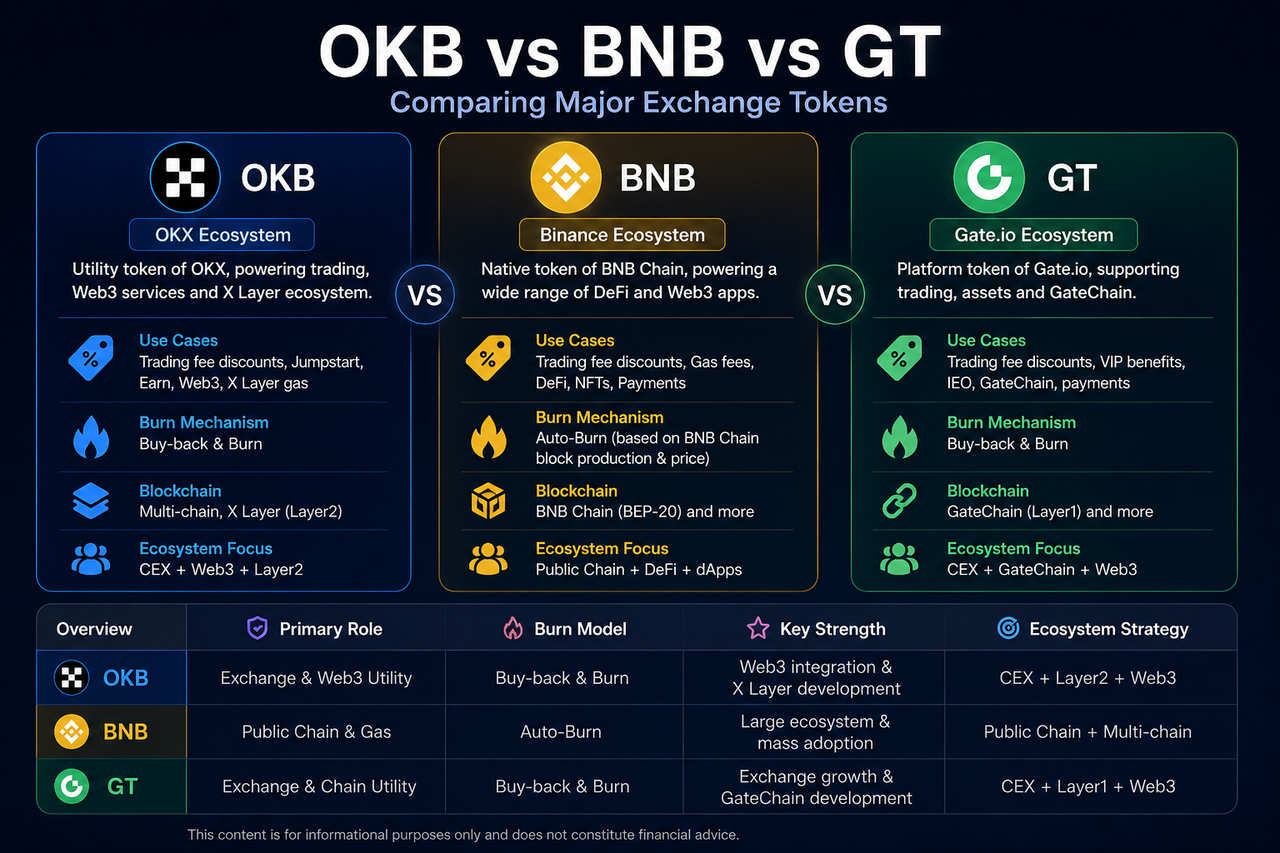
What Are the Main Differences Between the Uses of OKB, BNB, and GT?
All three exchange tokens offer trading fee discounts, but their ecosystem use cases differ quite noticeably.
OKB places greater emphasis on coordination between the trading platform and Web3 services. For example, OKB is used for fee tiers, Jumpstart, Earn products, and ecosystem scenarios such as X Layer.
BNB’s use cases lean more toward the public chain ecosystem. Beyond trading discounts, BNB is also the core gas asset of the BNB Chain network and is widely used for on-chain transactions, DeFi, and NFT applications.
GT’s ecosystem structure is built around Gate and GateChain. GT is commonly used for platform benefits, on-chain asset management, and certain ecosystem services.
| Exchange Token |
Core Ecosystem |
Main Uses |
On-Chain Positioning |
| OKB |
OKX |
Fees, Web3, X Layer |
Ecosystem coordination asset |
| BNB |
Binance |
Gas, DeFi, trading |
Core public chain asset |
| GT |
Gate |
Platform benefits, GateChain |
Platform plus on-chain asset |
How Do the Burn Mechanisms of OKB, BNB, and GT Differ?
Burn mechanisms are one of the core components of exchange token tokenomics. They are mainly used to reduce circulating supply.
OKB has long used a buyback and burn model, under which the platform regularly repurchases and burns a portion of the tokens.
$$S_{t+1}=S_t-B_t $$
BNB uses an Auto-Burn mechanism, where the amount burned is usually related to on-chain activity and market conditions.
GT also uses a buyback and burn model to reduce circulating supply in the market and support a long-term ecosystem cycle.
Although all three use deflationary models, their specific mechanisms and ecosystem logic are not the same. Some exchange tokens depend more heavily on on-chain activity, while others place greater emphasis on platform business growth and ecosystem expansion.
Differences in the On-Chain Ecosystems of OKB, BNB, and GT
BNB has the clearest role within an on-chain ecosystem. With the development of BNB Chain, BNB has become an important base asset across DeFi, GameFi, NFTs, and multichain applications.
OKB’s on-chain expansion is more closely centered on OKX’s Web3 strategy and X Layer. Its focus is on connecting the centralized trading platform, wallet services, and Layer 2 network.
GT’s on-chain ecosystem mainly relies on GateChain. GateChain places stronger emphasis on digital asset security, asset management, and on-chain transfer scenarios.
How Do the Value Logics of OKB, BNB, and GT Differ?
The value logic of exchange tokens is usually connected to user scale, trading activity, ecosystem expansion capability, and on-chain application scenarios.
BNB’s value logic comes more from demand within the public chain ecosystem, including gas usage, DeFi applications, and on-chain interactions.
OKB’s value structure is more closely tied to trading platform services, Web3 products, and coordination with the Layer 2 ecosystem.
GT’s value logic leans more toward the growth of the Gate ecosystem and applications within the GateChain network.
What Common Risks Do Exchange Tokens Have?
Although exchange tokens have different ecosystem structures, they still share several common risks.
First, exchange tokens are usually closely tied to the business of their trading platforms. As a result, changes in platform operations, market cycles, and the regulatory environment may all affect their ecosystems.
Second, exchange tokens are often highly volatile, and their market performance can be easily influenced by shifts in industry sentiment and on-chain activity.
In addition, as Web3 and DeFi ecosystems continue to develop, exchange tokens also face competition from public chain native assets and new protocol tokens.
Conclusion
Although OKB, BNB, and GT are all exchange tokens, their development paths and ecosystem structures have already diverged significantly.
BNB places greater emphasis on public chain and on-chain ecosystem infrastructure; OKB focuses more on coordination among the trading platform, Layer 2, and Web3; GT develops around the trading platform ecosystem and the GateChain network.
As the crypto industry expands from centralized trading into multichain ecosystems and Web3 infrastructure, exchange tokens are also shifting from “trading discount tools” into “ecosystem assets.” The differences between exchange tokens essentially reflect the different strategic directions and ecosystem layouts adopted by trading platforms in the Web3 era.
FAQs
Why Is BNB Often Viewed as a Public Chain Token?
Because BNB has become the core gas asset of BNB Chain and is widely used for on-chain transactions and DeFi applications.
What Are the Main Uses of OKB?
OKB is mainly used for trading fee discounts, Jumpstart, Web3 services, and the X Layer ecosystem.
What Is the Relationship Between GT and GateChain?
GT is the exchange token within the Gate ecosystem and is also connected to the GateChain network ecosystem.
Why Do Exchange Tokens Have Burn Mechanisms?
Platforms usually reduce circulating supply through buybacks and burns in order to build a deflationary model and an ecosystem cycle for their exchange tokens.
Are Exchange Tokens DeFi Assets?
Exchange tokens are essentially trading platform ecosystem assets, but some have already expanded into DeFi and on-chain ecosystem scenarios.







