Russia’s cryptocurrency law introduces regulated investment access for Bitcoin, creates a legal pathway for broader stablecoin use in cross-border trade and encourages activity to shift toward licensed exchanges. At the same time, the Russia cryptocurrency legal framework continues to prohibit domestic crypto payments and does not ensure higher cryptocurrency prices. Its overall market impact will depend on licensing, eligible-asset rules, banking access and business adoption.
TL;DR
-
Bitcoin could gain a clearer regulated investment channel, but Russia alone is unlikely to determine its global price direction.
-
Stablecoins may benefit most from cross-border settlement demand, although issuer controls and sanctions exposure remain important risks.
-
Licensed Russian exchanges could gain domestic volume as compliance requirements make unregulated and foreign platforms less convenient.
-
The most credible base case is gradual market formalisation rather than immediate mass adoption.
-
The outcome depends on implementing rules that were not fully settled when the legislation passed the State Duma.
What Does Russia’s New Cryptocurrency Law Change?
Russia’s law creates a formal route for cryptocurrency investment and intermediation while maintaining strict limits on how digital assets may be used.
The State Duma passed legislation in its second and third readings on July 21, 2026. Reported provisions divide investors into qualified and non-qualified categories, introduce regulated crypto intermediaries and preserve the prohibition on using cryptocurrency to pay for domestic goods and services.
The wider Russia cryptocurrency legal framework separates several activities that are often incorrectly treated as one issue:
-
owning and investing in cryptocurrency;
-
trading through regulated intermediaries;
-
holding assets in private wallets;
-
using crypto for cross-border settlements;
-
paying for domestic goods and services.
This distinction matters because legal investment access does not make Bitcoin or stablecoins legal tender. Russia is formalising selected crypto-market activities rather than replacing the ruble-based domestic payment system.
How Could the Law Affect Bitcoin?
Bitcoin could gain from clearer investment access, stronger custody infrastructure and greater institutional participation, but the law should not be treated as a direct global price catalyst.
A regulated market may reduce uncertainty for Russian investors who previously depended on foreign exchanges, peer-to-peer markets or informal arrangements. Licensed brokers, exchanges and custodians could make ownership records, compliance checks and fiat settlement more predictable.
Bitcoin is also a plausible candidate for regulated retail access because it has deep global liquidity and established trading infrastructure. However, its inclusion should remain an assumption until Russian regulators publish or apply the final eligibility criteria.
Three channels could influence demand:
-
Retail access: Non-qualified investors may obtain a clearer route to eligible cryptoassets, although investment limits and testing requirements can restrict participation.
-
Institutional access: Qualified investors and financial companies may be able to use regulated custody and execution services.
-
International settlements: Some businesses may use Bitcoin where counterparties accept its volatility and liquidity characteristics.
These developments could increase Russian Bitcoin activity without producing a proportionate increase in global demand. Bitcoin trades across a worldwide market, so monetary policy, institutional flows, risk appetite and liquidity conditions are likely to remain more influential than one national framework.
The legal difference between ownership, trading and payment is examined in whether cryptocurrency is legal in Russia.
Could Stablecoins Benefit More Than Bitcoin?
Stablecoins may experience the strongest practical effect because businesses generally need predictable settlement values rather than exposure to Bitcoin’s price movements.
Russia has already explored cryptocurrency as a tool for international transactions while opposing its use as domestic money. The Bank of Russia previously supported restricting crypto settlements between residents outside authorised experimental arrangements, showing that cross-border utility and domestic payment policy are treated differently.
Stablecoins could support importers and exporters by offering:
-
faster settlement outside traditional correspondent-banking chains;
-
a unit of account that is less volatile than Bitcoin;
-
broad liquidity across international crypto markets;
-
easier wallet-based transfers between counterparties.
However, a stablecoin is not free from centralised control. Issuers may freeze addresses, restrict jurisdictions or comply with foreign enforcement orders. Reserve quality, redemption access, blockchain fees and counterparty acceptance may also affect whether a stablecoin works as intended.
The likely result is selective business use rather than unrestricted adoption. Stablecoins may be suitable for particular trade corridors, while Bitcoin or other assets may be chosen when issuer control presents a greater concern than price volatility.
What Could Happen to Russian Cryptocurrency Exchanges?
Licensed Russian exchanges could gain market share as trading moves from foreign or informal channels into supervised domestic infrastructure.
A regulated cryptocurrency exchange in Russia may benefit from clearer access to local investors, financial institutions and custody providers. Banks and brokers could also become important distribution channels if the implementing framework allows them to offer crypto-related services.
Foreign exchanges may face the opposite effect. Russian users could encounter more reporting obligations, funding friction or legal uncertainty when using platforms without an approved domestic structure. This does not mean foreign exchanges will disappear, but regulated alternatives may become more convenient for users seeking predictable compliance.
Formalisation may also concentrate the market. Licensing, cybersecurity, transaction monitoring, capital requirements and custody controls can be expensive. Large institutions may absorb those costs more easily than smaller platforms.
Russia’s path toward this regulated structure developed through multiple stages rather than one law. The Russia crypto regulation timeline tracks the shift from central-bank warnings to mining rules, experimental settlements and regulated investment access.
Scenario Model: How Large Could the Market Impact Be?
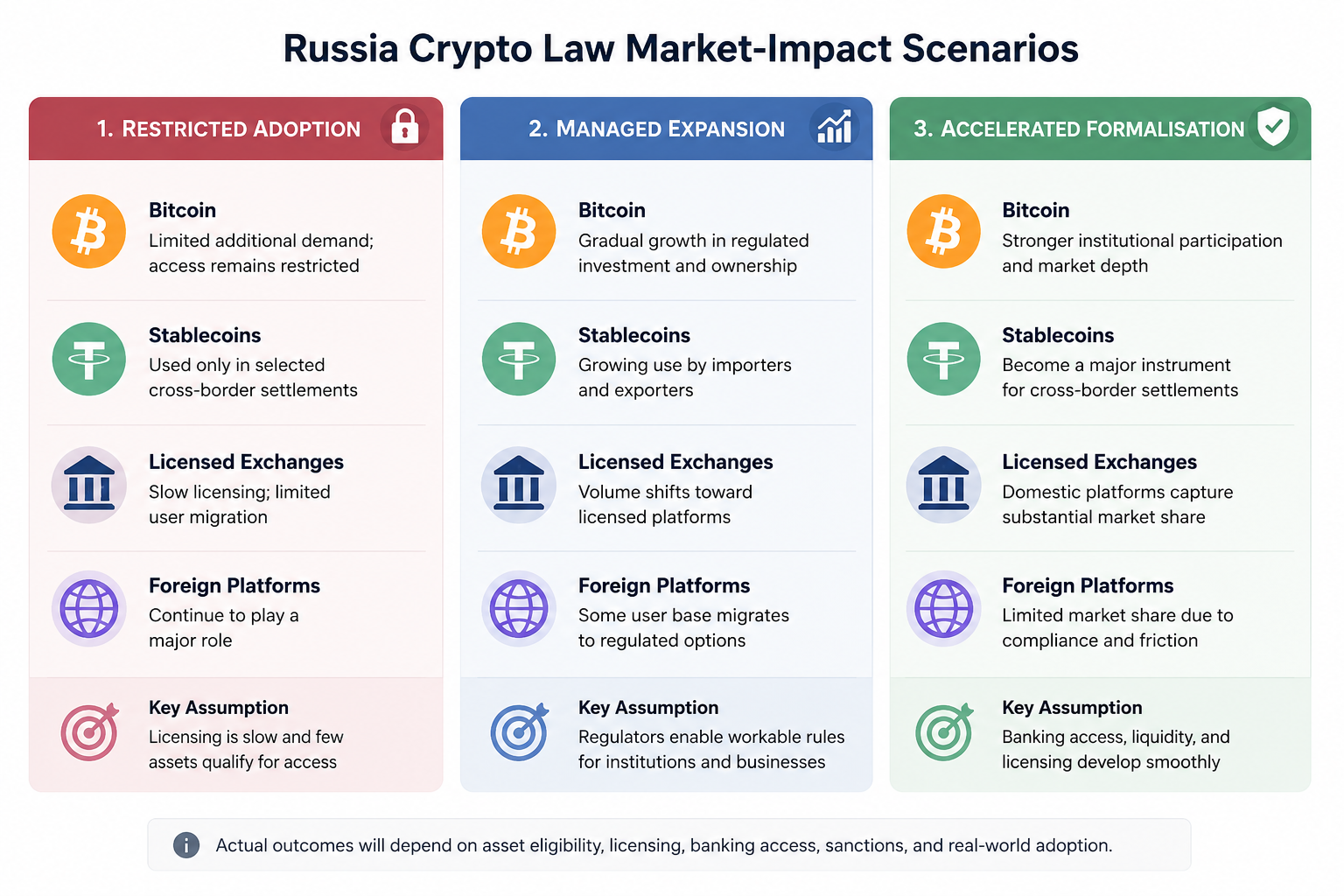
The law’s effect can be evaluated through three scenarios rather than a single bullish or bearish prediction.
| Scenario |
Bitcoin |
Stablecoins |
Exchanges |
Key assumption |
| Restricted adoption |
Limited additional demand |
Used only in selected settlements |
Offshore and informal activity remains significant |
Licensing is slow and few assets qualify |
| Managed expansion |
Gradual growth in regulated ownership |
Growing use by importers and exporters |
Volume shifts toward licensed platforms |
Major institutions receive workable rules |
| Accelerated formalisation |
Stronger institutional participation |
Stablecoins become major settlement instruments |
Domestic platforms capture substantial activity |
Banking, liquidity and licensing develop smoothly |
The managed-expansion scenario is the most reasonable base case. This is an inference rather than a confirmed outcome. It assumes that regulators permit meaningful market access while retaining limits on payments, retail exposure and unlicensed activity. The legislation’s investor classifications and controlled-market approach support that interpretation.
Russia’s model also differs from the European Union’s MiCA framework. The Russia crypto regulation versus EU MiCA comparison shows how differences in stablecoin oversight, service-provider rules and retail access may lead to different market structures.
What Could Limit the Law’s Impact?
Implementation may matter more than legislative language.
The main uncertainties include:
-
which cryptocurrencies qualify for broader investor access;
-
how investor limits are calculated across intermediaries;
-
what capital and custody standards exchanges must meet;
-
whether banks provide reliable fiat access;
-
how foreign stablecoins are approved or restricted;
-
whether businesses can find willing international counterparties;
-
how sanctions affect issuers, wallets and transaction liquidity.
A law can create legal permission without creating liquidity, operational capacity or commercial demand. Exchanges still need banking relationships, businesses still need counterparties, and users still face custody and market risks.
Conclusion
Russia’s crypto law is more likely to reshape domestic market infrastructure than transform global cryptocurrency valuations. Bitcoin could gain a clearer investment channel, stablecoins could become more useful for international settlements, and licensed Russian exchanges could capture activity from foreign or informal platforms.
The eventual Russia crypto law market impact will depend on asset eligibility, licensing costs, banking cooperation, sanctions and actual transaction demand. Until those variables become measurable, the most credible conclusion is gradual formalisation with uneven effects across Bitcoin, stablecoins and exchanges.
This content is for educational purposes only and does not constitute legal, financial or investment advice.
FAQ
Will Russia’s crypto law increase Bitcoin’s price?
Russia’s law does not guarantee an increase in Bitcoin’s price. It may support additional regulated demand inside Russia, but Bitcoin’s global price depends on worldwide liquidity, macroeconomic conditions and investor activity.
Will stablecoins become legal for domestic payments in Russia?
Stablecoins should not be assumed to be legal tender for ordinary domestic purchases. Russia’s policy continues to distinguish regulated crypto ownership and cross-border use from domestic payments, which remain restricted.
Could foreign exchanges lose Russian users?
Foreign exchanges could lose some Russian users if licensed domestic platforms offer easier funding, reporting and legal protection. The scale of any shift will depend on the final compliance rules and the quality of local exchange infrastructure.
Is Russia banning cryptocurrency?
Russia is not imposing a complete ban on cryptocurrency ownership and investment. The emerging framework permits selected regulated activities while restricting domestic crypto payments and increasing oversight of exchanges and investors.







