Russia’s cryptocurrency legal framework is not the result of a single comprehensive crypto law. It is a layered regulatory system that began with Bank of Russia warnings, introduced a statutory definition of digital currency in 2020, expanded to regulated mining and experimental cross-border settlements in 2024, and moved toward controlled domestic investment access in 2025 and 2026.
TL;DR
-
Russia first issued an official cryptocurrency warning in January 2014, but that statement did not itself prohibit individual ownership.
-
Federal Law No. 259-FZ, adopted in July 2020 and effective from January 1, 2021, created Russia’s core statutory definition of digital currency.
-
Russian law prohibits using digital currency as payment for goods, work or services when the payment falls within the domestic prohibition.
-
Federal Laws No. 221-FZ and No. 223-FZ introduced regulated mining and an experimental framework for certain cryptocurrency-based international settlements in 2024.
-
A cryptocurrency-market bill passed the State Duma in July 2026, but its final legal effect depends on completing the remaining legislative and publication stages.
publications, official federal laws, Federal Tax Service guidance and State Duma legislative records.
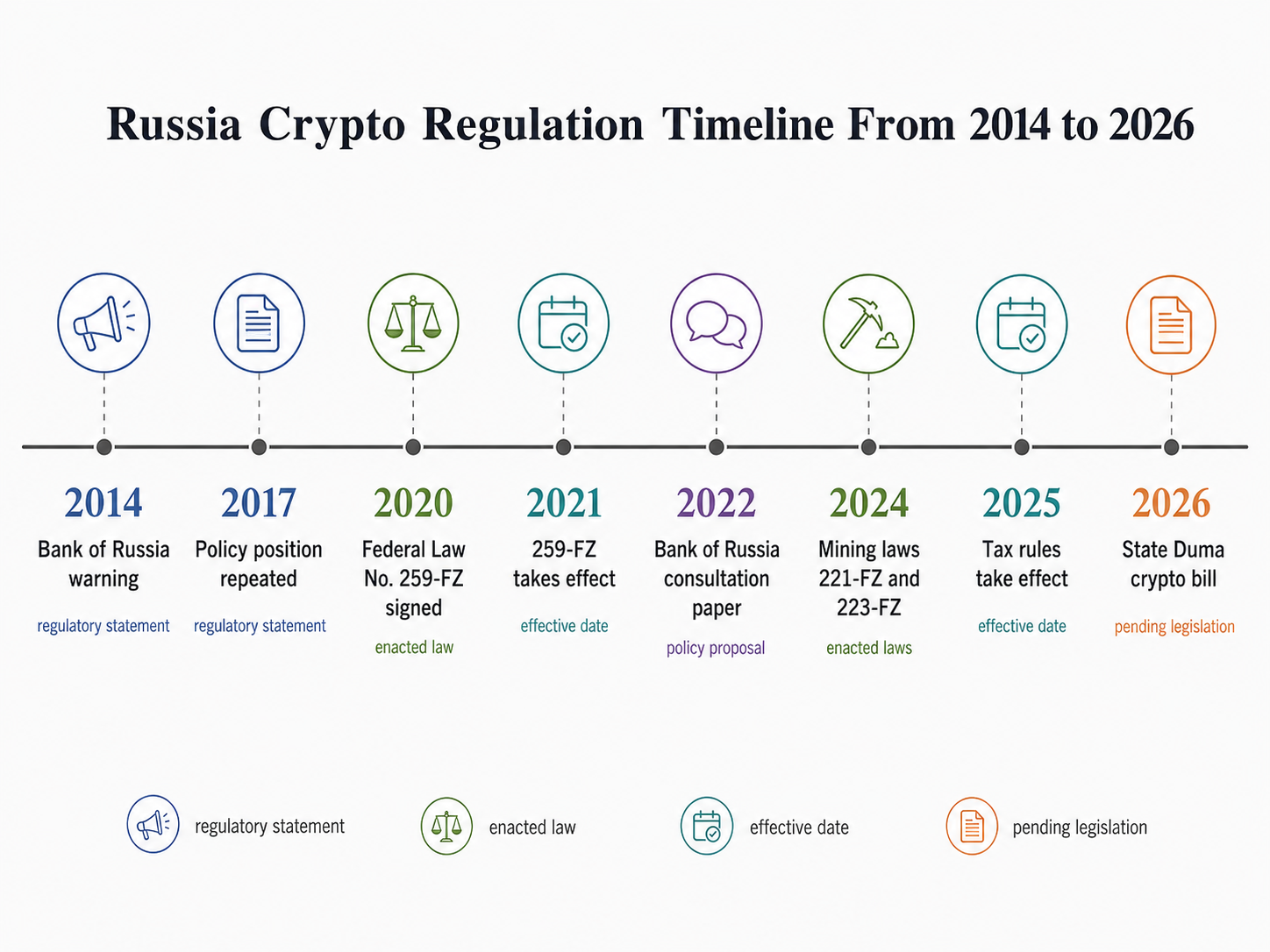
Russia Crypto Regulation Timeline at a Glance
The most important distinction in the Russia cryptocurrency legal framework is the difference between a regulator’s policy statement, an enacted federal law and a law’s effective date. A warning may signal future enforcement policy, while a passed State Duma bill does not become enforceable merely because the lower chamber approved it.
| Date |
Milestone |
Legal significance |
| January 27, 2014 |
Bank of Russia warning on Bitcoin and virtual currencies |
Warned of speculative, financial-crime and loss risks |
| September 2017 |
Bank of Russia repeated its restrictive position |
Confirmed that formal regulatory approaches were being developed |
| July 31, 2020 |
Federal Law No. 259-FZ signed and published |
Defined digital currency and established the foundational legal framework |
| January 1, 2021 |
Federal Law No. 259-FZ took effect |
Domestic payment restrictions and disclosure-related rules became operative |
| January 2022 |
Bank of Russia proposed broad restrictions |
Influenced policy debate but did not itself create a total legal ban |
| August 8, 2024 |
Federal Laws No. 221-FZ and No. 223-FZ signed |
Regulated mining and enabled experimental cryptocurrency settlement arrangements |
| November 1, 2024 |
Core mining rules became effective |
Registration and reporting infrastructure began operating |
| January 1, 2025 |
Cryptocurrency tax amendments became effective |
Added clearer taxation rules for mining and digital-currency transactions |
| December 23, 2025 |
Bank of Russia published a regulated-market concept |
Proposed controlled investor access while retaining the domestic payment ban |
| July 21, 2026 |
State Duma passed a cryptocurrency-market bill |
Major legislative milestone, but not equivalent to final enactment |
The timeline shows a consistent policy direction: Russia has increasingly recognized cryptocurrency as an asset or regulated economic activity while resisting its use as an unrestricted domestic substitute for the ruble.
2014: The Bank of Russia Issues Its First Major Warning
The Bank of Russia’s January 27, 2014 statement marked the beginning of Russia’s formal cryptocurrency policy. The central bank warned individuals, banks and other financial organizations about using virtual currencies such as Bitcoin, citing speculative activity, price-loss risk and the absence of a legally responsible issuer.
The 2014 statement was significant, but it was not a comprehensive cryptocurrency statute. It expressed the regulator’s risk assessment and warned regulated institutions against facilitating transactions that could involve questionable activity.
This distinction matters because later summaries sometimes describe cryptocurrency as having been “banned in Russia” in 2014. The statement did not establish the detailed ownership, mining, taxation or investment regime that exists today.
2017: Russia Moves From Warnings Toward Legislation
In September 2017, the Bank of Russia repeated its position on private virtual currencies and confirmed that it was working with federal authorities on approaches to defining and regulating cryptocurrency.
The Bank of Russia also supported developing distributed-ledger technology separately from permitting private cryptocurrency to function as money. That separation between blockchain technology and private digital currencies remained a recurring feature of Russian policy.
By 2018, draft legislation on digital financial assets and crowdfunding had entered the public-policy process. The proposals laid the groundwork for the statutory framework eventually enacted in 2020.
2020-2021: Federal Law No. 259-FZ Creates the Legal Foundation
Federal Law No. 259-FZ, dated July 31, 2020, became the foundation of the modern Russia cryptocurrency legal framework. The officially published law addressed digital financial assets, digital currency and amendments to other Russian legislation.
The law entered into force on January 1, 2021. It recognized “digital currency” as a legally defined category while distinguishing decentralized cryptocurrency from Russian digital financial assets issued through regulated information systems.
The law did not recognize Bitcoin or similar cryptocurrencies as legal tender. It also restricted the use of digital currency as consideration for goods, work or services by Russian legal entities and certain residents covered by the legislation.
Therefore, the 2021 framework did not make every cryptocurrency activity illegal. Ownership and transfers could exist within the legal structure, but domestic payment use remained restricted. The practical activity-by-activity position is set out in the analysis of whether cryptocurrency is legal in Russia.
2022: The Bank of Russia Proposes Stronger Restrictions
In January 2022, the Bank of Russia released a consultation paper titled Cryptocurrencies: Trends, Risks, and Regulation. The paper argued that cryptocurrency created risks for financial stability, monetary sovereignty and consumer protection, and proposed extensive restrictions on issuance, mining, circulation and financial-sector involvement.
The proposal attracted attention because it represented the regulator’s preferred policy direction. However, a consultation paper is not the same as enacted legislation. Russia did not simply convert every proposed restriction into a nationwide prohibition.
This period also exposed a continuing policy tension. The Bank of Russia generally favored strict domestic restrictions, while other state institutions increasingly considered mining regulation and cryptocurrency use in foreign trade.
2024: Russia Regulates Mining and Experimental Settlements
August 2024 produced two of the most important legislative milestones in Russia’s crypto regulation timeline.
Federal Law No. 221-FZ amended Russian legislation to establish a formal framework for digital-currency mining. Its provisions addressed miners, mining-pool participants, mining-infrastructure operators, reporting obligations and government authority to restrict mining in specified regions or under certain energy conditions.
Core mining provisions became effective on November 1, 2024. The Federal Tax Service launched its Mining Register service on that date for qualifying miners and mining-infrastructure operators.
Federal Law No. 223-FZ created a legal route for cryptocurrency transactions within an experimental legal regime supervised by the Bank of Russia. The framework was designed principally to test digital-currency settlements and related infrastructure under controlled conditions rather than legalize unrestricted domestic crypto payments.
The two laws therefore addressed different activities:
-
Federal Law No. 221-FZ focused primarily on producing and recording mined digital currency.
-
Federal Law No. 223-FZ focused on controlled transaction and settlement experiments.
-
Neither law converted cryptocurrency into general legal tender inside Russia.
2025: Tax Rules and a Regulated-Market Proposal Take Shape
Federal Law No. 418-FZ introduced clearer tax treatment for digital-currency mining and transactions. Relevant taxation provisions took effect on January 1, 2025, according to Federal Tax Service guidance.
The tax amendments reinforced the treatment of cryptocurrency as taxable property or an economic asset rather than recognized domestic money. Miners became subject to registration, reporting and taxation rules depending on their legal status and operational scale.
On December 23, 2025, the Bank of Russia published a broader cryptocurrency-market concept. The proposal contemplated access for both qualified and non-qualified investors under different conditions while maintaining the prohibition on using cryptocurrency for payments inside Russia.
The concept proposed that non-qualified investors could access selected liquid cryptocurrencies after passing a knowledge test and within a specified annual limit. Qualified investors would receive broader access, although anonymous cryptocurrencies would remain excluded under the proposal. These were policy proposals at that stage, not automatically effective market rules.
2026: The State Duma Advances a Broader Crypto-Market Bill
On July 21, 2026, the State Duma passed Bill No. 1194918-8 in its second and third readings. Reports describing the vote indicate that the bill is intended to regulate cryptocurrency circulation and investor access while continuing to prohibit cryptocurrency payments for ordinary domestic goods and services.
The State Duma vote is a major milestone, but it should not be described as a fully effective federal law unless the remaining process has been completed. A Russian federal bill normally requires Federation Council consideration, presidential signature and official publication before its operative provisions can be treated as enacted law.
As of the July 22, 2026 verification date, no final official publication record confirming the bill as a signed federal law was identified in the reviewed official publication sources. Consequently, proposed investor limits, commencement dates and asset-eligibility criteria should remain labelled as pending until the final published text is available.
The distinction between existing law and the expanding 2026 framework is examined in the broader overview of the Russia cryptocurrency legal framework.
What Has Remained Consistent Throughout the Timeline?
Russia’s cryptocurrency policy has changed substantially, but three principles have remained comparatively consistent.
First, the ruble retains its protected role in domestic monetary circulation. Russian authorities have repeatedly opposed allowing decentralized cryptocurrency to operate as ordinary domestic money.
Second, Russia distinguishes cryptocurrency ownership from cryptocurrency payment. A person’s ability to acquire, hold, transfer, declare or sell an asset does not automatically create a right to use that asset to pay for everyday goods and services.
Third, cryptocurrency activity is moving toward greater state visibility. Mining registers, tax reporting, transaction monitoring, controlled intermediaries and experimental settlement regimes all increase the ability of authorities to identify participants and trace regulated activity.
What Could Change Next?
The most important next step is the final legal status of Bill No. 1194918-8. The official text must be checked after Federation Council review, presidential action and publication.
Future implementation may also depend on:
-
Bank of Russia regulations defining eligible cryptocurrency assets;
-
investor-testing and classification requirements;
-
rules for exchanges, brokers, custodians and exchange offices;
-
reporting obligations for foreign cryptocurrency accounts or transfers;
-
penalties for unauthorized cryptocurrency intermediaries;
-
regional mining and electricity-consumption restrictions.
Until implementing measures are published, draft provisions and announced policy concepts should not be treated as fully operational rules.
FAQs
When did cryptocurrency become legally recognized in Russia?
Cryptocurrency received its foundational statutory recognition through Federal Law No. 259-FZ, adopted on July 31, 2020 and effective from January 1, 2021. The law defined digital currency but did not recognize it as legal tender.
Is cryptocurrency completely banned in Russia?
No. Russia permits or regulates certain activities involving cryptocurrency, including ownership, transfers, mining and taxable disposals. However, using cryptocurrency as payment for ordinary domestic goods, work or services remains restricted.
When did cryptocurrency mining become regulated in Russia?
Russia’s formal mining framework was enacted through Federal Law No. 221-FZ on August 8, 2024. Its principal mining and registration provisions became effective on November 1, 2024.
Can Russian companies use cryptocurrency for international trade?
Certain cryptocurrency-based international settlement arrangements may be tested within the experimental legal regime created by Federal Law No. 223-FZ. This is a controlled exception and does not amount to general permission for domestic cryptocurrency payments.
Is the July 2026 State Duma crypto bill already effective?
The State Duma passed the bill in second and third readings on July 21, 2026, but a Duma vote alone does not establish final enforceability. The Federation Council, presidential signature, official publication and the commencement clauses in the final text must be verified.







