Sei and Solana are both widely regarded as leading examples of high-performance public blockchains, which is why they are often compared side by side. Both emphasize low latency, high throughput, and real-time on-chain interaction, but their underlying architectures and ecosystem development paths are clearly different. As the blockchain industry moves toward more complex applications, high-performance infrastructure has become a key focus in public blockchain competition.
Today’s on-chain applications are no longer limited to simple asset transfers. DeFi, blockchain games, on-chain order books, AI agents, and SocialFi all place higher demands on network performance and user experience. Against this backdrop, Sei and Solana represent two different approaches to high-performance public blockchains: one focuses on EVM compatibility and parallel execution, while the other is built around an independent runtime environment and a native high-performance architecture.
Sei’s Core Architectural Features
As a Layer 1 public blockchain centered on Parallelized EVM, Sei’s core goal is to improve on-chain execution efficiency and real-time interaction while remaining compatible with the Ethereum development environment.
Traditional EVMs usually follow a sequential execution model. Sei, by contrast, uses Parallelized EVM to allow certain non-conflicting transactions to run at the same time, thereby improving network throughput. At the same time, Sei combines Twin-Turbo Consensus, low-latency finality, and structures such as SeiDB to optimize overall performance.
Another important feature of Sei is its compatibility with Solidity and the Ethereum toolchain. Developers can continue using MetaMask, Remix, and Solidity to deploy applications without having to learn an entirely different development system.
Solana’s Core Architectural Features
Solana is a Layer 1 public blockchain designed around native high performance. Its focus is to improve network throughput and low-latency capabilities through an independent execution architecture.
Solana uses the Sealevel parallel execution model, allowing multiple smart contracts to run simultaneously. It also uses the Proof of History, PoH, mechanism to optimize time synchronization between nodes. This structure can improve transaction processing capacity in high-concurrency scenarios.
Unlike EVM chains, Solana is not compatible with Solidity or the traditional Ethereum toolchain. Developers typically need to build with languages such as Rust and learn Solana’s independent account model and runtime logic.
Because its architecture is fully independent, Solana has greater flexibility in performance optimization, but this also means the migration cost for developers is relatively higher.
Core Differences Between Sei and Solana
Both Sei and Solana are high-performance Layer 1 public blockchains, but Sei leans more toward a “high-performance EVM” path, making it suitable for migration from the existing EVM ecosystem. Solana, meanwhile, is built around an independent ecosystem and native high-performance applications, with a development system and runtime logic that differ significantly from Ethereum.
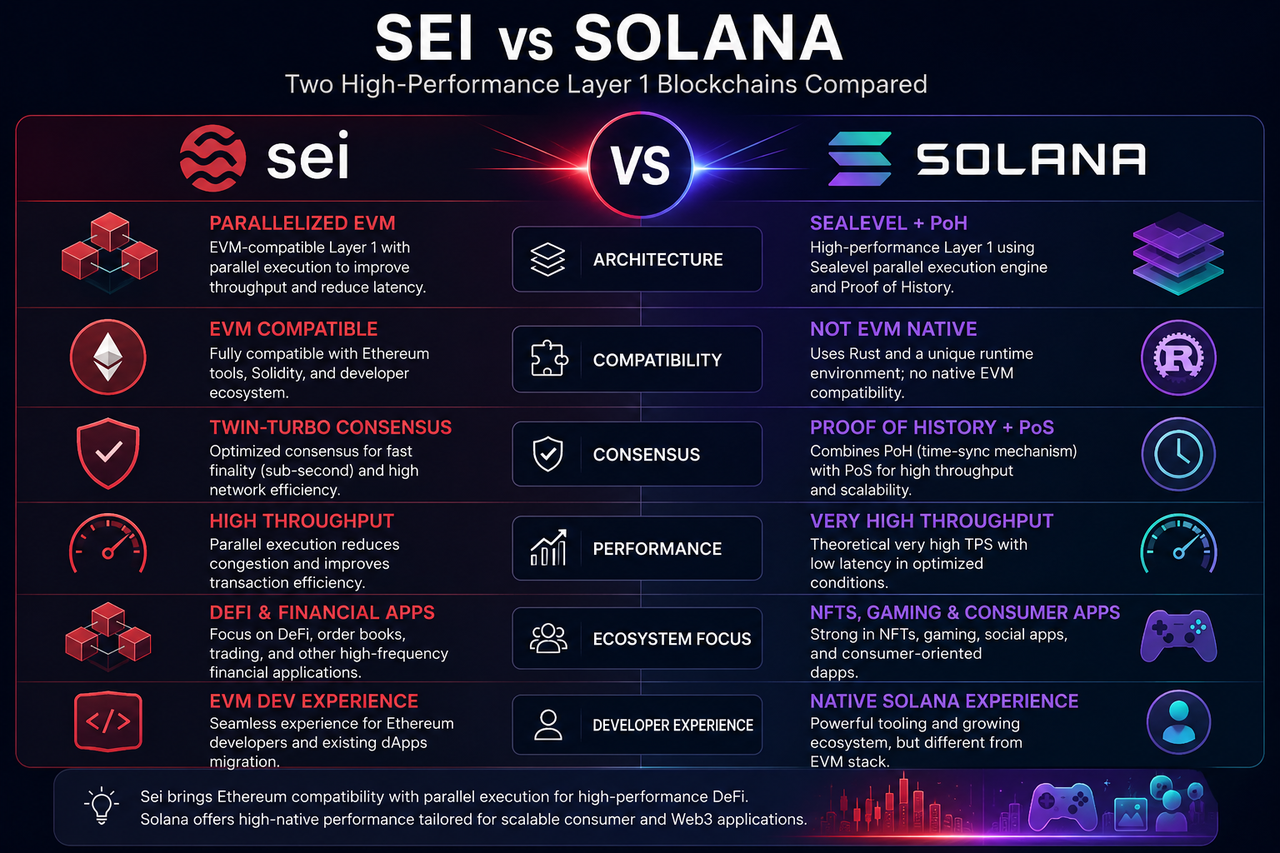
Sei places greater emphasis on improving on-chain execution efficiency through Parallelized EVM while staying compatible with Ethereum and the Solidity development environment. Solana, on the other hand, uses an independent runtime architecture and a native parallel execution model, focusing on maximum throughput and low-latency performance.
| Comparison Dimension |
Sei |
Solana |
| Network type |
Layer1 |
Layer1 |
| EVM compatibility |
Fully compatible |
Not native |
| Smart contract language |
Solidity |
Rust |
| Execution model |
Parallelized EVM |
Sealevel |
| Consensus feature |
Twin-Turbo Consensus |
Proof of History |
| Ecosystem focus |
High-performance EVM |
Native high-performance applications |
| Developer migration cost |
Relatively low |
Relatively high |
| Typical use cases |
DeFi, order book trading |
Blockchain games, consumer applications |
How Do Sei and Solana Differ in EVM Compatibility?
EVM compatibility is one of the most obvious differences between Sei and Solana.
Sei places strong emphasis on compatibility with the Ethereum ecosystem. Developers can directly migrate Solidity smart contracts and continue using the existing EVM toolchain. This compatibility lowers the barrier to development and helps attract mature EVM projects into the Sei ecosystem.
By contrast, Solana uses an independent runtime environment and does not natively support EVM. Although some third-party projects have attempted to build compatibility layers, Solana’s overall development model remains very different from Ethereum.
For developers already familiar with Solidity, Sei generally offers a lower migration cost. Solana is better suited to teams willing to adopt a new architecture and development model.
How Do Sei and Solana Differ in Parallel Execution?
Both Sei and Solana emphasize parallel execution, but they implement it in different ways.
Sei’s Parallelized EVM is mainly built on EVM compatibility. The system detects whether state conflicts exist between transactions and allows transactions that do not affect one another to execute simultaneously. This approach is designed to address the performance limitations of traditional sequential EVM execution.
Solana’s Sealevel is a more fundamental native parallel execution structure. Developers need to declare in advance the account data a transaction will access, allowing the system to schedule parallel tasks more efficiently.
Because their architectural designs differ, Solana generally has stronger theoretical throughput at the native performance level, while Sei places more emphasis on balancing performance with EVM compatibility.
How Do Sei and Solana Differ in Developer Ecosystem and Development Experience?
The developer ecosystem is another important distinction between the two public blockchains.
Ethereum has accumulated a large base of tools, tutorials, and development resources over time, giving the EVM ecosystem a powerful network effect. Because Sei is compatible with Solidity, it can more easily absorb existing EVM developers and application migrations.
Solana has formed an independent developer ecosystem. Its development frameworks, account model, and runtime logic differ clearly from EVM, so developers usually need to relearn the relevant tools and architectural concepts.
Even so, Solana has built a strong community foundation in blockchain games, consumer applications, and high-performance interaction, which has attracted many native development teams.
How Do Sei and Solana Differ in Application Direction?
Although both are high-performance public blockchains, their actual ecosystem directions differ to some extent.
Sei places greater emphasis on high-performance EVM scenarios, such as on-chain order books, perpetual contracts, DeFi, and high-frequency trading systems. Its focus is to improve the performance experience within the EVM ecosystem.
Solana has strong influence in blockchain games, NFTs, consumer applications, and real-time on-chain interaction. Because of its native performance advantages, some applications that require extremely high throughput are more inclined to choose Solana.
Conclusion
Sei and Solana are both important representatives of high-performance public blockchains, but they have chosen different technical paths.
Sei focuses on improving performance while maintaining Ethereum compatibility. Its Parallelized EVM architecture is designed to solve the efficiency issues caused by traditional sequential EVM execution. Solana, by contrast, pursues higher throughput and low latency through an independent runtime environment and a native parallel execution structure.
These two paths represent different directions in the development of high-performance public blockchains today: one prioritizes compatibility with the existing EVM ecosystem, while the other builds an independent ecosystem around a native high-performance architecture.
FAQs
What Is the Biggest Difference Between Sei and Solana?
The biggest difference is EVM compatibility. Sei is fully compatible with the Ethereum toolchain, while Solana uses an independent runtime environment and development system.
Do Sei and Solana Both Support Parallel Execution?
Yes. Sei uses Parallelized EVM, while Solana uses the Sealevel parallel execution model.
Is Sei Compatible With Solidity?
Yes. Developers can use Solidity directly to deploy smart contracts on the Sei network.
Why Is Solana Not Compatible With EVM?
Because Solana uses an independent architecture and runtime environment, and its design goal is not centered on EVM compatibility.
Which Public Blockchain Is More Suitable for DeFi Applications?
Both support DeFi, but Sei leans more toward high-performance EVM DeFi scenarios, while Solana has advantages in native high-performance trading and consumer applications.
Are Sei and Solana Both Layer 1 Blockchains?
Yes. Both are independently operated Layer 1 public blockchain networks.







