In recent years, the global payments market has gradually entered a new development phase. In the past, businesses looking to complete cross-border payments typically had to rely on banks, clearinghouses, and multiple intermediary institutions working in coordination. Not only was the process cumbersome, but it also often involved high costs and long settlement times. As blockchain technology matures and stablecoins gain broader market acceptance, the payments industry has started exploring whether new financial infrastructure can improve these existing processes.
Against this backdrop, the market's attention has shifted beyond stablecoins themselves to focus on which blockchains can truly support enterprise-grade payment needs. It is in this context that Tempo has drawn significant interest. Unlike most public blockchains, which prioritize DeFi, NFTs, or on‑chain gaming applications, Tempo has chosen to focus on payments, cross‑border remittances, and enterprise settlement, aiming to build a payment infrastructure better suited to commercial needs.
Meanwhile, international payments companies such as Stripe, MoneyGram, and Visa have increasingly invested in stablecoin and blockchain‑related technologies in recent years, signaling that the global payments industry is progressively exploring the integration of Web3 and traditional finance. So what role does Tempo play within the broader Web3 payments ecosystem? And how does it connect different businesses and financial institutions to drive the development of the next‑generation payments network?
The Web3 Payments Ecosystem Is Rapidly Taking Shape
In the past few years, Web3 development has largely revolved around cryptocurrency trading, decentralized finance (DeFi), and digital assets. However, as the market matures, more and more businesses are turning their attention to applications closer to real commercial needs, with payments being one of the most closely watched areas. Payments have always been the most fundamental function in financial activities—whether for corporate payments, international trade, cross‑border payroll, or e‑commerce, a stable, efficient payment system is essential. As stablecoins gain higher liquidity and broader acceptance, the market has begun building a new Web3 payments ecosystem, hoping to improve traditional payment processes through blockchain. Unlike the early blockchain era, which mainly served cryptocurrency investment, this new generation of payments ecosystem places greater emphasis on enterprise needs, including transaction efficiency, system stability, compliance capabilities, and global capital flow. This also means that the importance of payment infrastructure is steadily increasing, and Tempo has aligned itself with this direction, aiming to become a key underlying network for stablecoin payments.
Tempo's Position in the Web3 Payments Ecosystem
 (Source: tempo.xyz)
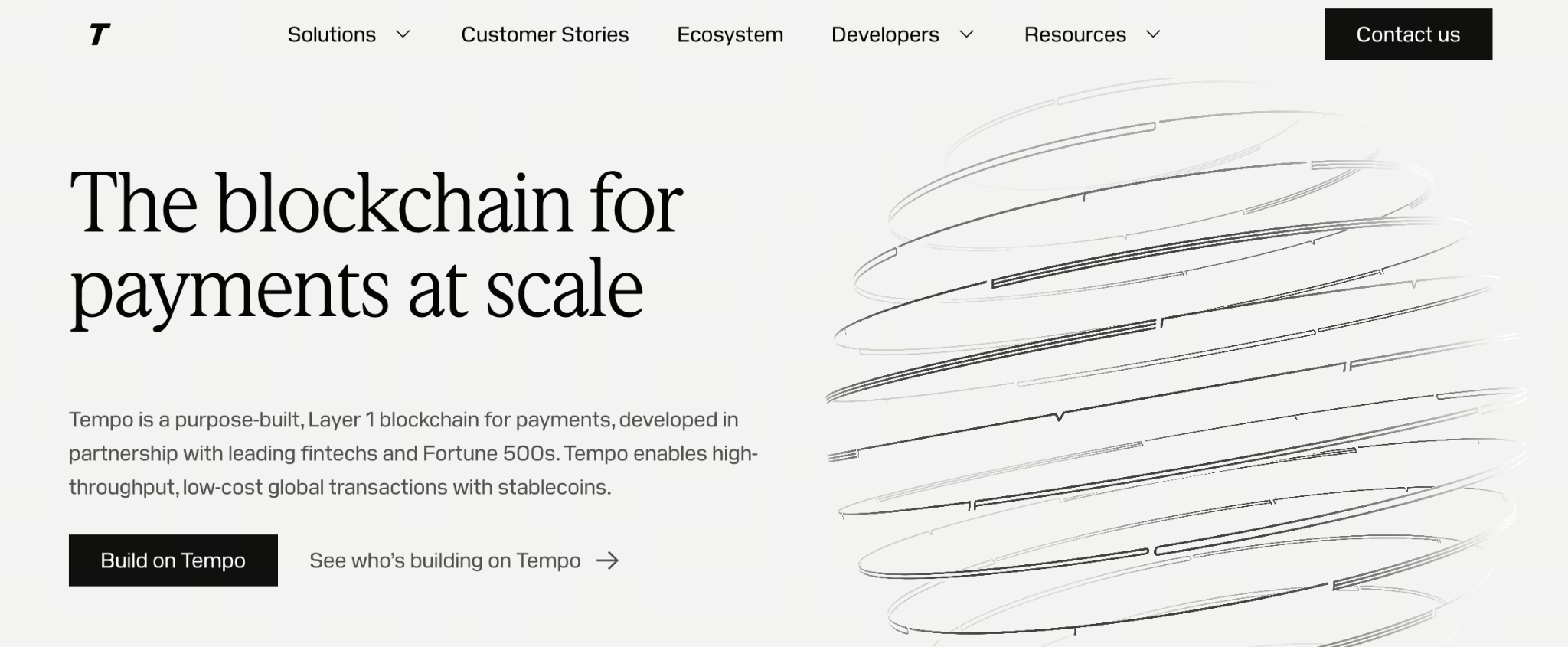
Tempo is positioned more as a "payment infrastructure" than a typical public blockchain. Many Layer 1 blockchains provide general‑purpose development platforms that support smart contracts, decentralized applications (DApps), and various on‑chain services. In contrast, Tempo has chosen to focus on payment scenarios, aiming to build a blockchain network dedicated to stablecoin transactions, enterprise settlement, and cross‑border payments. This positioning makes Tempo more like a highway designed specifically for financial transactions. Its primary goal is not to increase the number of on‑chain applications but to enhance capital‑flow efficiency, reduce friction in cross‑border payments, and make it easier for businesses to integrate blockchain technology into their existing payment processes. From the perspective of the overall Web3 payments ecosystem, Tempo plays the role of an underlying infrastructure provider responsible for payments and settlements, while payment companies, financial institutions, and businesses can develop various commercial services on top of it.
Why Are Stripe, MoneyGram, and Visa Actively Positioning Themselves?
In recent years, more and more international payments companies have begun researching stablecoins and blockchain payments—not just because of the pursuit of new technology, but out of a desire to address long‑standing efficiency issues in the global payments network. Take Stripe, for example. As a globally recognized payments technology company, it serves a vast number of businesses and e‑commerce platforms. As stablecoins increasingly become a new option for cross‑border business payments, Stripe has continued to invest in related infrastructure, hoping to improve global payment efficiency and expand its enterprise financial services. MoneyGram, which has long experience in the international remittance market, has joined the Tempo ecosystem as an Anchor Remittance Validator. This not only signals that traditional remittance providers are beginning to participate in blockchain network construction but also reflects the importance that payment companies place on stablecoin‑based cross‑border remittances. Visa, meanwhile, continues to explore blockchain payments, tokenized assets, and stablecoin settlement technologies, aiming to stay competitive in the future payments market. For these companies, blockchain is not about replacing existing payment systems but about providing new payment methods to meet the increasingly diverse needs of global enterprises.
How Does Tempo Connect Different Players to Build a Payments Ecosystem?
A complete payments ecosystem cannot be built by a single company—it requires collaboration across different parties. Tempo provides the blockchain infrastructure responsible for transaction validation, payment processing, and stablecoin settlement; payment companies offer payment and collection services and merchant networks; financial institutions handle fiat currency circulation and regulatory cooperation; and businesses are the end users who complete global commercial activities through this payment network. Under this framework, each party leverages its strengths to jointly build a comprehensive payment service. For example, payment platforms can use Tempo to deliver faster stablecoin transaction capabilities, while businesses can complete cross‑border payments through existing payment interfaces without having to build complex blockchain systems from scratch. This model of collaboration is gradually moving blockchain payments from technical concepts to commercial applications.
How Does Tempo Bridge Web2 and Web3 Finance?
Currently, most businesses still rely on traditional banks and payment platforms as their primary financial tools, while Web3 payments are still in a rapid development phase. Therefore, what the market truly needs is not a complete replacement of the existing financial system, but rather a bridge between the two.
Tempo's development direction aligns perfectly with this need. In the future, businesses can continue to use familiar payment platforms for receiving and making payments, while payment platforms can leverage Tempo as an underlying payment infrastructure, converting some cross‑border payment processes to stablecoins. In this way, businesses do not need to interact directly with complex blockchain technology, yet they can still enjoy faster, more efficient payment services. This model also helps lower the barrier for businesses to adopt Web3, allowing blockchain to gradually integrate into the existing financial system rather than creating two separate, independent markets.
Why Has Payment Infrastructure Become a New Market Focus?
In the early days, the blockchain market largely revolved around token prices and investment opportunities. However, in recent years, the market has gradually recognized the importance of infrastructure.
As stablecoin transaction volumes continue to grow, businesses begin to adopt on‑chain payments, and more financial institutions enter digital asset services, what truly limits market development is often not payment tools themselves, but whether there is a stable, secure, and highly efficient payment network. Consequently, payment infrastructure has started to attract more attention. Compared with general‑purpose public blockchains, payment‑focused blockchains need to balance transaction throughput, finality speed, system reliability, and enterprise adoption requirements. Tempo's development direction is precisely aimed at addressing these market demands, creating a blockchain‑based payment environment suitable for commercial applications.
What Potential Impact Could Tempo Have in the Future?
As stablecoins gradually enter the mainstream financial market, businesses' demands for global payment efficiency will continue to increase. If more payment platforms, financial institutions, and businesses join the Tempo ecosystem in the future, its application scope could expand from cross‑border remittances to corporate payroll, supply chain finance, global receivables and payables, treasury management, and international business settlement, among other scenarios. Moreover, the maturity of payment infrastructure could also spur the emergence of more Web3 commercial services. When businesses can easily use stablecoins to complete transactions, blockchain technology will no longer be just a concept of financial innovation but will gradually become part of everyday commercial activity. Of course, the payments industry is still influenced by factors such as national regulations, compliance requirements, and market acceptance, so the relevant ecosystem will continue to evolve. However, judging from current trends, payment‑focused blockchains have gradually become an important component of Web3 infrastructure, and Tempo is one of the key players attracting attention.
Summary
The development of Web3 payments is progressively extending from the cryptocurrency market to global corporate finance. Rather than competing over which stablecoin prevails, the more critical task is to build infrastructure that can support payments, settlements, and capital flow. Tempo is positioned precisely around this core, focusing on stablecoin payments, cross‑border settlement, and enterprise financial needs, aiming to create a blockchain‑based payment network more suited for commercial applications. At the same time, the continued investment of companies like Stripe, MoneyGram, and Visa shows that the payments industry is actively exploring the integration of blockchain and traditional finance. In the future, as more businesses and financial institutions join the Web3 payments ecosystem, payment‑focused Layer 1 platforms like Tempo have the opportunity to play an even more important role in the global digital payments landscape, serving as a vital bridge connecting stablecoins, corporate finance, and cross‑border payments.
FAQ
Q1: What is Tempo's position in the Web3 payments ecosystem?
Tempo is a Layer 1 blockchain focused on stablecoin payments, primarily offering the underlying infrastructure needed for payments, cross‑border settlement, and enterprise fund management, aiming to help businesses improve global payment efficiency.
Q2: Why are Stripe, MoneyGram, and Visa paying attention to blockchain payments?
As stablecoin applications grow, payments companies want to use blockchain to improve cross‑border payment efficiency, reduce settlement costs, and explore more enterprise financial services, so they are continuously investing in the development of related payment infrastructure.
Q3: How is Tempo different from general public blockchains?
Compared with general‑purpose public blockchains that support a wide variety of on‑chain applications, Tempo is more focused on stablecoin payments, enterprise settlement, and cross‑border capital flow, aiming to build a payment network tailored for commercial needs.
Q4: What impact could Tempo have on the future payments market?
As businesses gradually adopt stablecoin payments, Tempo has the potential to support cross‑border remittances, global receivables and payables, enterprise treasury management, and commercial settlement, further driving the development of the Web3 payments ecosystem.







