The blockchain industry has evolved through several stages, from digital currencies and smart contracts to decentralized finance, or DeFi. Throughout this process, most on-chain assets have remained native crypto assets, with their value largely tied to the crypto ecosystem itself.
As institutional capital and traditional financial markets have increasingly turned their attention to blockchain technology, real world assets, or RWAs, have begun to emerge as a new direction for growth. Assets such as real estate, government bonds, corporate bonds, private credit, commodities, and intellectual property are entering on-chain markets through tokenization, allowing blockchain networks to support a broader range of financial activities.
What Is Plume (PLUME)?
As a blockchain network built specifically for the financialization of real world assets, or RWAfi, Plume combines real world assets with on-chain financial infrastructure to enable asset tokenization, yield generation, liquidity management, and related functions.
Plume is designed to serve as a complete lifecycle management platform for RWAs. From asset issuance to on-chain circulation, yield distribution, and cross chain use, the entire process can be carried out within a unified network.
Compared with platforms that only provide tokenization services, Plume places greater emphasis on integrating real world assets with DeFi, allowing these assets to participate in on-chain financial activities much like native crypto assets.
How Does Plume Work?
Plume has built a modular architecture designed around real world assets.
Asset issuers first complete asset verification, legal structuring, and compliance review through the platform. Once certified, the assets can be mapped into on-chain tokens and receive the corresponding proof of rights.
These asset tokens then enter the Plume network ecosystem, where they can be used in lending protocols, yield products, liquidity pools, and other DeFi applications.
To ensure that on-chain data remains consistent with the real world status of the underlying assets, Plume also integrates oracles, custody services, and off-chain data verification mechanisms. Together, these components create a trusted connection between real world assets and the blockchain.
Plume’s Core Infrastructure
Nest Yield Ecosystem
Nest is an important part of the Plume ecosystem, primarily used to connect real world asset yields with on-chain capital markets.
Through Nest, users can gain access to yield products backed by real world assets, while asset issuers can reach a broader pool of capital.
Nest is designed to bring real world asset yields into the DeFi ecosystem in a standardized way, enabling automated yield distribution and asset management.
SkyLink Cross Chain Infrastructure
SkyLink is the cross chain connectivity layer built by Plume.
Real world asset tokens are not limited to a single blockchain environment. Through cross chain mechanisms, assets and liquidity can move across different blockchain networks, improving market reach and capital efficiency.
On-Chain Compliance Modules
Real world assets often involve securities laws, anti money laundering rules, and investor qualification requirements.
Plume integrates compliance tools into its underlying architecture, allowing asset issuers to set access rules, identity verification processes, and permission management mechanisms based on regulatory requirements.
What Is the PLUME Token?
PLUME is the native token of the Plume network and an essential part of how the ecosystem operates.
PLUME mainly serves four functions:
First, it is used to pay network transaction fees.
Second, it is used to participate in network governance decisions.
Third, it is used in staking mechanisms to help maintain network security.
Fourth, it serves as an ecosystem incentive tool to support participation from developers, validators, and users.
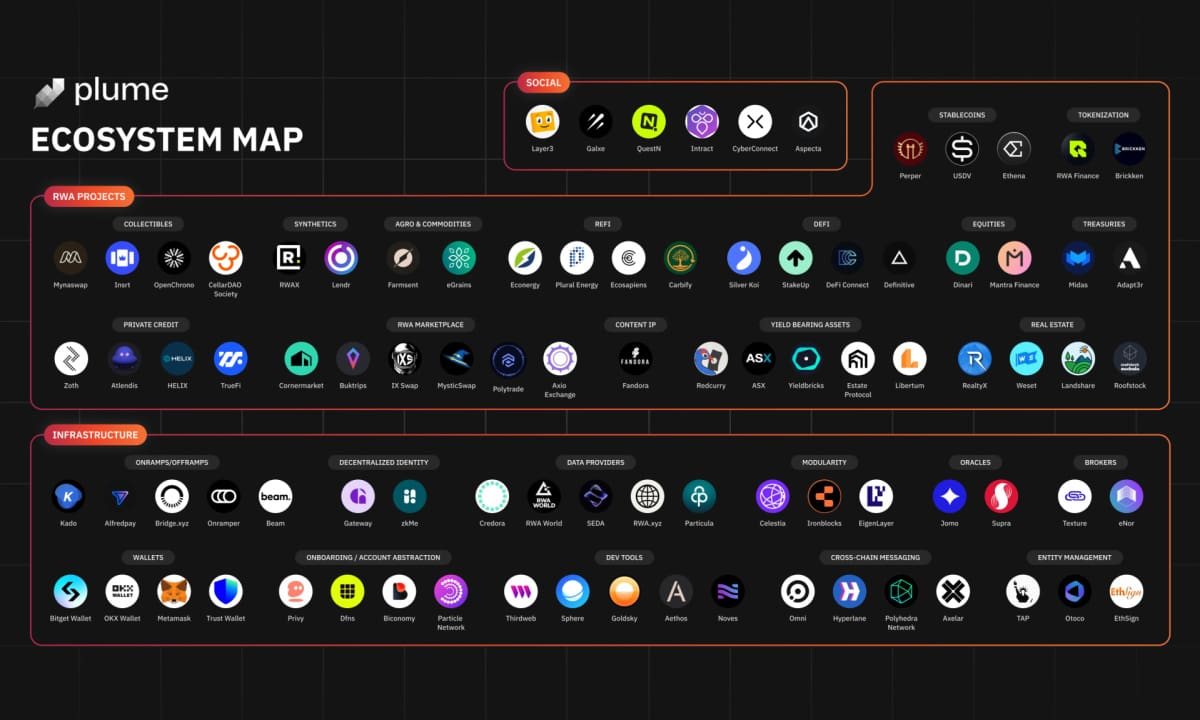
What Does the Plume Ecosystem Include?
The Plume ecosystem spans several layers.
The infrastructure layer includes on-chain compliance systems, asset issuance tools, and data services.
The protocol layer includes yield protocols such as Nest, along with liquidity products.
The application layer covers a range of use cases, including lending, trading, asset management, and yield aggregation.
At the same time, Plume has also established partnerships with asset managers, custodians, data service providers, and blockchain development teams to jointly support the movement of real world assets into on-chain markets.
How Is Plume Different from Other RWA Projects?
Several well known projects have already emerged in the RWA sector, but their positioning differs.
| Project |
Core Positioning |
Main Features |
| Plume |
RWAfi public blockchain |
Builds a complete RWA financial ecosystem |
| Ondo Finance |
Asset issuance platform |
Focuses on on-chain government bond products |
| Centrifuge |
RWA financing protocol |
Serves enterprise financing scenarios |
| MANTRA |
Compliance focused public blockchain |
Emphasizes integration with regulatory frameworks |
Compared with projects such as Ondo Finance, Plume stands out because it aims to build integrated infrastructure covering asset issuance, compliance management, yield generation, and DeFi applications, rather than focusing only on a single asset class or one specific business scenario.
Plume’s Advantages and Potential Challenges
Plume’s main advantages come from its vertical design approach.
Dedicated infrastructure built around real world assets can help improve asset issuance efficiency, strengthen liquidity, and simplify the development process.
At the same time, Plume also faces challenges common across the real world asset sector, including differences in regulation, the complexity of legal structures, the reliability of off-chain data, and the pace of market adoption.
Conclusion
Plume is an RWAfi blockchain network built specifically for the financialization of real world assets. By integrating asset tokenization, on-chain compliance, cross chain infrastructure, and DeFi applications, Plume aims to create a complete pathway for real world assets to enter blockchain-based financial markets.
FAQs
Plume not only supports the tokenization of real world assets, but also focuses on building infrastructure that allows these assets to participate in DeFi. Compared with platforms that only handle asset issuance, Plume places greater emphasis on liquidity, yield generation, and financial composability.
What Is RWAfi?
RWAfi stands for Real World Asset Finance. It refers to a new financial system formed by combining real world assets with decentralized finance. Its goal is to allow real world assets to participate in on-chain activities such as lending, trading, and yield strategies.
What Is the PLUME Token Used For?
The PLUME token is mainly used to pay network fees, participate in governance voting, support staking for network security, and power ecosystem incentive mechanisms. It is an important part of how the Plume network operates.
Which Real World Assets Does Plume Support?
Plume supports multiple types of real world assets, including government bonds, real estate, private credit, commodities, fund shares, and other verifiable financial assets.
Is Plume a Layer 1 or Layer 2?
Plume is positioned as a blockchain network built specifically for the RWAfi ecosystem. Its underlying architecture is designed around the needs of real world asset financialization and provides full infrastructure support.