From digital asset trading and cross-border payments to capital management in the DeFi ecosystem, stablecoins are increasingly serving as “on-chain dollars.” Compared to highly volatile crypto assets, stablecoins preserve the blockchain’s efficient settlement capabilities while minimizing uncertainty from value fluctuations. As a result, more institutions and payment platforms are adopting stablecoins.
For Ripple, the launch of RLUSD marks not only an expansion from its single XRP asset ecosystem into the stablecoin space, but also signals heightened institutional demand for compliant, transparent, and low-volatility digital assets. As Ripple Payments, the XRPL ecosystem, and on-chain financial applications continue to grow, RLUSD is positioned as a vital addition to Ripple’s payment infrastructure.
What Is RLUSD?
RLUSD is a US dollar stablecoin issued by Ripple, pegged 1:1 to the dollar and backed by cash and short-term dollar-equivalent assets. RLUSD is deployed on the XRP Ledger (XRPL) and Ethereum networks, serving cross-border payments, on-chain settlements, and stable value transfers in digital finance.
RLUSD is currently available on both XRP Ledger and Ethereum. XRPL delivers lower trading fees and faster on-chain settlements, while Ethereum offers a mature DeFi and Smart Contract ecosystem. With multi-chain issuance, RLUSD can support a broader range of payment and financial applications.
Within Ripple’s ecosystem, RLUSD is not a replacement for XRP. Instead, it acts as a stable settlement asset, working alongside XRP to form a comprehensive payment and liquidity system.
Why Did Ripple Launch RLUSD?
Ripple has long specialized in cross-border payments and institutional financial infrastructure. As stablecoins become integral to digital payments, relying solely on volatile digital assets no longer meets institutional demand for stable settlement assets.
By launching RLUSD, Ripple can introduce a stable, USD-denominated asset into its payment network, expanding coverage across institutional payments and on-chain finance. For example, in corporate cross-border settlements, digital asset trading, on-chain dollar transfers, and DeFi liquidity management, stablecoins are often preferred as value intermediaries.
Global regulatory trends are also steering the stablecoin market toward greater transparency and compliance. Ripple aims to build a more institutional-grade stablecoin system with RLUSD to strengthen its position in payments and financial infrastructure.
How Does RLUSD Work?
RLUSD operates through three core mechanisms: issuance, circulation, and redemption.
When users or institutions deposit equivalent USD assets, RLUSD is minted at a 1:1 ratio. The newly issued RLUSD enters on-chain circulation and can be used for payments, transfers, or financial applications.
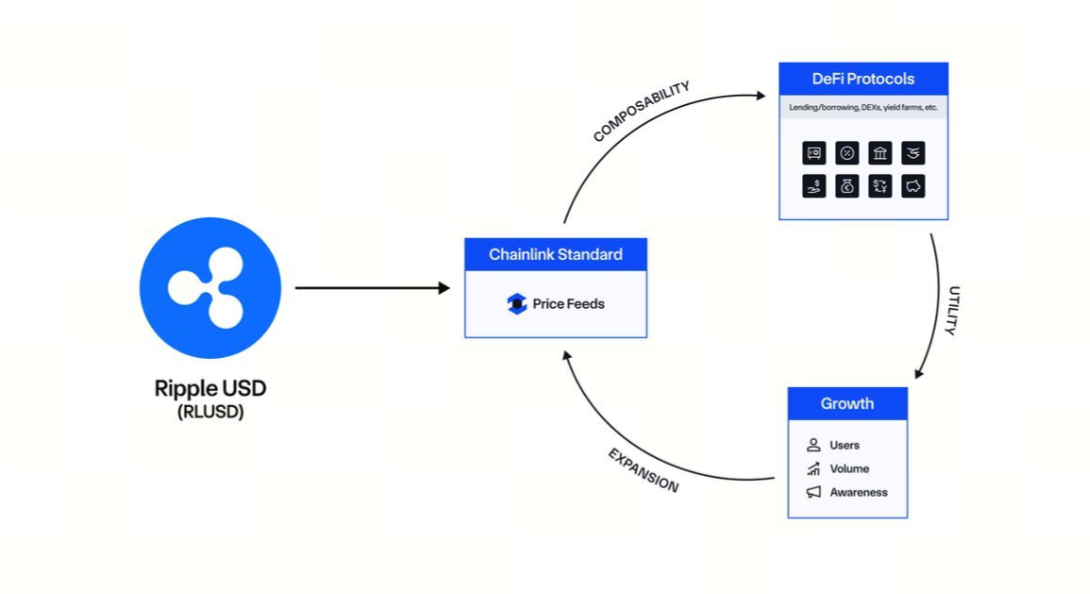
When users wish to swap RLUSD back to USD, the corresponding RLUSD is burned, and the reserve assets facilitate redemption. This mechanism ensures that on-chain RLUSD circulation matches real-world USD reserves.
To maintain stability, RLUSD reserves consist of cash, short-term US Treasury bonds, and highly liquid assets—similar to mainstream fiat stablecoins. The core objective is to guarantee liquidity and redemption capability.
Technically, RLUSD runs on both XRPL and Ethereum. On XRP Ledger, RLUSD leverages low trading fees and rapid confirmations for payment settlements. On Ethereum, RLUSD integrates with a mature DeFi ecosystem and Smart Contract applications.
How Does RLUSD Differ From XRP?
Both RLUSD and XRP are key digital assets within Ripple’s ecosystem, but their design goals and use cases are distinct.
XRP is a market-driven asset with price volatility, primarily used for liquidity bridging, cross-coin conversion, and as an intermediary in select payment scenarios. RLUSD is a stablecoin designed for price stability, making it ideal for payments, settlements, and value storage.
In short, XRP prioritizes liquidity efficiency, while RLUSD focuses on value stability.
In Ripple’s cross-border payment system, XRP facilitates liquidity conversion between different fiat currencies, while RLUSD acts as a stable USD asset for payment settlements. The two assets complement each other rather than compete directly.
Their risk profiles also differ: XRP’s price is influenced by market supply and demand, whereas RLUSD’s value relies on the stability of its reserves and issuance mechanism.
Where Can RLUSD Be Used?
As stablecoin adoption grows, RLUSD’s use cases are expanding from payments into broader digital finance.
For cross-border payments, RLUSD enables on-chain USD settlements between enterprises or institutions. Compared to traditional Bank Transfer, blockchain payments typically reduce settlement times and eliminate intermediaries.
In the digital asset trading market, stablecoins serve as key pricing and trading mediums. RLUSD can be used as a USD settlement tool for digital asset trading, enhancing capital flow efficiency.
With the growth of DeFi, RLUSD can also serve as an on-chain liquidity asset, collateral, or trading pair asset within various financial protocols. Supporting both XRPL and Ethereum, RLUSD offers broad ecosystem compatibility.
Potential Risks and Limitations of RLUSD
While stablecoins reduce price volatility risk, RLUSD has certain limitations.
First, RLUSD is a centralized stablecoin, and its stability depends on the issuer’s reserve management and compliance. Changes in reserve transparency, liquidity management, or regulatory conditions could impact the stablecoin system.
Second, compared to USDT and USDC—which have established large-scale liquidity—RLUSD is still in its ecosystem expansion phase, with market coverage and trading depth needing improvement.
Additionally, the stablecoin sector faces challenges such as regulatory changes, cross-chain security, and on-chain compliance. RLUSD’s long-term development depends not only on technical capabilities but also on the evolving global regulatory landscape.
Summary
Ripple USD (RLUSD) is Ripple’s USD stablecoin, designed to provide a stable value carrier for cross-border payments, on-chain settlements, and digital finance. Unlike XRP, RLUSD maintains price stability through USD reserves, making it more suitable for payments and settlements.
As stablecoins become a core element of blockchain financial infrastructure, RLUSD’s launch reflects Ripple’s expansion from payment networks to a more comprehensive digital asset ecosystem. By combining XRPL’s efficient settlement and Ethereum’s DeFi ecosystem, RLUSD aims to bridge institutional payments and on-chain finance.
FAQs
Are RLUSD and XRP the same asset?
No. XRP is a price-volatile digital asset, while RLUSD is a stablecoin. Each serves a different function within the Ripple ecosystem.
On which blockchains is RLUSD deployed?
RLUSD is currently available on the XRP Ledger (XRPL) and Ethereum networks.
Can RLUSD be used for cross-border payments?
Yes. RLUSD is specifically designed to enable efficient on-chain cross-border payments and institutional settlements.
Is RLUSD fully decentralized?
No. RLUSD is a centralized stablecoin, with issuance and reserve management handled by Ripple entities.
What distinguishes RLUSD from USDT and USDC?
RLUSD is also a fiat stablecoin, but it is tailored for the Ripple payment ecosystem, institutional settlements, and XRPL network scenarios.







