As the DePIN concept rapidly gains traction across the Web3 industry, a growing number of blockchain projects are leveraging token-based incentive mechanisms to build real-world infrastructure. Communication networks have emerged as one of the most representative applications of DePIN. Unlike the traditional internet model, which depends entirely on large operators and centralized infrastructure, communication-focused DePIN aims to lower network build costs through community-operated nodes and steer wireless connectivity toward open, decentralized networks.
In the current communication DePIN landscape, Helium and World Mobile Chain are two of the most widely discussed projects. While both seek to reimagine communication networks using blockchain, they differ significantly in technical architecture, target market, and network logic. Helium leans more toward wireless hotspots and IoT device connectivity, whereas World Mobile Chain aims to build a complete decentralized mobile communication system.
World Mobile Chain vs. Helium: A Brief Analysis and Core Differences
Designed as a Layer 3 blockchain network specifically for decentralized communication infrastructure, World Mobile Chain primarily supports mobile communications, eSIM services, identity verification, and on-chain communication settlement. Its network architecture is built on Base and OP Stack, and is compatible with the EVM Smart Contract environment. World Mobile Chain’s ambition extends beyond simply providing wireless coverage—it seeks to establish a fully community-owned communication operations ecosystem.
Helium, a blockchain-based wireless network project, initially focused on IoT (Internet of Things) device connectivity. Its core model involves community-deployed Hotspots to extend wireless coverage, with token incentives driving network participation. The early Helium network operated primarily on LoRaWAN technology, making it ideal for low-power IoT devices like sensors, trackers, and smart hardware.
Helium later expanded into 5G networks, aiming to enter the broader wireless communication market.
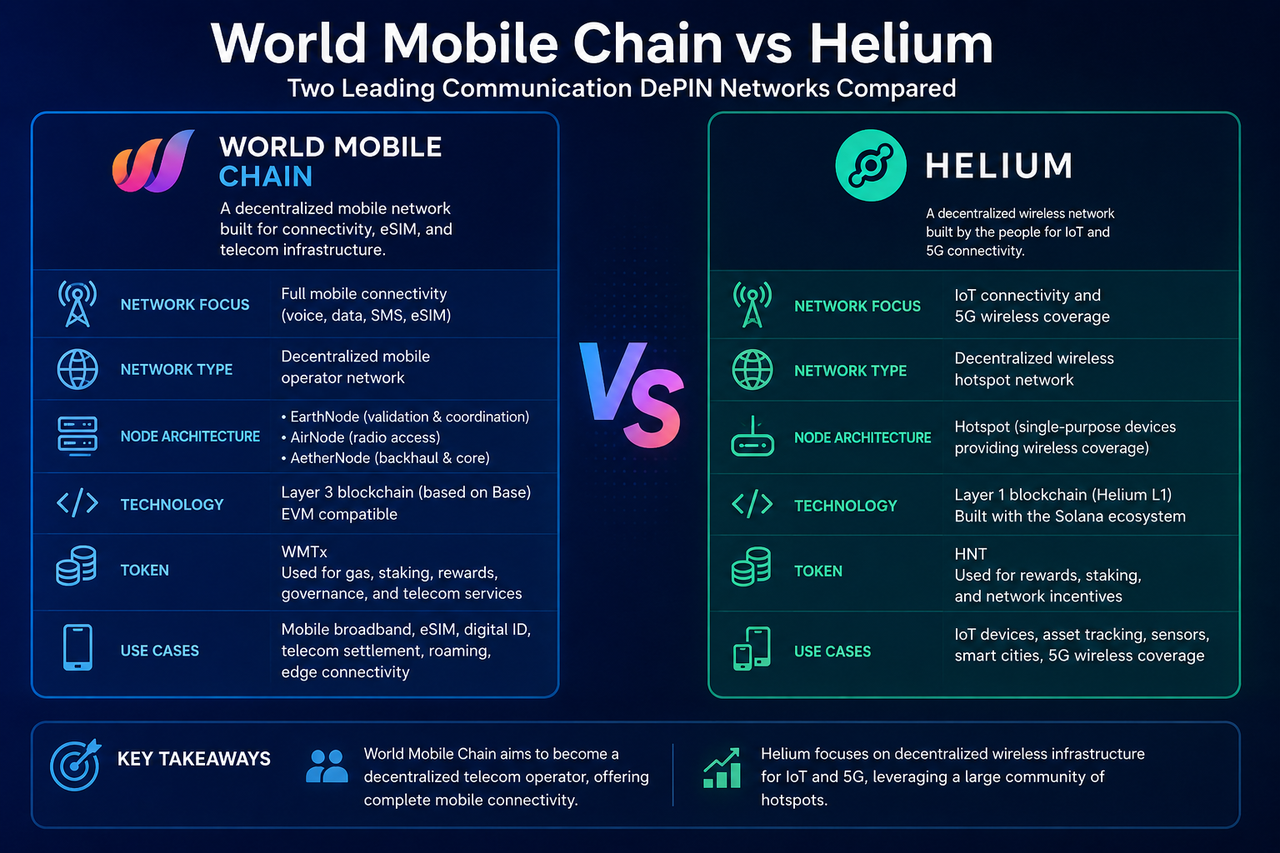
Core Positioning: How Does World Mobile Chain Differ From Helium?
Though both fall under the communication DePIN category, their core positioning varies significantly.
World Mobile Chain prioritizes a complete mobile communication ecosystem, including:
- User identity verification
- eSIM services
- Communication settlement
- Network governance
- Node-based economic system
Its goal is closer to that of a decentralized operator.
Helium, on the other hand, centers around wireless hotspot networks and IoT connectivity, functioning more like an open wireless coverage platform.
Their target audiences also differ:
| Project |
Primary Target Users |
Network Objective |
| World Mobile Chain |
Mobile communication users |
Decentralized operator |
| Helium |
IoT and wireless devices |
Wireless hotspot network |
In short, World Mobile Chain leans toward comprehensive communication infrastructure, while Helium focuses on wireless access networks.
Network Architecture and Node Models: How Do They Compare?
World Mobile Chain and Helium employ markedly different node designs.
World Mobile Chain adopts a layered node structure:
| Node Type |
Function |
| EarthNode |
Verification and on-chain coordination |
| AirNode |
Local wireless coverage |
| AetherNode |
Internet connectivity |
This architecture closely mirrors real-world communication operator networks.
Helium, in contrast, relies primarily on Hotspot nodes. Each Hotspot handles both wireless coverage and data transmission, resulting in a simpler structure.
Furthermore, World Mobile Chain emphasizes its Layer 3 blockchain capabilities, while Helium prioritizes wireless network coverage itself. Although both rely on community-operated nodes, their node complexity and network hierarchy are clearly distinct.
Communication Technology and Use Cases: What Sets Them Apart?
Helium was originally built on the LoRaWAN network, excelling in low-power, long-range IoT data transmission. This makes it ideal for smart sensors, GPS trackers, industrial IoT, and smart city devices.
World Mobile Chain, meanwhile, focuses on mobile communications and internet access, including eSIM services, mobile data networks, digital identity verification, and edge communication networks. In essence, Helium resembles an IoT network, while World Mobile Chain functions as a mobile communication network.
This fundamental difference shapes their respective market demands and network development trajectories.
Tokenomics: How Do Their Economic Models Differ?
Helium uses HNT as its core token, distributing rewards based on hotspot coverage contributions. Its economic model revolves around wireless hotspot deployment and data transmission.
World Mobile Chain uses WMTx as its network token, serving purposes such as network Gas, communication service settlement, node staking, governance, and network rewards.
Compared to Helium, World Mobile Chain’s token is more deeply integrated into communication operations and the on-chain economic framework. Additionally, because World Mobile Chain includes a verification layer like EarthNode, its token model shares certain similarities with traditional blockchain networks.
Shared Challenges: What Obstacles Do Both Face?
Despite their different approaches, communication DePIN networks face common hurdles.
First, the telecommunications industry has high regulatory barriers. Countries enforce strict requirements for wireless networks, spectrum usage, and operating licenses.
Second, deploying physical infrastructure is inherently more complex than running purely on-chain protocols. Whether it’s hotspot deployment or mobile network construction, ongoing hardware investments are essential.
Third, the long-term sustainability of node incentive models depends on actual user adoption. If network usage remains low, node returns may decline.
Thus, the core challenges for communication DePIN projects stem not only from blockchain technology but also from the realities of the telecommunications industry itself.
World Mobile Chain vs. Helium: Which Model Fits Future Communication Networks?
As it stands, Helium and World Mobile Chain represent two distinct communication DePIN pathways.
Helium is better suited for low-power IoT and wireless hotspot networks. Its lightweight model allows for rapid community node expansion.
World Mobile Chain, by contrast, emphasizes a comprehensive communication system with on-chain operational capabilities. Its goals are more complex, but its potential market is also larger.
Looking at long-term trends, communication networks are gradually shifting toward openness, software-driven architectures, and community collaboration. DePIN offers a novel incentive framework for infrastructure development.
However, which model proves more sustainable will ultimately depend on user scale, regulatory conditions, and real-world network deployment capabilities.
Summary
Both World Mobile Chain and Helium belong to the communication DePIN category, yet their core positioning diverges. Helium zeroes in on IoT and wireless hotspot coverage, while World Mobile Chain champions a complete mobile communication system with a decentralized operator model.
In terms of technical architecture, World Mobile Chain employs a Layer 3 multi-node structure integrated with DID, eSIM, and on-chain settlement. Helium, on the other hand, revolves around Hotspots and wireless coverage.
FAQs
What is the biggest difference between World Mobile Chain and Helium?
World Mobile Chain is oriented toward a complete mobile communication operations system, whereas Helium focuses on IoT and wireless hotspot networks.
Is Helium a DePIN?
Yes. Helium is one of the most representative communication DePIN projects.
Does World Mobile Chain Support Mobile Communication Services?
Yes. One of World Mobile Chain’s key objectives is to provide decentralized mobile communication and eSIM services.
Why Is Helium Primarily Used for IoT?
Helium was originally designed on the LoRaWAN network, making it ideal for low-power IoT device connectivity.
Why Does World Mobile Chain Use Layer 3?
The Layer 3 architecture is better suited for high-throughput communication scenarios and supports communication-network-specific functions.







