Summary
-
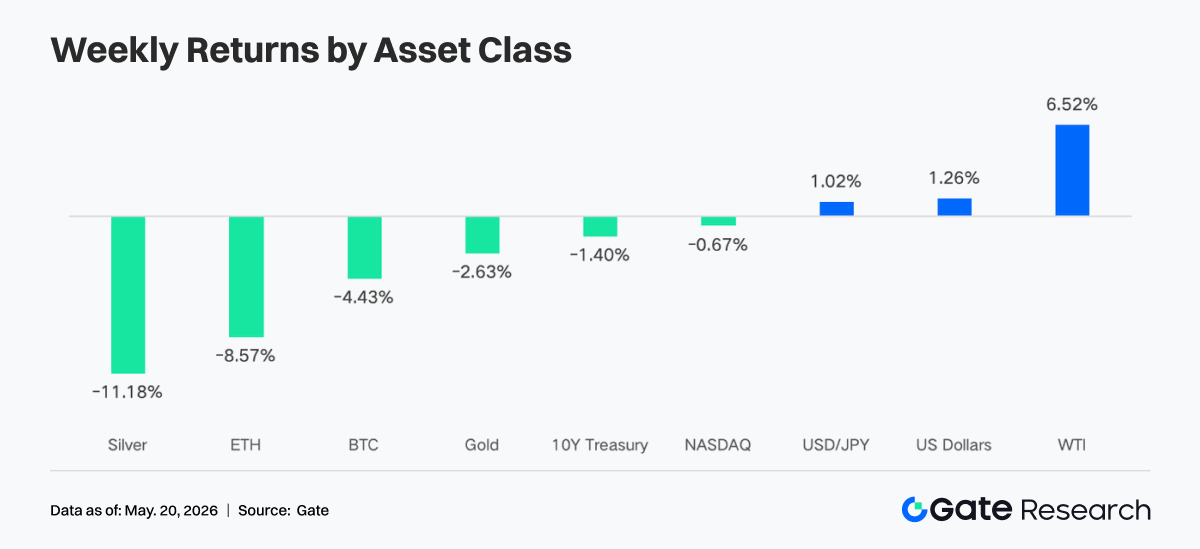
Market conditions reversed significantly last week. Higher-than-expected U.S. April CPI, the lack of substantive breakthroughs in China-U.S. talks, and a renewed escalation in the Strait of Hormuz jointly pushed U.S. Treasury yields higher and risk assets lower; the S&P and Dow pulled back notably on Friday after hitting record highs, and the market began to reassess the Fed’s policy path in the Warsh era.
-
BTC ETFs saw weekly net outflows of about $996 million, while ETH ETFs saw net outflows of about $255 million, both weakening significantly from the previous week, as institutional funds temporarily shifted toward defense; however, the overall AUM of BTC and ETH ETFs remained at historical highs.
-
TradFi on-chain and CEX derivatives trading continued to be dominated by safe-haven assets such as gold. The higher-than-expected U.S. CPI and geopolitical risks drove increased trading volume in gold-related perpetual contracts; meanwhile, the share of stock- and tech-stock-related trading rebounded, indicating stronger macro-driven characteristics.
-
On-chain liquidity continued to concentrate in leading DEXs such as PancakeSwap and Raydium, while deep-liquidity and stablecoin swap protocols saw significant volume contraction; the stablecoin market favored dollar assets with stronger compliance, payment, and banking-channel attributes.
-
Aave mainnet lending and the LST sector pulled back, while leverage demand on both ETH and Solana cooled simultaneously; meanwhile, new chains such as Plasma and MegaETH continued to absorb structural capital migration.
-
The derivatives market entered a deleveraging phase. BTC funding rates turned from positive to negative, OI continued to decline, the share of Puts trading and the negative value of 25D Skew both expanded, and the DVOL center moved higher amid volatility, showing that market pricing of downside risk and volatility had risen notably.
-
Gate institutional spot market share rose against the trend, increasing 10% MoM; cross-margin lending scale increased 10% WoW; Spot SBE is expected to move toward launch in June.
1. Market Focus Analysis
Over the past week, market conditions reversed sharply, as stronger-than-expected inflation data and heightened policy uncertainty challenged the rally in risk assets. On Thursday, U.S. equities hit record highs, with the S&P 500 closing above 7,500 for the first time and the Dow Jones returning to the 50,000 level; however, they then pulled back sharply on Friday, as the market reassessed the inflation and policy environment. First, the April CPI data released on Tuesday came in stronger than expected, with headline inflation rising 3.8% YoY, higher than the market consensus of 3.7%, and rising 0.6% MoM. Second, the China-U.S. bilateral talks on Wednesday and Thursday did not achieve any substantive policy breakthrough. Third, geopolitical tensions escalated again, with military conflict breaking out once more in the Strait of Hormuz on Friday, intensifying concerns that the process of easing tensions could deteriorate.
The rates market reacted strongly to this. As federal funds futures prices adjusted sharply, the market expected policy to become more restrictive, and the 10-year U.S. Treasury yield rose 28 bps this week to 4.58%, the highest level since September 2025. USD/JPY continued to climb due to dollar strength. The market lowered its easing expectations and began to price in the possibility of further policy tightening. The Powell era officially ended last Friday, as Jerome Powell’s term as Fed Chair ended on May 15, and Kevin Warsh was sworn in as his successor over the weekend. Warsh will chair the June 16-17 FOMC meeting, which will release the updated Summary of Economic Projections and revised dot plot, giving the market its first formal view of the policy outlook under Warsh’s leadership.
2. Liquidity Analysis
2.1 BTC ETF Scale Continues to Expand
Last week, the BTC ETF market showed a clear pattern of fund outflows. At the beginning of the week, May 11 still recorded net inflows of about $27.2 million, but market sentiment then weakened rapidly. On May 12 and May 13, large net outflows of about $233.2 million and $630.4 million occurred respectively, showing that institutional funds began to withdraw from risk assets in a concentrated manner. Overall, Bitcoin ETFs saw cumulative net outflows of about $995.5 million last week, close to $1 billion. Compared with net inflows of about $623 million in the previous week, from May 4 to May 8, market risk appetite clearly reversed, and institutional investors as a whole became more inclined toward profit-taking and temporary risk avoidance.
The ETH ETF market was also under pressure. Over the past week, ETH ETFs recorded net outflows for multiple consecutive trading days, with weekly cumulative net outflows of about $255.2 million, forming a sharp contrast with net inflows of about $70.49 million in the previous week. This indicates that, amid macro uncertainty and intensified market volatility, ETH assets were also affected by fund reductions, and overall sentiment was weaker than previous market expectations.
-
Overall AUM: As of May 14, cumulative net inflows into BTC ETFs had reached about $58.63 billion, with assets under management (AUM) of about $107.75 billion; cumulative net inflows into ETH ETFs were about $11.9 billion, with AUM of about $13.45 billion. Although short-term fund flows fluctuated, the overall ETF scale remained at historical highs, showing that institutional allocation demand had not fundamentally reversed.
-
Institutional trends: Last week, fund divergence was obvious. For BTC ETFs, BlackRock’s IBIT saw weekly net outflows of about $317.1 million, while Morgan Stanley’s MSBT recorded net inflows of about $39.1 million against the trend, reflecting that some institutions were still carrying out structural rebalancing and low-level allocation. For ETH ETFs, BlackRock’s ETHB achieved slight net inflows, while ETHA saw relatively large fund outflows, indicating that the market still had obvious divergence regarding the liquidity, fee structure, and long-term allocation value of different products.
2.2 TradFi Liquidity
- TradFi Perp DEX: Over the past week, the trading structure of TradFi assets on Perp DEXs continued to show a pattern of “commodities dominant, indexes auxiliary, stocks rebounding.” From the perspective of trading share, commodities still occupied the absolute core position, with the overall weekly share roughly remaining in the 45% to 65% range. Although this was slightly lower than the peak period in March-April, commodities remained the main liquidity source for on-chain TradFi derivatives trading. Among them, gold-related assets remained the trading core, reflecting the market’s continued preference for safe-haven assets and macro trading themes amid recurring inflation, rising geopolitical risks, and fluctuations in dollar rate expectations. At the same time, the share of stock assets rebounded significantly over the past week, rising again from a previous low below 10% to close to about 30%, indicating that as U.S. equity volatility expanded again, on-chain users’ demand for trading tech stocks, U.S. equity indexes, and AI-concept-related assets recovered. The current on-chain TradFi Perp user structure is still mainly composed of crypto-native traders with a preference for high volatility and high leverage, rather than a full migration of traditional macro capital.
-
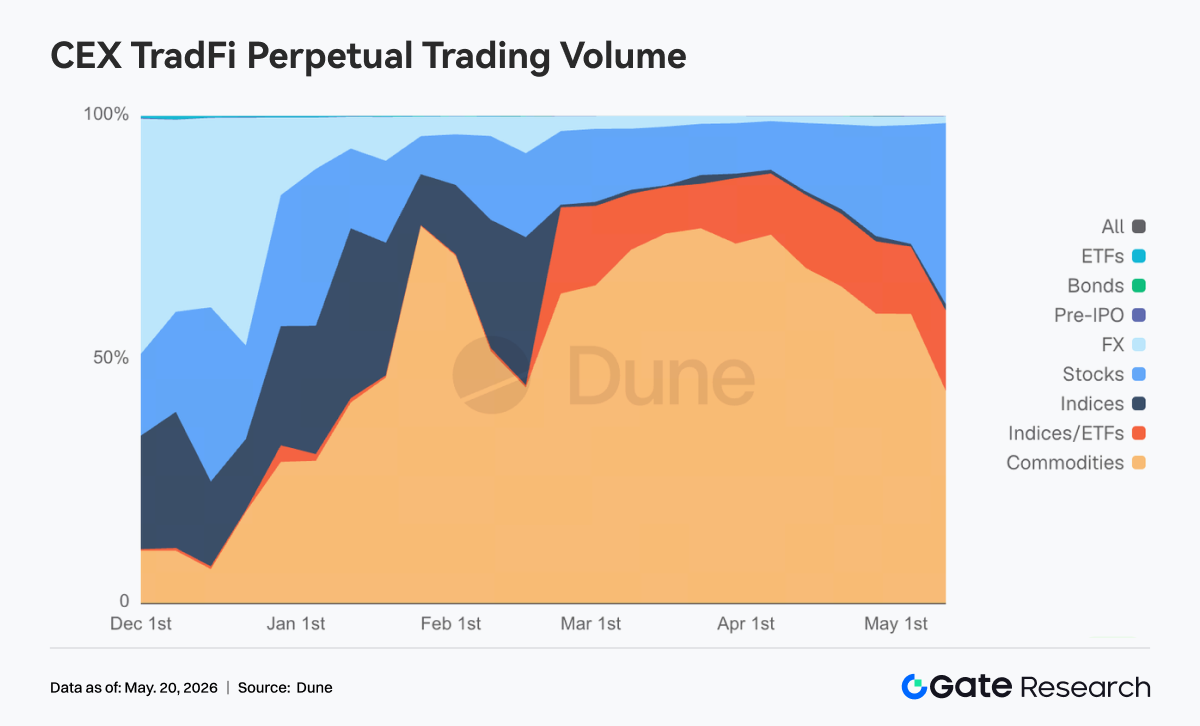
TradFi Perp CEX: Over the past week, overall trading activity in the CEX TradFi perpetual contract market remained high, but structurally it showed clear characteristics of “precious metals dominant, stocks auxiliary, other sectors less active.” From the distribution of TradFi Perp daily trading volume, Metals assets such as gold still occupied the absolute core position, with trading volume on most trading days remaining in the $300 million to $700 million range, and even exceeding $1 billion during some high-volatility periods. Among them, a phased peak of more than $1.5 billion appeared in mid-to-late March. Although last week’s overall trading volume pulled back from previous extreme highs, it was still significantly higher than the level in early February, showing that safe-haven and macro trading demand remained strong. In terms of rhythm, trading volume expanded significantly again in the second week of May, especially against the backdrop of higher-than-expected U.S. CPI, escalating Middle East geopolitical risks, and fluctuations in dollar rate expectations, making gold-related perpetual contracts the main trading direction for funds. At the same time, trading in stock assets also rebounded, more reflecting short-term trading demand brought by volatility in U.S. equity indexes and tech stocks. Overall, the current CEX TradFi Perp market has gradually shifted from previous pure crypto beta trading toward stronger macro-driven and cross-asset allocation logic.
-
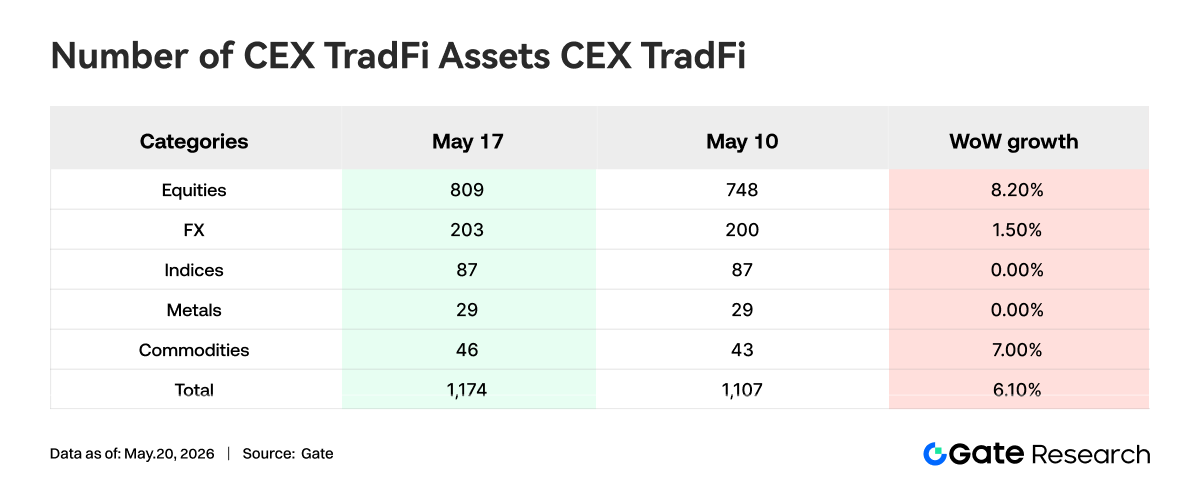
Number of CEX TradFi assets: In the past week, the number of CEX TradFi asset categories expanded further. The total number of TradFi assets across three mainstream CEXs, counting only the TradFi and CFD sectors and excluding perpetual contracts, increased from 1,107 to 1,174, a MoM increase of 6.10%. Among them, stock assets saw the most significant growth, increasing from 748 to 809, a MoM increase of 8.20%; among the three CEXs, Gate had the highest growth rate, with stock-type TradFi assets increasing by 62 MoM, a gain of 16.71%. This content cannot currently be displayed outside the Lark document.
- TradFi order book depth: We selected XAUT, the TradFi asset with the highest trading volume, to analyze its order book depth (Delta). Last week, XAUT order book liquidity showed a clear characteristic of “safe-haven funds flowing in temporarily and then weakening.” From May 6 to May 12, the XAUT price generally remained in high-level fluctuation near $4,700, accompanied multiple times by large positive Delta inflows. Around May 12 in particular, there was once a liquidity net increase close to $2.8 million, showing that amid higher-than-expected U.S. CPI and rising Middle East geopolitical risks, funds concentrated in the short term into gold-related assets for safe-haven allocation. However, after May 13, the market structure reversed clearly, with the order book showing consecutive large negative Delta readings, with a single outflow exceeding $2 million. The XAUT price also fell below $4,650 at the same time and continued to decline to the $4,520-$4,550 range, reflecting that earlier safe-haven funds began temporary profit-taking. It is worth noting that from May 15 to May 17, although the price continued to weaken, the order book saw consecutive medium-sized positive Delta accumulation, indicating that some funds began trying to absorb at lower levels, and the market had not entered a one-sided liquidity withdrawal phase. Overall, XAUT currently appears more to be in a “high-level rebalancing after cooling safe-haven sentiment” stage, and its short-term trend will still be highly dependent on changes in macro variables such as Fed rate-cut expectations, the dollar rate path, and the situation in the Strait of Hormuz.
3. On-Chain Data Insights
3.1 Leading DEX Volume Is Concentrated in PancakeSwap, but Vertical Protocol Divergence Intensifies
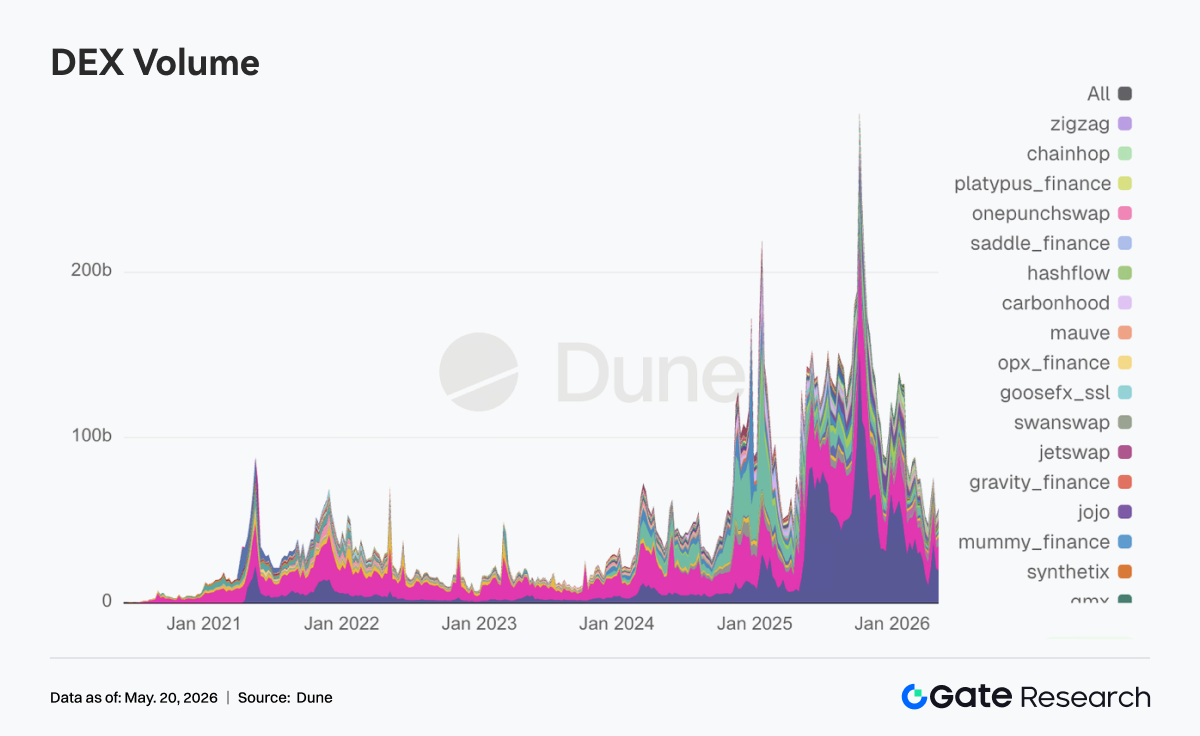
PancakeSwap rebounded about 12% from last week, with BNB Chain-side spot-supporting traffic becoming the main battlefield of institutional and retail resonance. Uniswap fell about 7% from last week. Aerodrome on Base grew about +3% MoM. Activity on Solana remained, with the structure leaning toward high transaction counts and medium dollar trading volume. Among them, Raydium increased by about 1.26 billion from last week, while Meteora was basically flat. The high number of on-chain transactions shows that Meme and routing-type trades have not fully died out. Vertical DEX protocols focused on deep liquidity and stablecoin swaps, such as Fluid and Curve, saw significant volume contraction this week.
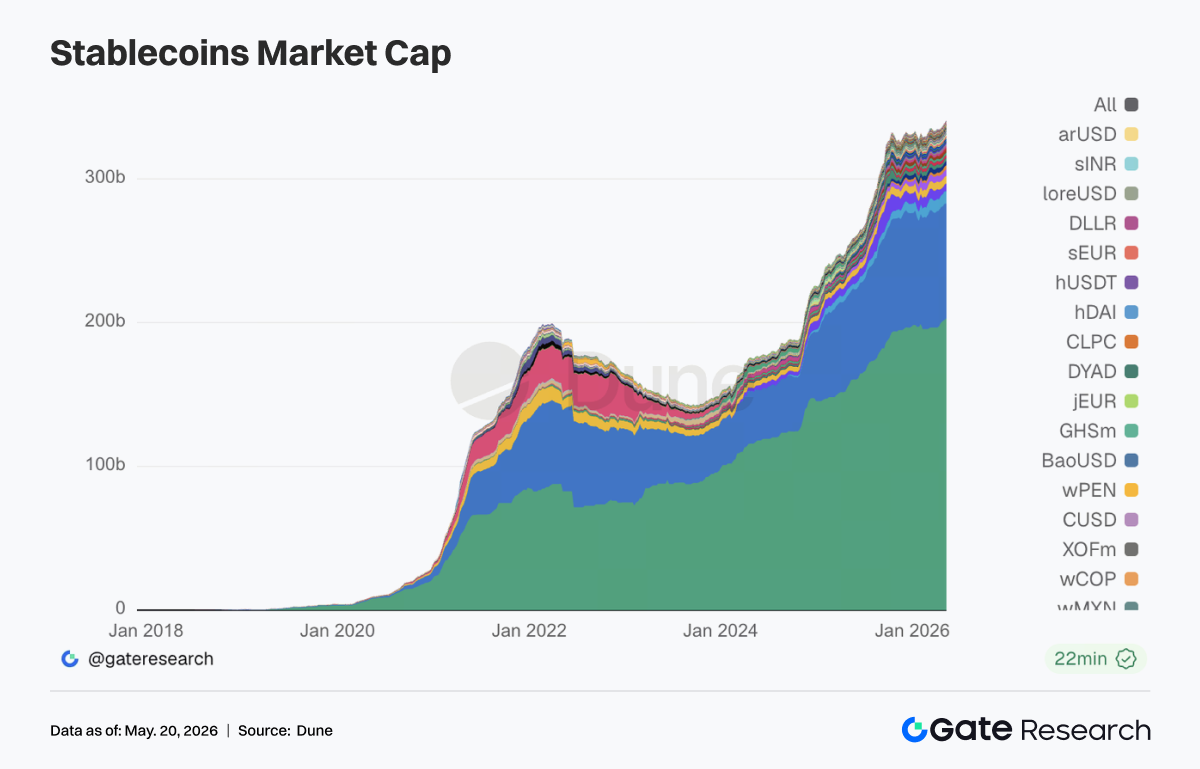
Under the premise that USDT and USDC dominate, second-tier stablecoins such as PYUSD, RLUSD, EURC, and USDG, which are closer to payment, custody compliance, and banking channels, outperformed older on-chain dollar stablecoins such as DAI in terms of stock growth. USDe expanded significantly this week, reflecting arbitrage and staking demand for yield-type and synthetic dollars in a volatile market, especially in cross-network layouts. In addition, after the implementation of the GENIUS Act, institutional capital expenditure on stablecoin infrastructure accelerated significantly. Institutions such as Bitwise publicly stated that GENIUS reduced regulatory uncertainty for stablecoin and tokenization projects, and subsequent market-structure legislation such as the Clarity Act will be a growth variable.
On the ETH side, LST protocols such as Lido, Rocket Pool, and StakeWise all recorded TVL pullbacks from mid-to-high single digits to about 10%, reflecting that staking certificates shrank in the same direction as ETH when beta moved downward. On the Solana side, high-beta LSTs such as jupSOL and Sanctum fell more deeply, as funds prioritized reducing high-volatility staking exposure when risk appetite declined. Overall, LSTs remain slow-variable tools for long-term ETH/SOL allocation, but the past week was not full-sector deleveraging; Ethereum leaders, supported by scale and liquidity, still slightly outperformed small-cap LSTs in terms of drawdown magnitude.
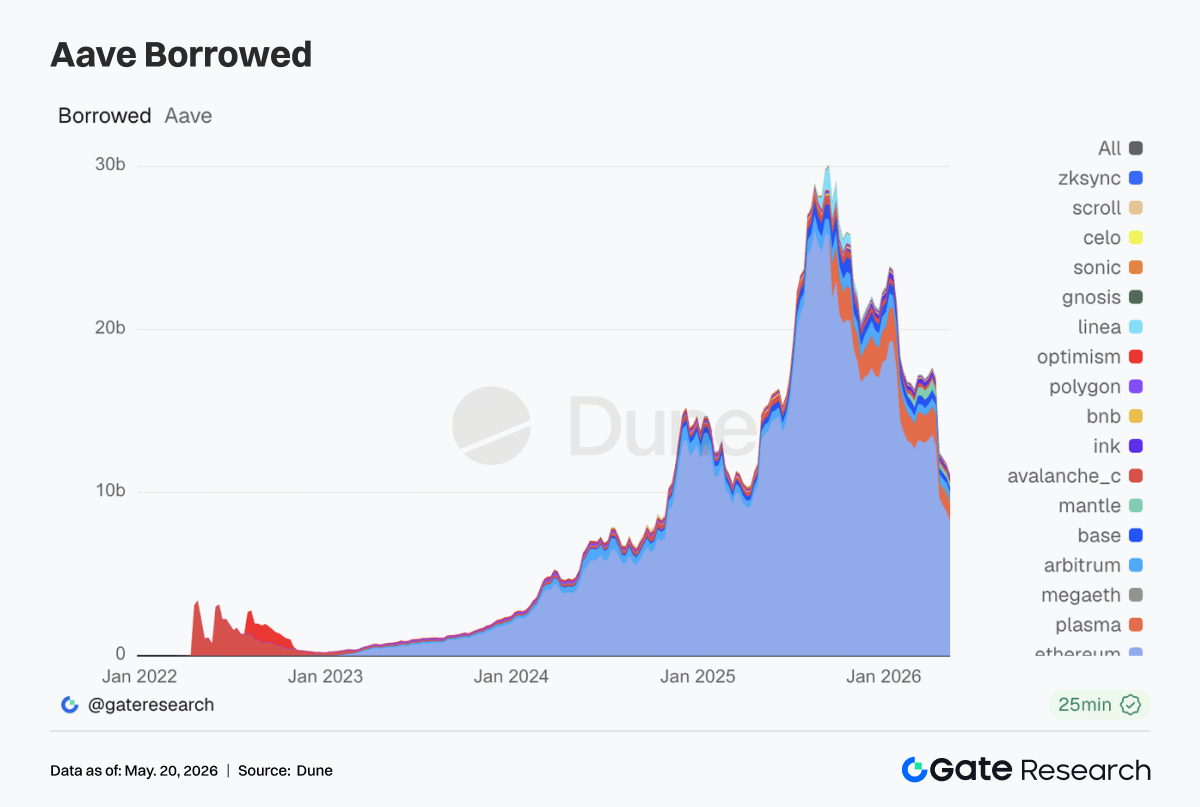
3.4 Aave Mainnet Lending Continues to Contract, Plasma / MegaETH Absorb Structural Migration
The Ethereum main market remains the absolute core, but it has contracted for the second consecutive week, indicating that after the rsETH-related risk event in April, institutions and whales remained conservative in the mainnet collateral market. At the same time, older major L2s such as Arbitrum and Ink also weakened. The relative bright spots were Plasma and MegaETH. Funds continued to migrate toward new-chain incentives and closed-loop collateral scenarios. This is consistent with the recent direction of Aave’s risk team in raising caps for new assets, with the growth engine shifting from mainnet leverage expansion to stablecoins with clearer regulatory attributes and new-chain closed loops.
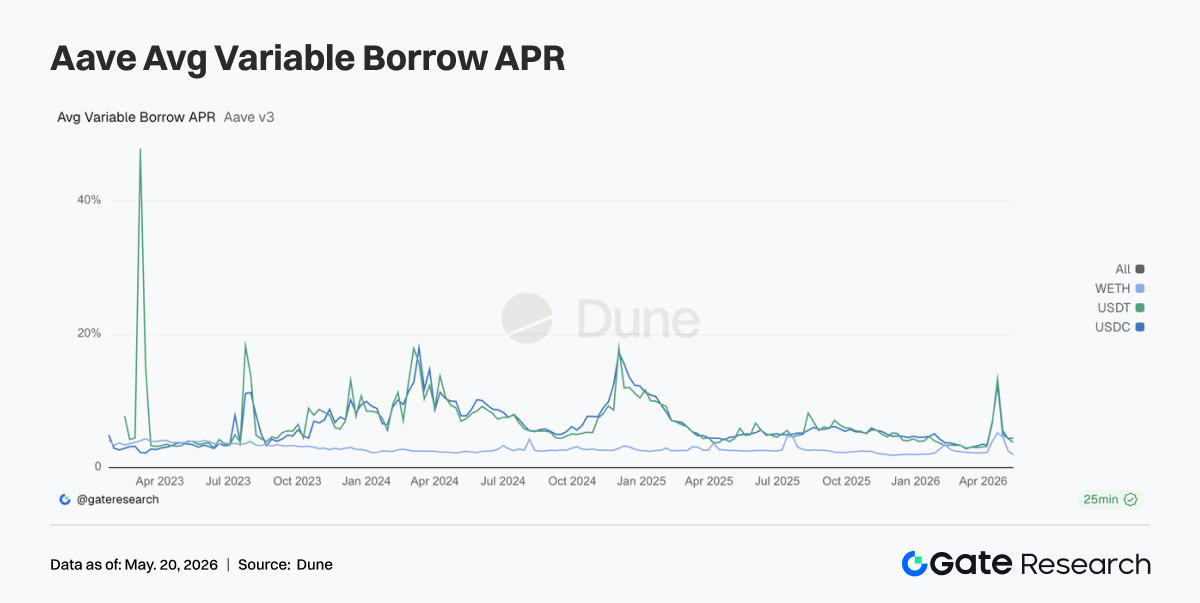
3.5 Aave Core Borrowing Rates Return to Normal, with WETH Leverage Retreating Most Clearly
Stablecoin borrowing costs returned to the mid-single-digit range, reflecting an easing of liquidity tightness and the fading of liquidation waves. WETH saw the largest decline, indicating that the rapid pullback in ETH leverage demand and the decline in mainnet lending stock confirmed each other. Market behavior shifted from rushing for liquidity and preserving positions to selectively borrowing stablecoins. On the stablecoin side, there is still support from structured arbitrage, cross-border dollar demand, and new-chain incentive mining; on the ETH side, active deleveraging is underway. This also explains why the protocol layer is more willing to raise the caps for compliant stablecoins and new-chain dollars, rather than simply stimulate WETH loop lending.
3.6 Stablecoin Issuance Is the Ballast, Hyperliquid Expands Event Contract Trading
Tether and Circle contribute the most stable cash flow, consistent with the dominant pattern of existing dollar coins. Circle is strengthening the vertical integration of issuer, settlement chain, and agent payments through Arc financing + Agent Stack. Hyperliquid revenue declined slightly MoM, but its absolute value remained in the first tier of on-chain derivatives, and it continued to expand product lines such as Bitcoin outcome markets. The market is still paying for an integrated financial stack narrative of perpetuals + prediction/outcome markets + validators/reserves. Aave’s revenue fell significantly this week compared with last week, appearing at the same time as lending stock contraction and interest-rate normalization, meaning risk premiums declined, but active borrowers also decreased.
4. Derivatives Tracking
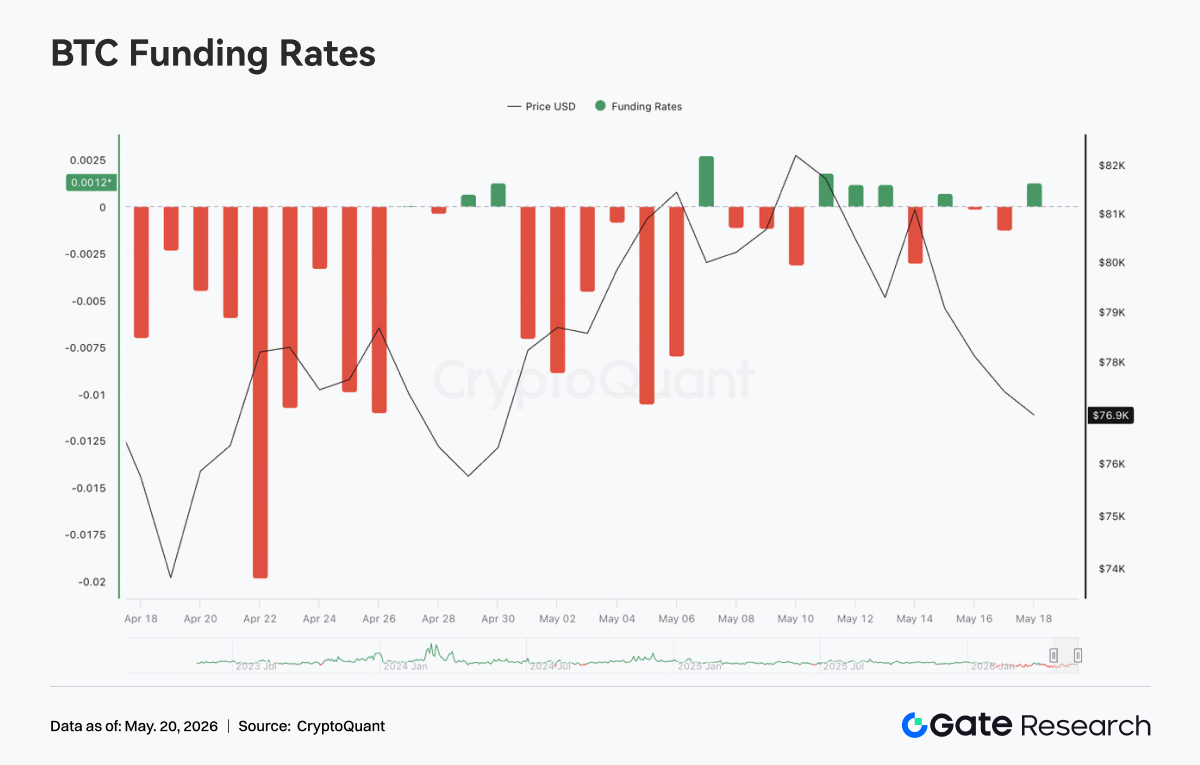
4.1 BTC Funding Rates Turn from Positive to Negative, OI Decline Shows Rising Leverage-Clearing Pressure
From May 11 to May 17, 2026, BTC prices generally showed a trend of rising and then falling. At the beginning of the week, prices still stayed near 81K, and funding rates were repeatedly in a slightly positive range from May 11 to May 13, showing that short-term bullish sentiment still continued. However, prices then failed to continue breaking higher, weakened rapidly after May 14, and fell back to around 77K on May 17, as the market shifted from high-level fluctuation to pullback adjustment. In terms of OI, the overall trend this week was downward. Around May 11, OI still remained near 26.8B, briefly rebounding above 27B on May 14, but then quickly declined and fell back to around 25.5B over the weekend. The combination of falling price and declining OI indicates that this round of decline was more accompanied by leverage position clearing, rather than simply a large-scale buildup of new shorts.
The funding-rate structure also changed significantly. Funding rates were positive at the beginning of the week, reflecting that the market still had chase-up sentiment; but as the price weakened, funding rates turned negative again from May 14 to May 17, indicating that short-term sentiment quickly shifted toward defense, while short or hedging demand rose again. Overall, this week’s BTC derivatives market gradually shifted from the previous high-level short-squeeze structure to a deleveraging state of “price pullback + OI contraction + funding rates turning negative.” If OI continues to decline later, it will show that the market is still clearing; if prices stabilize while OI rises again, attention should be paid to the formation of a new round of directional positions.
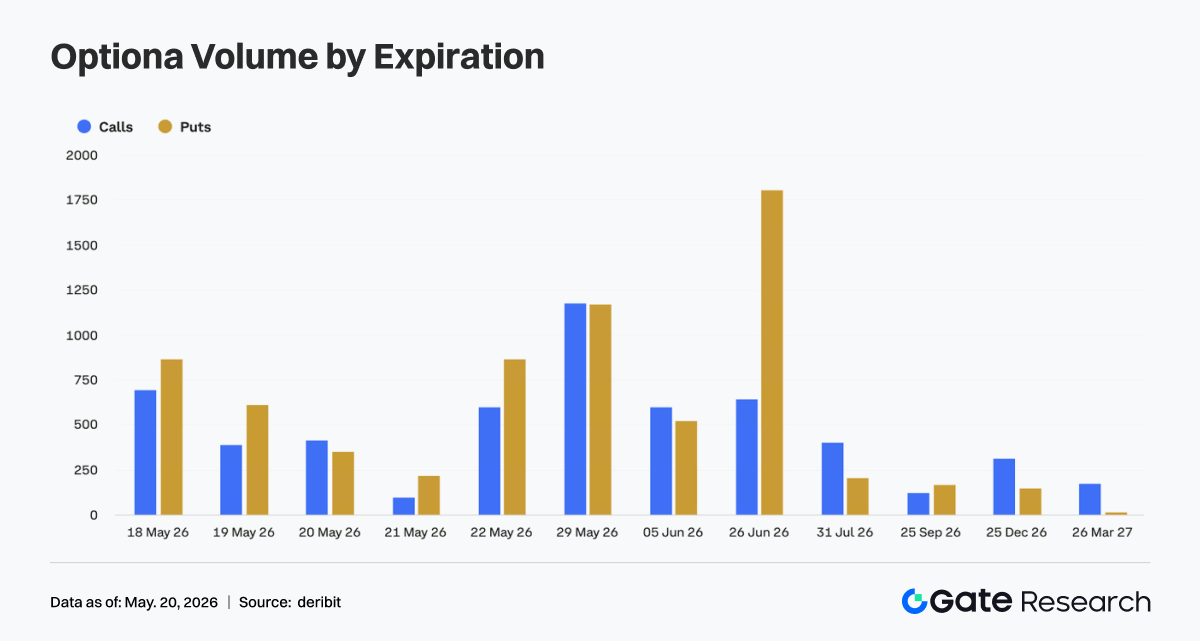
4.2 Calls and Puts Trading Is Relatively Balanced, and Term Distribution Shows Strong Monthly Protection Demand
From the structure of Calls and Puts, trading in contracts expiring on May 29 was relatively balanced between calls and puts, indicating that the market still had major divergence on the direction at month-end; while in contracts expiring on June 26, Puts trading was significantly higher than Calls, showing that medium-term protection demand had clearly strengthened. Among near-term expiries, May 18, May 19, and May 22 also showed the characteristic of Puts being slightly higher than Calls, reflecting that after the price pullback, the short-term market was more inclined to increase downside protection or hedge exposure.
Overall, although total weekly trading-volume data is lacking, the current options term structure shows that the market is not one-sidedly chasing upside, but is placing more emphasis on risk management after a high-level pullback. Monthly contracts remain the main trading vehicle, and the concentration of Puts trading in late-June contracts means that investors’ pricing of medium-term volatility and downside risk has risen.
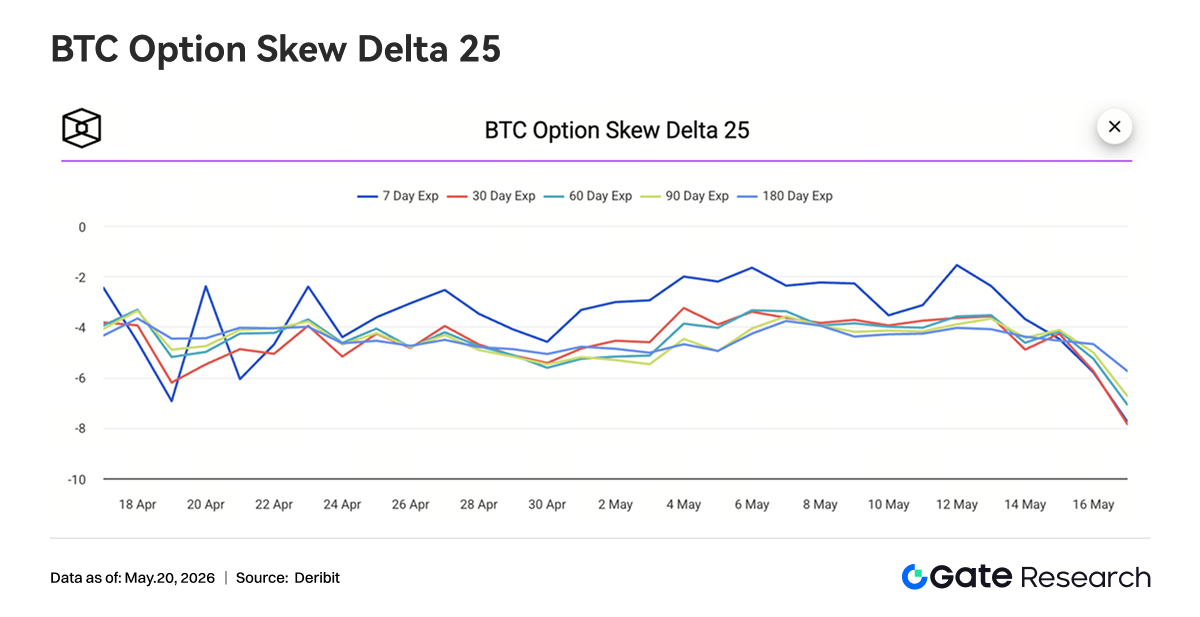
4.3 25D Skew Drops Rapidly, Protective Demand Clearly Heats Up
From May 11 to May 17, BTC 25D Skew across all tenors generally remained negative and declined notably in the second half of the week. At the beginning of the week, 7D Skew once repaired to around -1.5, and short-term protection premiums eased somewhat, indicating that the market still retained some risk appetite during the high-price stage. However, as BTC prices fell back from around 82K, Skew across all tenors weakened rapidly. From May 16 to May 17, both 7D and 30D Skew fell sharply, with short-term Skew approaching -8 and 30D Skew also falling back into a deeply negative range. 60D, 90D, and 180D Skew declined simultaneously, indicating that this round of protection demand was not concentrated purely in the short term, but spread to medium- and long-term tenors. The simultaneous weakening of Skew across different tenors reflects a clear increase in market concerns about subsequent downside volatility.
Overall, the Skew structure shifted from previous mildly negative values to deeply negative values, indicating that the options market is repricing downside risk. If BTC cannot quickly reclaim above 80K later, protective buying may continue to support Puts premiums; but if prices stabilize and rebound, short-term Skew may also repair first.
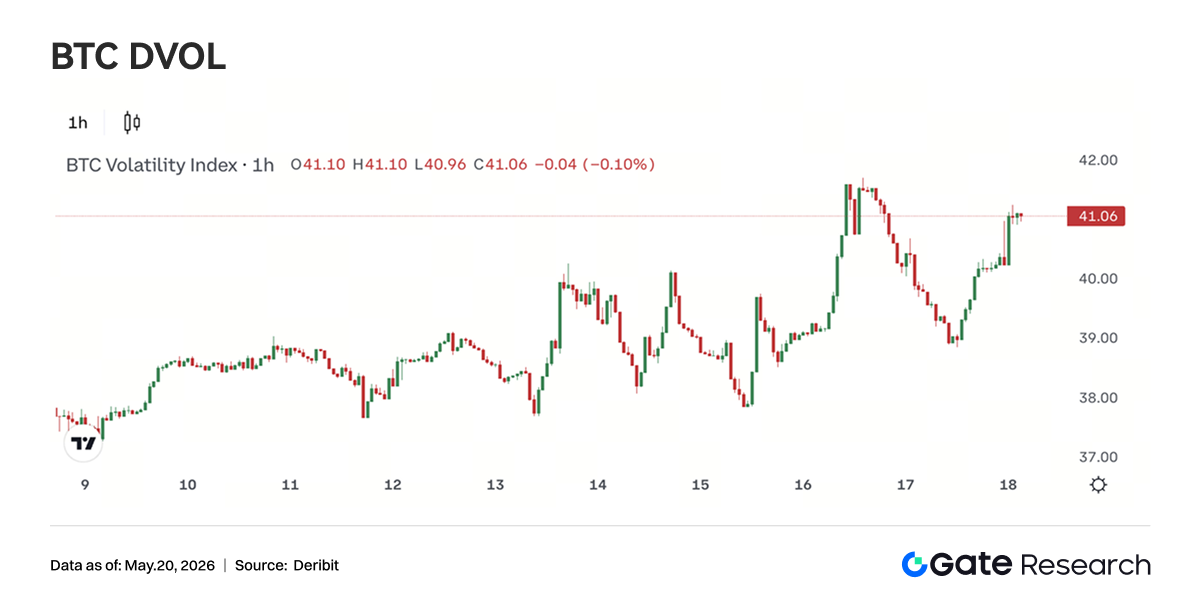
4.4 BTC Volatility Index Rises Amid Fluctuation, Price Pullback Drives Higher Volatility Expectations
Last week, the BTC volatility index (DVOL) generally showed a pattern of rising amid fluctuation. At the beginning of the week, DVOL stayed near 38, then saw its first rise from May 13 to May 14, reflecting that the market’s pricing of price volatility began to recover. Around May 16, as BTC’s high-level pullback accelerated, DVOL once surged above 41, showing that volatility expectations rose significantly during the decline.
In terms of rhythm, this week’s DVOL rise confirmed the price pullback and Skew decline. The price fell from around 82K to around 77K, funding rates turned negative, OI declined simultaneously, while the options side showed rising protection demand and higher volatility. Compared with the previous week’s structure of “high-level price fluctuation + volatility compression,” the market this week had entered a more typical risk-repricing stage.
Overall, the core characteristics of the current BTC derivatives market are: leverage position clearing, weakening funding rates, deeply negative Skew, and a rising DVOL center. In the short term, if the price continues to fall below key support, volatility still has room for further expansion; if the price stabilizes in the 77K-80K range, volatility may enter high-level fluctuation while waiting for the next directional signal.
5. Outlook
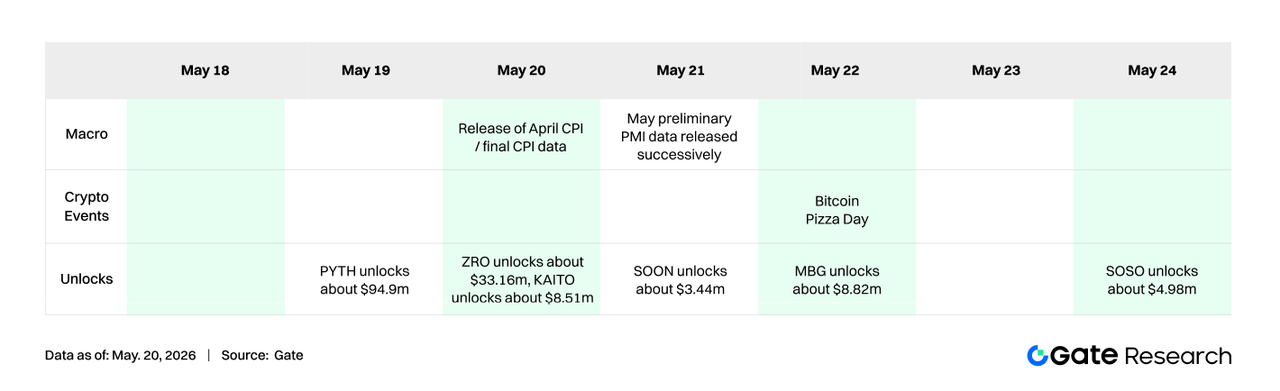
6. Gate Institutional Updates
Business Growth
- Institutional spot market share rose against the trend, increasing 10% MoM
- Client structure continued to improve, with multiple global quantitative and asset management institutions entering the integration and testing stage
Continued Expansion of Lending Business
- Cross-margin lending scale increased 10% WoW
- The new 0-interest lending plan will be launched soon, further lowering barriers and optimizing the lending experience.
Continued Upgrades to Technical Infrastructure
- Spot SBE is expected to move toward launch in June
- Continued optimization of contract push, market data latency, and trading stability
- CrossEx multi-exchange access and institutional API capabilities continued to be upgraded
Brand and Ecosystem Development
- The Institutional Circle event in Amsterdam on June 2 continues to advance, with multiple partners promoting joint brand exposure.
Sources:
-
Investing, https://investing.com/currencies/xau-usd-historical-data
-
Gate, https://www.gate.com/trade/BTC_USDT
-
CMC, https://coinmarketcap.com/real-world-assets/?type=all-tokens
-
Coinglass, https://www.coinglass.com/pro/depth-delta
-
Dune, https://dune.com/gateresearch/gate-tradfi#weekly-volume
-
Dune, https://dune.com/gateresearch/gate-institutional-weekly-report
-
Bybit, https://www.bybit.com/future-activity/en/tradfi
-
Bitget, https://www.bitgettradfi.com/tradfi/XAUUSD
-
CryptoQuant, https://cryptoquant.com/asset/btc/chart/derivatives
-
Amberdata, https://pro.amberdata.io/options/deribit/btc/current/
Gate Research is a comprehensive blockchain and cryptocurrency research platform that provides deep content for readers, including technical analysis, market insights, industry research, trend forecasting, and macroeconomic policy analysis.
Disclaimer
Investing in cryptocurrency markets involves high risk. Users are advised to conduct their own research and fully understand the nature of the assets and products before making any investment decisions. Gate is not responsible for any losses or damages arising from such decisions.