As decentralized finance continues to evolve, perpetual futures trading has become an increasingly important component of on-chain activity. Compared to simple token swaps, derivatives trading places significantly higher demands on system performance, liquidity, and risk management. This has driven a diverse range of architectural innovations among Perp DEXs.
Within this space, edgeX, Hyperliquid, and Aster represent three distinct design paths: off-chain matching with on-chain settlement, fully on-chain high-performance matching, and modular liquidity architecture. These design choices not only affect trading experience but also determine system security, scalability, and long-term potential, making them key to understanding the evolution of Perp DEXs.
Overview of edgeX, Hyperliquid, and Aster
The primary goal of a Perp DEX is to deliver a high-frequency trading experience comparable to centralized exchanges, without relying on trusted intermediaries. To achieve this, projects must balance performance, security, and decentralization.
edgeX adopts a typical “off-chain matching + on-chain settlement” model. A high-performance matching engine processes trades off-chain, while on-chain smart contracts handle custody and settlement.
Hyperliquid, in contrast, builds a dedicated high-performance Layer 1 blockchain. Its fully on-chain order book enables low-latency matching while emphasizing both decentralization and performance.
Aster leans toward a modular design, aggregating liquidity and enabling flexible market structures to support a broader range of asset types.
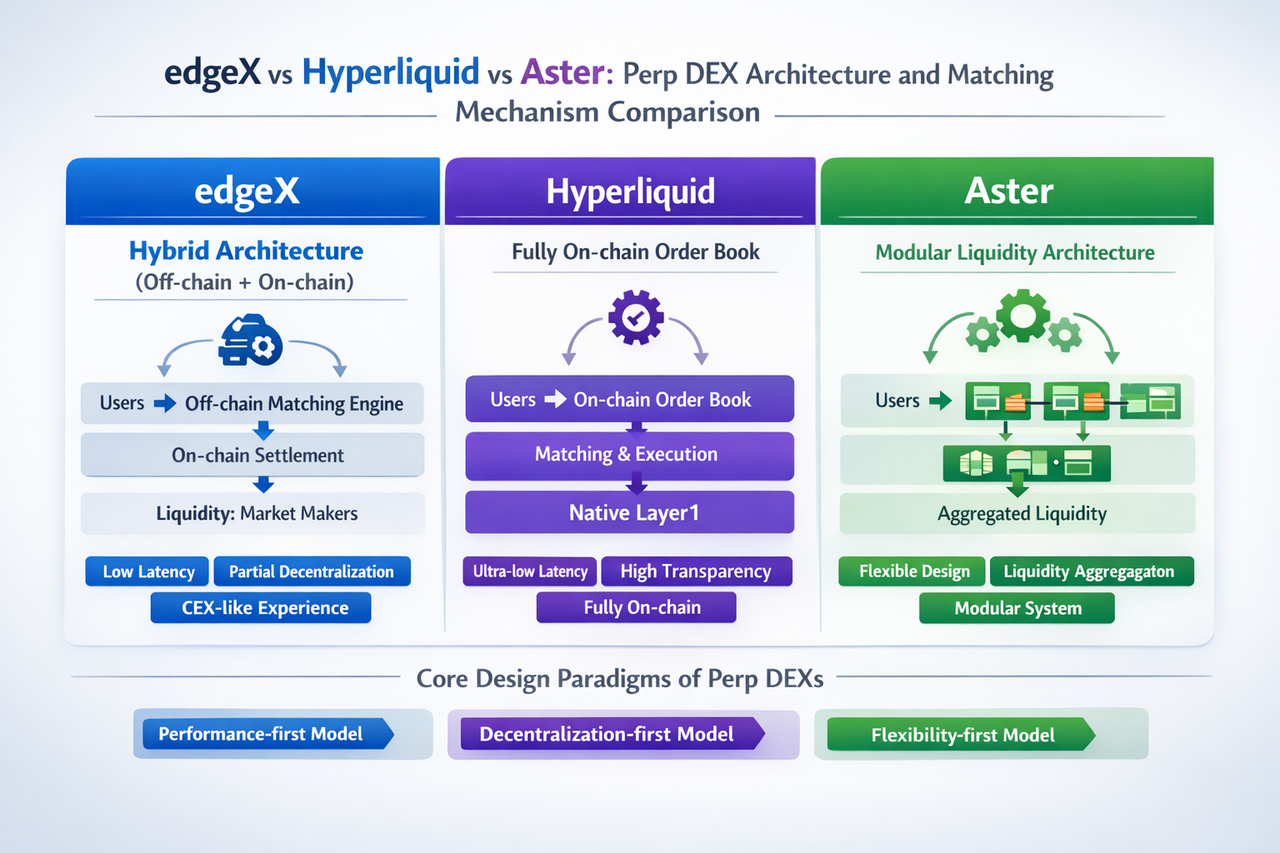
Core Differences: edgeX vs Hyperliquid vs Aster
Overall, edgeX, Hyperliquid, and Aster differ significantly in trade execution, system architecture, degree of decentralization, and liquidity sourcing.
| Dimension |
edgeX |
Hyperliquid |
Aster |
| Matching Mechanism |
Off-chain matching |
Fully on-chain order book |
Hybrid / modular |
| System Architecture |
Hybrid (off-chain + on-chain) |
Custom high-performance L1 |
Modular protocol |
| Latency |
Low |
Ultra-low |
Depends on module |
| Decentralization |
Moderate |
High |
Moderately high |
| Liquidity Source |
Market makers + users |
Native order book |
Aggregated liquidity |
| Risk Management |
CEX-like model |
Fully on-chain transparent |
Flexible strategies |
Mechanism and Architecture Comparison edgeX, Hyperliquid, and Aster
From a structural perspective, the differences across edgeX, Hyperliquid, and Aster span matching logic, system design, liquidity and price discovery, as well as risk management and liquidation mechanisms.
Matching Mechanism
The matching mechanism is one of the most fundamental distinctions among Perp DEXs.
edgeX relies on an off-chain matching engine. Orders are matched within a centralized system and then submitted on-chain for settlement. This significantly reduces latency, though it requires trust in the correctness of the matching node.
Hyperliquid places both the order book and matching engine entirely on-chain. With a high-performance blockchain design, it achieves speeds close to centralized exchanges. This approach enhances transparency but places heavy demands on the underlying infrastructure.
Aster adopts a more flexible approach, selecting different matching mechanisms depending on the market type, such as order books or AMMs, allowing it to support a wider variety of assets.
System Architecture
Each platform reflects a distinct technical strategy.
edgeX uses a hybrid architecture, keeping performance-critical components like matching off-chain, while placing fund custody and settlement on-chain to balance efficiency and security.
Hyperliquid builds a dedicated Layer 1, moving all trading logic on-chain to form a fully integrated system without external dependencies.
Aster aligns with a modular protocol design, where components such as liquidity modules and pricing modules can evolve independently, increasing system adaptability.
Liquidity and Price Discovery
Liquidity directly impacts market depth and slippage.
edgeX primarily depends on professional market makers, resembling the order book model used in traditional exchanges.
Hyperliquid enables organic price discovery through its on-chain order book, where user orders directly shape market pricing.
Aster aggregates liquidity from multiple sources, including AMMs and external markets, improving overall capital efficiency.
Risk Management and Liquidation
Risk control mechanisms are critical to system stability.
edgeX follows a model similar to centralized exchanges, with margin systems and liquidation logic, though settlement occurs on-chain.
Hyperliquid employs a fully transparent on-chain risk model, where all liquidation processes are publicly verifiable.
Aster offers greater flexibility, allowing different markets to configure parameters such as leverage limits and liquidation thresholds.
From a user experience perspective, all three platforms aim to approach centralized exchange standards, but take different paths.
edgeX provides a familiar trading interface with fast execution, making it well-suited for users accustomed to CEX environments.
Hyperliquid combines ultra-low latency with on-chain transparency, offering a balance between performance and decentralization, though it may require a higher learning curve.
Aster emphasizes diverse product experiences. Users can choose different market structures based on their needs, but this flexibility comes with added complexity.
Conclusion
edgeX, Hyperliquid, and Aster each represent a distinct evolutionary path for Perp DEXs: hybrid architecture, high-performance on-chain order books, and modular design.
Their differences in matching mechanisms, system architecture, and liquidity organization reflect broader trade-offs between performance and security in decentralized trading systems. Understanding these distinctions helps build a clearer, more systematic view of on-chain derivatives infrastructure.
FAQs
What are the core differences between edgeX, Hyperliquid, and Aster?
The main differences lie in matching mechanisms and system architecture. edgeX emphasizes off-chain matching, Hyperliquid operates fully on-chain, and Aster adopts a modular design.
Which architecture is more decentralized?
Generally, fully on-chain systems like Hyperliquid offer a higher degree of decentralization, though they also demand more advanced technical infrastructure.
Why do Perp DEXs use different matching mechanisms
Each mechanism involves trade-offs between performance, cost, and security, so projects choose based on their target users and technical approach.
Why is liquidity source important?
Liquidity determines market depth and price stability, making it a key factor in overall trading experience.
What are the advantages of modular design?
Modular design enhances flexibility, allowing protocols to adapt to different market needs and evolve over time.







