Over the past decade, most blockchain networks have relied on traditional consensus mechanisms. Bitcoin uses Proof-of-Work (PoW) for security, while Ethereum switched to Proof-of-Stake (PoS) for greater efficiency. However, neither PoW nor PoS is well-suited to meet the emerging demands of AI and verifiable computing.
Nockchain is positioned as a verifiable computing network built on ZK Proof-of-Work (ZKPoW). It attempts to replace the hash operations performed by traditional miners with Zero-Knowledge Proof generation, aligning network security with real computational workloads.
How ZK Proof-of-Work Works
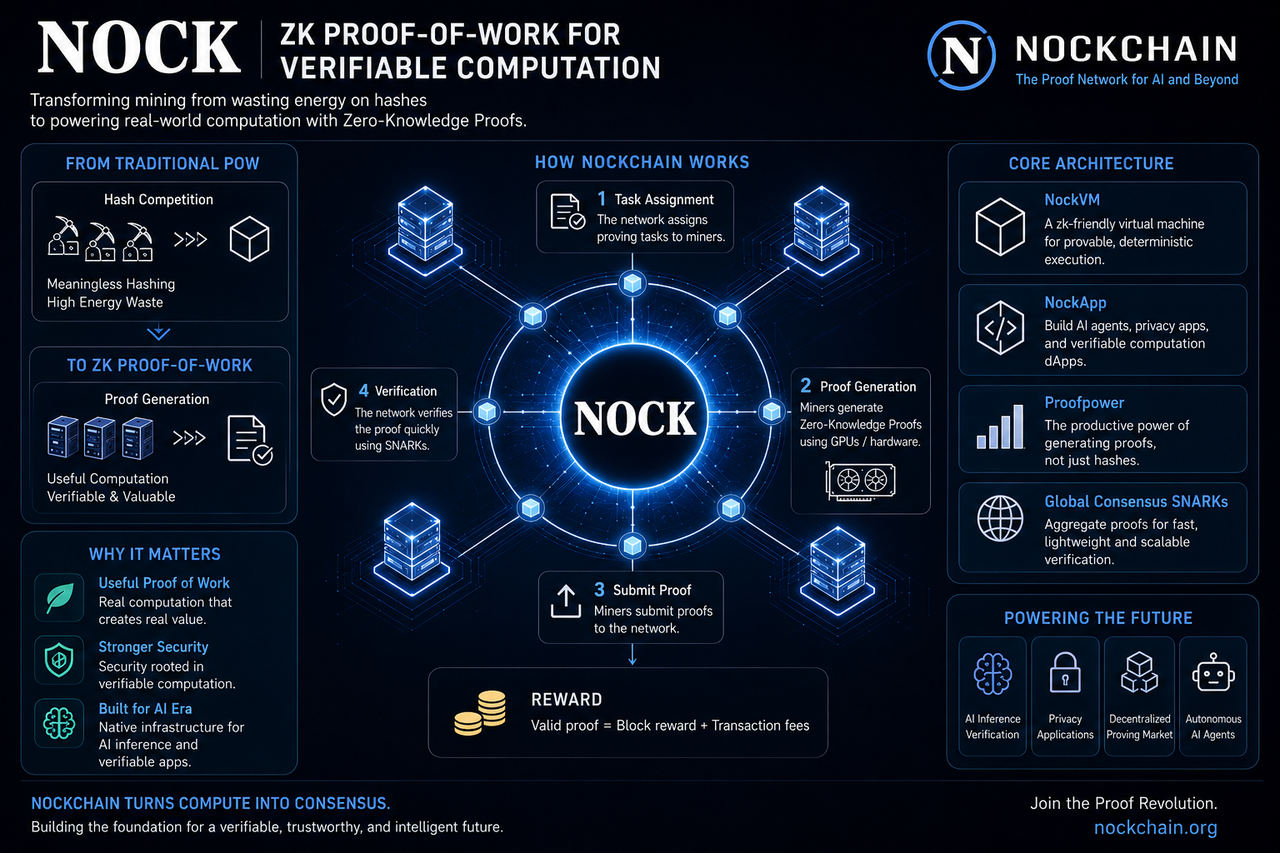
In a traditional PoW network, miners continuously perform hash operations until they find a solution meeting the network's difficulty target. In Nockchain, this process is replaced with Zero-Knowledge Proof generation.
The network assigns proving tasks to miners, who use GPUs or proving hardware to generate proofs. Once a proof is verified, the miner receives block rewards and network earnings.
This means miners no longer compete on hashpower, but on proof generation capability. Network security comes from verifiable proofs, and the actual computational power is used for real computation. That's why Nockchain is considered a key example of "Proof of Useful Work."
What Is Proofpower?
In Bitcoin, a miner's competitiveness is measured by hashpower. In Nockchain, it's measured by Proofpower.
Proofpower represents a miner's ability to generate valid Zero-Knowledge Proofs. It is influenced by GPU performance, proving speed, proof compression capability, and hardware optimization.
How NockVM Works
NockVM is the core virtual machine of Nockchain and a critical piece of infrastructure for the entire network.
Unlike traditional smart contract VMs, NockVM is not designed simply to increase TPS. Instead, it optimizes for provability. Smart contract execution on traditional blockchains is often complex and expensive to prove, whereas NockVM is built for zk-friendly computation.
Its operating logic emphasizes deterministic execution, lightweight proving, and verifiable execution, making it easier to generate Zero-Knowledge Proofs for application results. This is a key reason Nockchain can support verifiable AI and the proving economy.
How NockApp Works
NockApp is the application model running on Nockchain.
Developers can build AI agents, privacy apps, decentralized proving services, and verifiable AI applications on Nockchain. The key difference from traditional DApps is that NockApp's execution results can be verified using Zero-Knowledge Proofs.
For example, after an AI agent completes an inference task, it can generate a proof that the inference actually happened and was not tampered with. This is critical for future AI networks, as AI inference verification is becoming a major industry requirement.
What Are Global Consensus SNARKs?
To reduce verification costs, Nockchain introduces the Global Consensus SNARKs architecture.
Traditional blockchains require all nodes to re-execute computations. SNARK-based verification, on the other hand, allows a proof to be generated once and then quickly verified across the network. This reduces the on-chain computational burden and improves scalability.
As a result, Nockchain is better suited for complex computation scenarios, especially those requiring heavy verification, such as AI inference, privacy computation, and the proving market.
How Nockchain Differs from Traditional PoW
Both Nockchain and Bitcoin use PoW, but they represent different generations of blockchain models.
Bitcoin's primary goal is network security through hash competition. Nockchain's primary goal is to build a verifiable computing network through proof generation.
In Bitcoin, miners perform meaningless hash operations. In Nockchain, miners perform proving computations with real-world utility. This means blockchain hashpower starts to serve real needs like AI, ZK, and Verifiable Computation.
Challenges Facing Nockchain
While Nockchain's architecture is innovative, it faces several real-world challenges.
Zero-Knowledge Proof generation is still expensive and requires high-end GPUs and specialized hardware. Additionally, the AI proving market is still early, and actual demand remains unproven.
Nockchain also needs to build out its developer ecosystem, proving economy, and application-layer demand. Only when these elements form a complete loop can the ZKPoW model achieve sustainable long-term growth.
Summary
Nockchain is redefining how blockchain networks operate.
Through ZK Proof-of-Work (ZKPoW), Nockchain upgrades the meaningless hash operations of traditional PoW into Zero-Knowledge Proof generation with real-world utility. Miners no longer just consume energy—they actively contribute to verifiable computing and proving infrastructure.
FAQs
What Is ZKPoW?
ZKPoW (Zero-Knowledge Proof-of-Work) is a new PoW mechanism that replaces hash competition with proof generation, directing hashpower toward real computational tasks.
What Is Proofpower in Nockchain?
Proofpower refers to a miner's ability to generate valid Zero-Knowledge Proofs, similar to hashpower in traditional PoW networks.
What Does NockVM Do?
NockVM is Nockchain's core virtual machine, designed to improve proving efficiency and verifiable execution.
Why Is Nockchain Relevant to AI?
Nockchain focuses on verifiable computing and proving infrastructure, enabling verification of AI inference and AI agent execution, which is why it's considered an AI-native blockchain infrastructure.







