As a blockchain network combining PoW and PBFT architecture, Xphere requires long-term node operation and network security. To sustain this, Xphere must establish a continuous token issuance and reward system. Traditional centralized systems typically rely on platform operations for network maintenance, whereas Xphere depends on block rewards and node incentives to power the entire network.
XP tokens operate on a logic centered around block rewards, node validation, governance mechanisms, and ecosystem expansion. Xphere's economic model affects not only node profitability but also the network's data security and long-term stability.
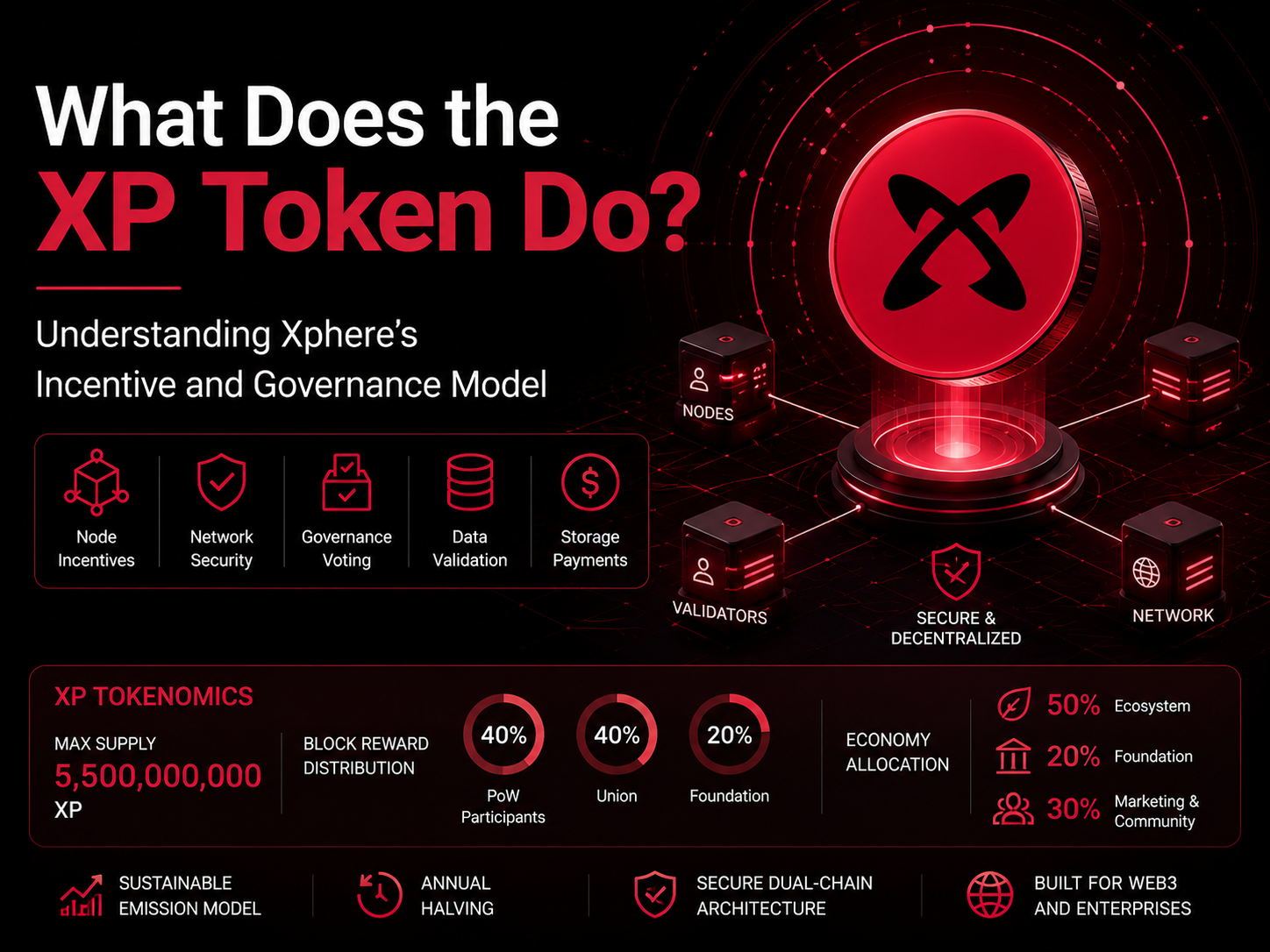
What Is XP Token
XP tokens serve as the core value coordination asset within the Xphere network. Xphere uses XP to coordinate collaboration among PoW nodes, Union nodes, the foundation, and the ecosystem.
Structurally, XP functions more like an underlying network asset than a typical utility token. It directly participates in block reward distribution, node incentives, and network governance, creating a direct link to Xphere's network security.
Block generation in the Xphere network requires multiple modules to operate in tandem. First, PoW nodes engage in block computation. Next, the Union validation structure confirms the network state. Then, the PBFT mechanism verifies transaction consistency. Finally, the system confirms the new block and distributes XP rewards.
This mechanism means XP tokens not only facilitate payments but also cover network operational costs and security incentives. If nodes stop participating in validation, overall network security could be compromised.
According to the official whitepaper, XP tokens are also allocated for ecosystem development, foundation operations, and community expansion. Thus, XP is a core resource for the long-term growth of the Xphere network.
Core Functions of XP in the Xphere Network
XP tokens primarily serve node rewards, network governance, ecosystem expansion, and data validation. These modules collectively influence Xphere's operational efficiency.
Xphere network nodes require XP to obtain long-term operational incentives. First, PoW nodes contribute to block generation. The system then confirms node contributions. Next, the Union validation layer synchronizes the network state. Finally, block rewards are distributed according to predefined rules.
The table below outlines the main functions of XP tokens in the Xphere network:
| Function Module |
Primary Role |
| Block Rewards |
Incentivize node operation |
| Network Governance |
Adjust protocol parameters |
| Data Validation |
Maintain network security |
| Ecosystem Development |
Support network expansion |
| Community Incentives |
Drive user growth |
The design focus of XP tokens is to sustain long-term, decentralized network collaboration. Unlike traditional systems, decentralized blockchain networks cannot rely on a single server, so Xphere must use its economic model to coordinate relationships among different nodes.
Unlike traditional internet systems, node revenue in Xphere is directly tied to network contribution. Nodes that actively participate in block generation and validation continuously earn XP rewards.
Why Nodes Need XP Incentives
The XP incentive mechanism is a critical component of Xphere's network security model. Blockchain networks require nodes to remain online continuously, making node incentives essential for system stability.
Xphere network nodes must engage in long-term block validation and data synchronization, necessitating a sustained reward structure. First, PoW nodes handle block computation. Then, the PBFT structure confirms transaction status. Next, Union nodes synchronize network results. Finally, the system distributes XP rewards to participants.
This mechanism means XP incentives affect not only node profitability but also overall network security. Without long-term rewards, the blockchain network might suffer from reduced validation capacity.
Structurally, the XP incentive mechanism simultaneously handles resource coordination and network security. Xphere uses block rewards to boost node participation and maintain distributed validation capabilities.
Xphere's dual-layer architecture also mitigates single points of failure. When PoW and PBFT operate together, the system's fault tolerance improves significantly.
How XP Participates in Network Governance
XP tokens influence governance voting and protocol upgrades in the Xphere network. Since blockchain networks need ongoing parameter adjustments, governance is a key component of Xphere.
XP holders can engage in the network governance process. First, the community proposes protocol modifications. Then, XP holders vote on these proposals. The system tallies the results, and approved proposals proceed to network execution.
Xphere's governance scope typically includes block parameters, reward ratios, and ecosystem rules. Different governance outcomes can affect network security, node revenue, and protocol expansion direction.
This mechanism means XP carries both economic value and governance rights. Higher XP holdings generally result in greater influence over network decisions.
Unlike traditional centralized platforms, Xphere's governance model prioritizes network collaboration. To maintain fairness among nodes, governance rights are not concentrated in a single entity.
How Xphere's Reward and Validation Mechanism Works
Xphere's reward and validation mechanism revolves around PoW, PBFT, and Union structures. These modules collectively determine network consistency and data security.
The block reward process in the Xphere network requires collaboration among multiple nodes. First, PoW nodes generate blocks. Then, the PBFT structure validates transaction validity. Next, the Union validation layer synchronizes the network state. Finally, the system distributes XP rewards according to set rules.
According to the official whitepaper, Xphere's block reward distribution is as follows:
| Block Reward Allocation |
Percentage |
| PoW Participants |
40% |
| Union |
40% |
| Foundation |
20% |
This structure emphasizes node collaboration and long-term ecosystem sustainability. When both PoW nodes and Union nodes receive rewards, the network maintains a more stable validation framework.
Xphere's validation mechanism also enhances network consistency. The PBFT architecture confirms transaction status, reducing the risk of faulty data entering the blockchain.
XP Token Supply and Economic Model Design
According to the official whitepaper, the maximum supply of XP tokens is 5.5 billion. Xphere's economic model is closer to an underlying blockchain issuance model than a traditional fundraising token distribution.
The focus of Xphere's economic model is long-term network operation and ecosystem growth. To continuously attract node participation, XP enters market circulation gradually through block rewards.
Official documentation reveals the XP allocation structure as follows:
| Allocation Direction |
Percentage |
| Ecosystem Development |
50% |
| Foundation |
20% |
| Market & Community |
30% |
The economic model also includes an annual reduction mechanism. Block rewards decrease over time, slowing the new issuance rate of XP.
This structure emphasizes long-term network stability. The reduction mechanism reduces the rate of new supply in later stages and increases the scarcity of network resources.
The official whitepaper also notes that XP issuance is directly tied to network operational status. Thus, Xphere's economic model fundamentally depends on the continuous operation of the blockchain network.
Main Use Cases of XP Tokens
XP tokens are primarily used for node rewards, network governance, block validation, and ecosystem collaboration. Various on-chain services interact with XP.
Block validation is a key use case. First, PoW nodes generate blocks. Then, the PBFT structure validates transaction status. Next, the Union layer synchronizes results. Finally, the system distributes XP rewards.
Xphere's ecosystem expansion also relies on XP coordination. Community activities, node expansion, and network development are built around the XP incentive model.
XP tokens can also be used for governance voting and protocol upgrades. XP holders can influence network rule changes, positioning XP as a vital part of Xphere's governance system.
Unlike traditional internet platforms, Xphere emphasizes on-chain network collaboration. XP tokens are involved in block generation, node operation, and governance processes, making Xphere's efficiency directly linked to its token model.
Summary
XP tokens are the core functional asset in the Xphere blockchain network, responsible for node incentives, block rewards, network governance, and data validation. Xphere uses XP to coordinate PoW nodes, Union structures, and ecosystem operations.
Xphere's economic model revolves around block rewards, continuous issuance, and annual reductions. PoW, PBFT, and Union structures jointly participate in network validation, making XP's operational logic similar to an underlying blockchain issuance system.
From a structural perspective, XP is more than just a payment medium. It also serves as the backbone for security coordination, governance collaboration, and long-term ecosystem expansion within the Xphere network.
FAQ
What is the role of XP tokens?
XP tokens are primarily used for block rewards, node incentives, governance voting, and data validation in the Xphere network. XP directly influences the operational mechanism of the Xphere network.
What is the maximum supply of XP in Xphere?
According to the official whitepaper, the maximum supply of XP tokens is 5,500,000,000.
How are block rewards distributed in Xphere?
Official documentation indicates that block rewards are allocated to PoW participants, the Union structure, and the foundation, with PoW and Union each receiving 40%.
Why does Xphere need an annual reduction mechanism?
The annual reduction mechanism is designed to slow the rate of new issuance and maintain long-term economic stability. As block rewards gradually decrease, the new supply of XP also diminishes.
How does XP participate in Xphere governance?
XP holders can participate in network governance, including adjusting protocol parameters, modifying reward mechanisms, and updating ecosystem rules.







