In the era of traditional social media, user-generated data, social relationships, and content assets are often heavily monopolized by centralized platforms such as Meta and X. This has led to systemic problems including privacy leaks, opaque algorithms, and content censorship.
As blockchain technology has developed, users have become increasingly aware of the need for data ownership and privacy protection. Yet moving hundreds of millions of users who are accustomed to the Web2 experience onto entirely new Web3 social protocols remains an extremely high barrier.
Mask Network addresses the pain points of data monopoly and privacy leakage in traditional social media. Instead of requiring users to migrate their social relationships, it gives them data autonomy while preserving their existing habits.
What Is Mask Network?
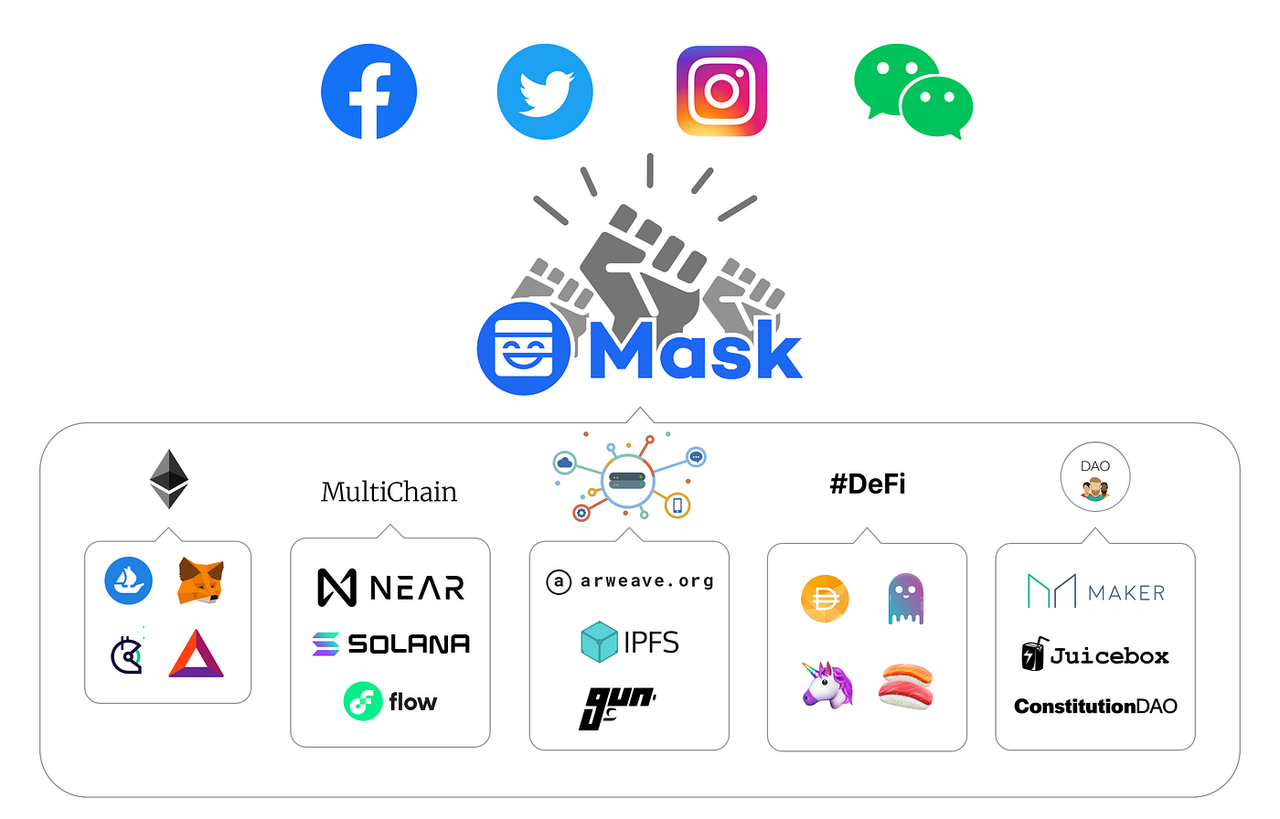
Mask Network is a decentralized privacy layer that runs on existing internet social platforms, such as Twitter and Facebook. Through its open-source browser extension, it aims to enable encrypted communication, cross-border asset transfers, and seamless access to decentralized applications, or DApps.
With its distinctive role as middleware, Mask Network adds a layer of decentralized functionality directly onto mainstream social media without changing how users already interact socially. This strategy gives it a critical position as an ecosystem gateway in the blockchain industry, making it a core hub connecting traditional internet traffic with decentralized finance, or DeFi, decentralized identity, or DID, and non-fungible tokens, or NFTs.
How Mask Network Works: Encryption Technology and Plugin-Based Architecture
Mask Network’s core technical logic lies in the integration of end-to-end encryption and decentralized identity, or DID. It is not a new social platform, but an application layer that runs on top of existing platforms.
After a user installs the Mask browser extension, the system generates an asymmetric key pair that complies with Web3 standards. When the user publishes an encrypted message, Mask processes the content locally through an asymmetric encryption algorithm and posts the encrypted hexadecimal string to the social platform. Only authorized recipients, whose public keys have been included in the decryption permissions, can use the Mask extension to automatically detect and restore the original text, image, or file.
This architecture ensures that the social media platform in the middle can only see a meaningless string of garbled characters, enabling truly private communication. In addition, Mask integrates decentralized storage protocols such as IPFS and Arweave, ensuring that shared content is not only encrypted, but also censorship-resistant and capable of long-term preservation.
Mask Network’s Core Features: From Encrypted Posting to Decentralized Finance
Mask Network simplifies complex blockchain operations into native components within social media. Its core features now span social interaction, finance, asset management, and more.
-
Encrypted Communication and File Sharing: This is Mask’s foundational function. Users can set specific decryption conditions, such as allowing only followers, holders of a specific token, or selected friends to view the content they publish.
-
Initial Twitter Offering (ITO): ITO is one of Mask Network’s signature innovations. It allows project teams to distribute tokens directly on Twitter. Users do not need to visit an external trading website. They can simply click the participation button in a tweet and complete the subscription through their connected wallet.
-
Social Finance Integration: Through integrations with protocols such as Uniswap and SushiSwap, users can view cryptocurrency price trends directly in the social interface and complete token swaps with one click.
-
NFT Profiles and Avatars: Mask allows users to set NFTs they own as social media avatars and verify ownership of those digital assets onchain through the extension.
MASK Token Economics and Governance Mechanism
The MASK token is the core governance tool of the entire network, designed to support the decentralized operation of the ecosystem through economic incentives.
The main uses of the MASK token include:
-
MaskDAO Governance: Each MASK represents voting power over future protocol decisions. Holders can vote on the use of treasury funds, feature development roadmaps, and ecosystem investment projects.
-
Ecosystem Incentives: The network distributes MASK to active participants through various activities, such as node rewards and community airdrops, to encourage user growth.
-
Service Enhancement: In the future, MASK may be used as a payment or staking medium for certain advanced features or specific ecosystem applications.
Unlike native underlying protocols such as Lens Protocol, Mask Network places greater emphasis on compatibility with existing assets. This makes the value of the MASK token closely tied to how efficiently Web2 traffic can be converted into Web3 participation.
Mask Network’s Advantages and Limitations
Mask Network’s Advantages:
-
Zero Migration Cost: Users can access blockchain features within their existing social circles without learning complex Web3 social protocols.
-
Enhanced Privacy: It provides strong end-to-end encryption protection in highly restricted social environments.
-
Cross-Chain Compatibility: It supports several major public chains, including Ethereum, Polygon, and Arbitrum.
Mask Network’s Limitations:
-
Platform Dependence: Although Mask is committed to decentralization, its carriers, Twitter and Facebook, are still centralized. There is a risk that the extension could be blocked or restricted by the platform side.
-
Mobile Experience: Compared with the desktop browser extension, the mobile app still needs further improvement in feature integration and interaction with third-party applications.
Conclusion
Mask Network represents a gradual approach to decentralization. Rather than trying to acquire users by disrupting social media giants, it enhances existing platforms and returns Web3 rights to users. Through the organic combination of encrypted communication, financial tools, and a governance token, Mask is building a comprehensive decentralized gateway that goes beyond social interaction to include privacy protection and asset circulation. As the Web3 social ecosystem matures, Mask Network’s position as an entry-level middleware will become increasingly solid.
FAQs
No. Mask Network is a decentralized privacy protocol and browser extension. It runs on top of existing social platforms, such as Twitter and Facebook, and adds Web3 functionality to them.
Does it cost money to use Mask Network?
Installing and using Mask Network’s basic features, such as encrypted communication and NFT viewing, is free. However, when making onchain asset transactions or participating in an ITO, users need to pay the Gas fees required by the relevant blockchain network.
What is the practical use of the MASK token?
MASK is primarily a governance token used to participate in MaskDAO decision-making. It also serves as an incentive tool within the ecosystem and is used to recognize and reward community members who contribute to the network’s development.
Is Mask Network safe?
Mask Network is an open-source protocol, and its code has undergone multiple security audits. In addition, Mask uses a local private key storage model. Users’ sensitive information is not uploaded to any centralized server, and security is supported by the user’s local device and the underlying blockchain.
What is ITO? How is it different from ICO?
ITO, or Initial Twitter Offering, specifically refers to token issuance conducted on the social platform Twitter. Compared with a traditional ICO, ITO has stronger social attributes, allowing users to interact directly within a social setting and lowering the barrier to participation.