Traditional internet storage typically relies on centralized servers for data management, making data security, control, and access stability subject to the influence of a single entity. Decentralized storage networks, by contrast, store data across distributed nodes, reducing the risks of single points of failure and data tampering.
Xphere's design focuses on coordinating node storage behavior through a blockchain network and establishing a data verification mechanism. According to official documentation, Xphere also addresses enterprise-grade data services, Web3 application support, and distributed node collaboration capabilities.
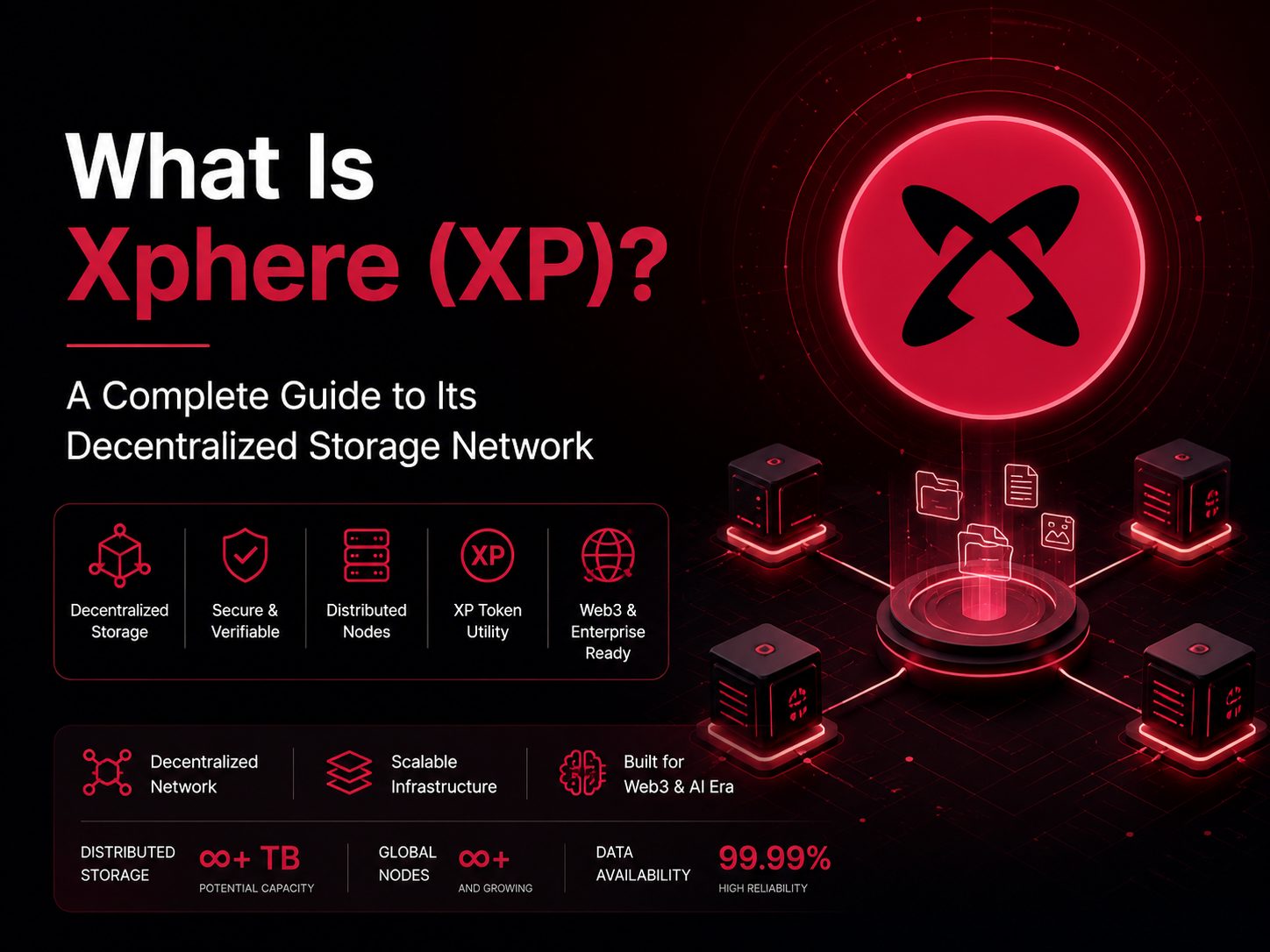
What Is Xphere
Structurally, Xphere is closer to a decentralized data network than a traditional file hosting platform. Its core focus is on completing data storage, verification, and distribution through node collaboration.
Data in the Xphere network is not centrally stored on a single server. Different nodes assume the tasks of data storage, state verification, and data synchronization, so Xphere emphasizes a distributed architecture.
Xphere's operational logic revolves around data writing, node storage, and verification mechanisms. First, a user submits a data storage request. Nodes then shard and save the data. Next, the Xphere network verifies the data state. Finally, users can access the data content through on-chain verification.
This mechanism means Xphere can reduce the risks of centralized data hosting. When multiple nodes jointly store data, a single server failure does not directly affect overall network operations.
How Does Xphere's Blockchain Architecture Work
Xphere's blockchain architecture is primarily used to coordinate node behavior and verify data state. Since a decentralized storage network requires continuous confirmation of data validity, Xphere must establish an on-chain verification framework.
Xphere's core architecture typically includes several main modules:
- Data Storage Layer
- Node Verification Layer
- Blockchain Consensus Layer
- Data Access Layer
These modules collectively influence Xphere's network stability. First, users upload data content. Storage nodes then receive and save the data. Next, verification nodes check the data state and integrity. Finally, the blockchain network records the verification results.
Xphere's architectural emphasis lies in making data state verifiable. Traditional storage platforms usually rely on the platform internally to manage data, while Xphere publicly verifies storage status through on-chain mechanisms.
Xphere's blockchain structure also supports multi-node collaboration. When different nodes participate together in network operation, data reliability and system fault tolerance are further enhanced.
The Role of the XP Token in the Xphere Network
The XP token serves incentive and governance functions within the Xphere network. Xphere uses XP to coordinate node behavior and sustain the operation of the decentralized storage network.
Nodes in the Xphere network typically need to acquire XP to qualify for storage and verification. First, a node submits a request to join the network. The system then verifies the node's status and resource capabilities. Next, the node can participate in data storage tasks. Finally, the node receives XP rewards based on its contribution.
The following table shows the main roles of the XP token in the Xphere network:
| Function Module |
Main Role |
| Node Incentives |
Increase storage participation |
| Data Verification |
Maintain network security |
| Governance Voting |
Adjust protocol parameters |
| Service Payment |
Pay storage fees |
| Ecosystem Collaboration |
Support network expansion |
The design emphasis of the XP token is to coordinate distributed nodes through an economic model. Since a decentralized storage network cannot rely on a single management entity, Xphere especially needs token incentives to sustain long-term node operation.
Unlike traditional cloud storage services, Xphere's node earnings are directly linked to the quality of data service. When nodes provide stable storage services, they can continuously earn XP incentives.
How Does Xphere Achieve Decentralized Data Storage
Xphere's data storage mechanism relies on distributed node collaboration. Different nodes jointly undertake data preservation and state verification tasks.
Xphere's data processing flow typically includes multiple stages. First, users upload files or data content. The Xphere network then performs sharding on the data. Next, multiple storage nodes each save different data fragments. Finally, verification nodes confirm the data state and synchronize on-chain records.
This mechanism means Xphere does not store complete data centrally on a single server. After data is split, even if some nodes go offline, users can still recover the data content.
Xphere's storage model also reduces risks of data tampering. Verification nodes continuously check the data state, so nodes cannot arbitrarily modify verified content.
Unlike traditional centralized storage, Xphere emphasizes decentralization of data control. Users can confirm whether data truly exists through on-chain verification mechanisms.
Xphere's Node Mechanism and Verification Process
Xphere's node system is primarily used to maintain network stability and verify data validity. A decentralized storage network needs continuous confirmation of node behavior, so the verification process directly affects system security.
Nodes in the Xphere network are typically divided into storage nodes and verification nodes. Storage nodes are responsible for saving data, while verification nodes are responsible for checking data integrity and network status.
Xphere's verification process revolves around data checks. First, the verification node reads the on-chain state. Then, the verification node checks the data state of the storage node. Next, the Xphere network aggregates the verification results. Finally, the verification state is recorded on the blockchain network.
This mechanism means Xphere can reduce risks of false storage. If a node cannot provide valid data, the verification system will detect the abnormal state.
Xphere's node structure also improves network fault tolerance. When multiple nodes participate together in verification, a single node failure does not directly affect overall data availability.
How Is Xphere Different From Traditional Public Blockchains
The main difference between Xphere and traditional public blockchains lies in their network focus and data processing direction.
Traditional public blockchains typically focus more on transaction processing, smart contract execution, and on-chain asset transfers, while Xphere emphasizes decentralized data storage and data verification capabilities.
Xphere's network structure prioritizes data state and storage verification. First, nodes confirm whether data exists. Then, the network verifies data integrity. Next, the system synchronizes verification results. Finally, on-chain records update the data state.
The focus of traditional public blockchains is more on transaction confirmation speed and block generation efficiency. Competition among different public blockchains usually centers on performance and scalability.
This difference means Xphere is more suitable for data storage scenarios, while traditional public blockchains are more suitable for financial transactions and smart contract scenarios. Although both networks rely on blockchain architecture, their service directions are different.
Applications of Xphere in Web3 and Enterprise Scenarios
Xphere's main application scenarios center on Web3 data services, enterprise-grade storage, and on-chain identity systems.
Web3 applications typically require reliable data preservation capabilities. NFT data, on-chain identity profiles, and decentralized application files all need long-term stable storage. Therefore, Xphere can become part of the Web3 data infrastructure.
Enterprise scenarios also require distributed storage capabilities. Some enterprises want to reduce reliance on centralized servers, so decentralized storage networks become a new data management solution.
Xphere's operational structure also supports on-chain verification scenarios. First, an enterprise submits a data storage request. Nodes then save and verify the data. Next, the blockchain network records the verification status. Finally, the enterprise can confirm data authenticity through on-chain methods.
Xphere also has application value in decentralized identity systems. Identity information needs long-term storage and verification, and a distributed storage network can improve data security and verifiability.
Advantages and Potential Limitations of Xphere
Xphere's core advantage lies in distributed data storage and on-chain verification capabilities. When multiple nodes jointly participate in data management, the system can reduce the risk of single points of failure.
Xphere's blockchain structure also improves data trustworthiness. Nodes must continuously undergo verification, making data state more transparent.
Xphere's network design also helps enhance data control. Compared to traditional centralized platforms, users can more directly verify data state and storage results.
However, decentralized storage networks also have certain limitations. Insufficient node numbers, reduced data synchronization efficiency, or limited network scalability can all affect Xphere's operational efficiency.
Xphere also needs to face competition from traditional cloud services and other decentralized storage protocols. Network scale, developer ecosystem, and node activity all affect Xphere's long-term scalability.
Conclusion
Xphere is a decentralized storage network based on blockchain architecture, primarily providing distributed data storage, node verification, and Web3 data service capabilities.
Xphere's operational logic revolves around data storage, node verification, and on-chain state synchronization. The XP token undertakes network incentives, governance, and service payment functions.
From an overall positioning perspective, Xphere is closer to a Web3 data infrastructure. As on-chain applications continue to expand, the importance of decentralized storage networks will also increase.
FAQ
What is Xphere?
Xphere is a decentralized storage network primarily providing distributed data storage, node verification, and Web3 data service capabilities. Xphere coordinates node behavior through a blockchain network and verifies data state.
What does the XP token do?
The XP token is mainly used for node incentives, governance voting, data verification, and storage service payments within the Xphere network. XP directly affects Xphere's network operation mechanism.
How does Xphere achieve decentralized storage?
Xphere splits data and distributes it to multiple nodes for storage. Verification nodes continuously check the data state, thereby ensuring data integrity and accessibility.
What is the difference between Xphere and traditional cloud storage?
Traditional cloud storage typically relies on centralized servers for data management, while Xphere stores and verifies data through distributed nodes, making data control more decentralized.
What are the application scenarios of Xphere?
Xphere is primarily used in Web3 data services, NFT data preservation, enterprise-grade storage, on-chain identity systems, and decentralized application file management.







