This article delves into the investment comparison between Brightpool Finance (BRI) and Arbitrum (ARB), two significant players in the cryptocurrency landscape. The content explores historical price trends, current market status, regulatory environments, and risk factors to determine their potential as investment options. It analyzes the economic and technological benefits of each approach, considering factors like AI-driven DeFi and Ethereum scaling solutions. The article aims to assist investors in forming strategies based on their risk appetite and investment goals, providing insights into the pros and cons of investing in either BRI or ARB.
Introduction: BRI vs ARB Investment Comparison
In the cryptocurrency market, the comparison between Brightpool Finance (BRI) and Arbitrum (ARB) remains a topic of interest for investors. The two not only differ significantly in market cap ranking, use cases, and price performance but also represent different positions in the crypto asset landscape.
Brightpool Finance (BRI): Launched as an AI-driven DeFi platform, it has gained recognition for its innovative approach to token minting and rewards distribution.
Arbitrum (ARB): Introduced as an Ethereum scaling solution, it has been hailed for enabling high-throughput, low-cost smart contracts while maintaining security.
This article will provide a comprehensive analysis of the investment value comparison between BRI and ARB, focusing on historical price trends, supply mechanisms, institutional adoption, technological ecosystems, and future predictions, attempting to answer the question investors care about most:
"Which is the better buy right now?"
I. Price History Comparison and Current Market Status
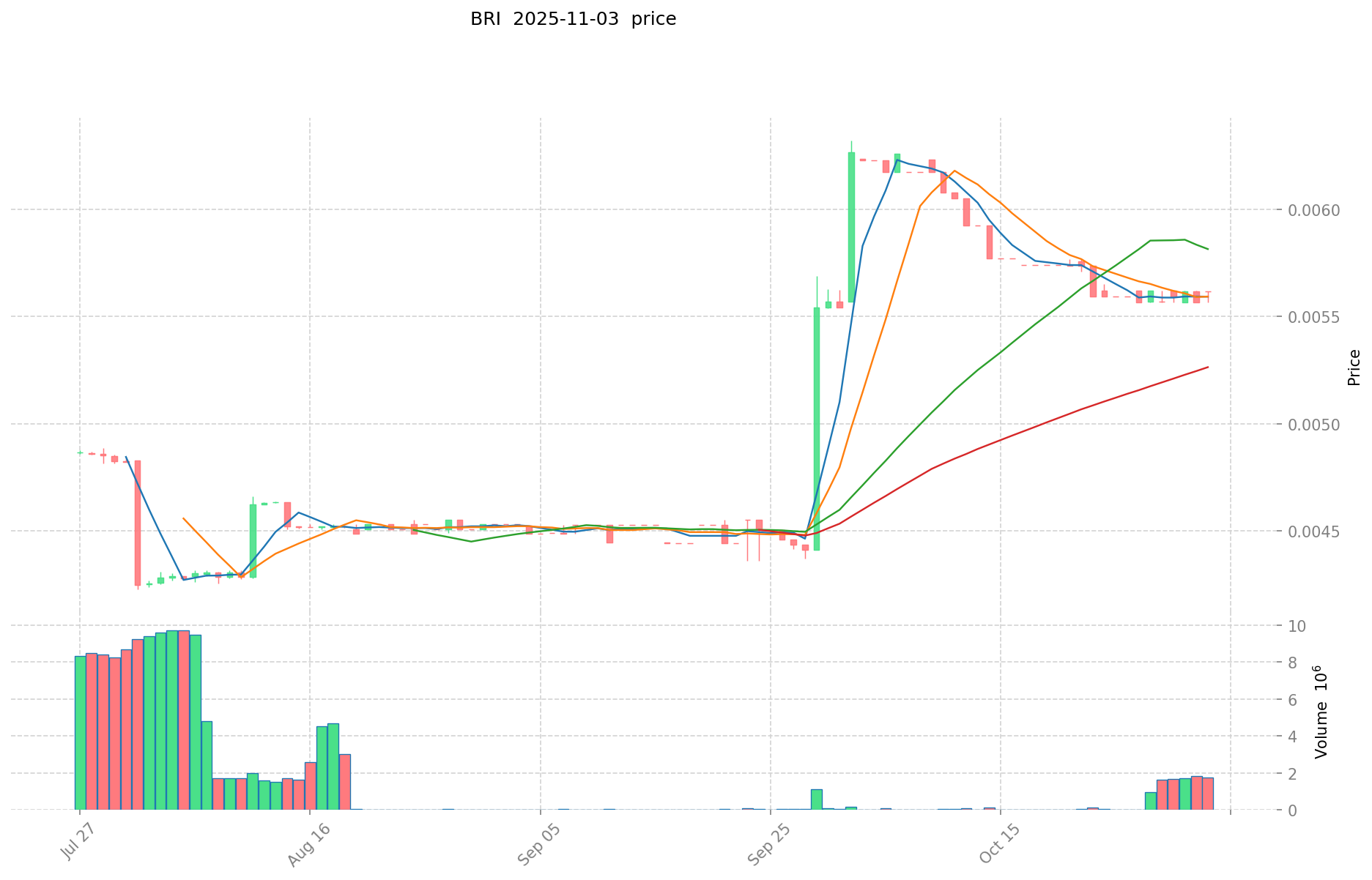
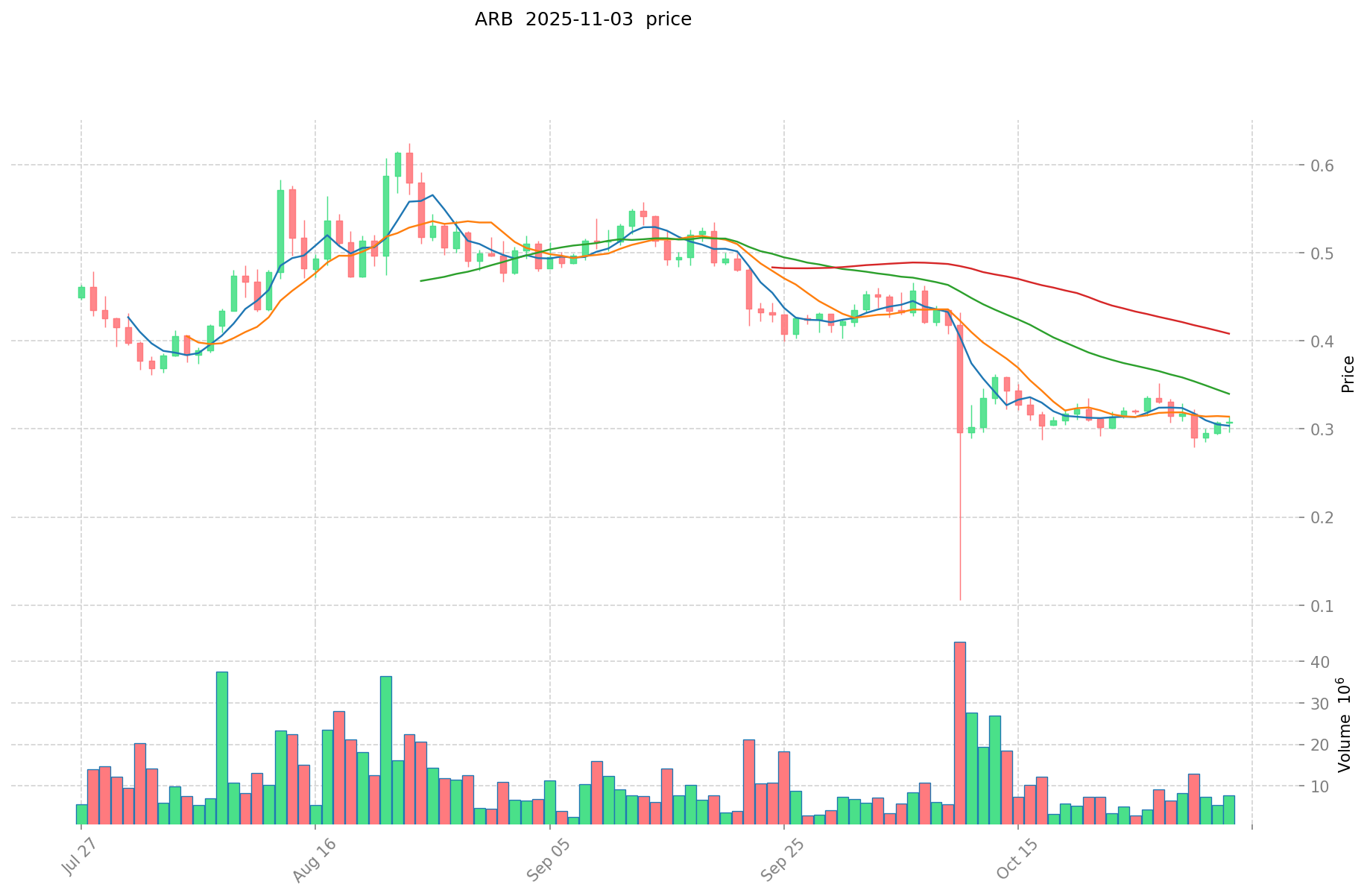
BRI (Brightpool Finance) and ARB (Arbitrum) Historical Price Trends
- 2024: BRI reached its all-time high of $1.33 on March 28, 2024, likely due to increased adoption of AI-driven trading platforms.
- 2023: ARB launched on March 23, 2023, with its price peaking at $2.39 on January 12, 2024, driven by growing interest in Ethereum Layer 2 solutions.
- Comparative analysis: During the recent market cycle, BRI dropped from its high of $1.33 to a low of $0.0021, while ARB declined from $2.39 to $0.1054, showing both tokens experienced significant volatility.
Current Market Situation (2025-11-03)
- BRI current price: $0.005567
- ARB current price: $0.2958
- 24-hour trading volume: BRI $9,509.77 vs ARB $2,541,733.17
- Market Sentiment Index (Fear & Greed Index): 42 (Fear)
Click to view real-time prices:
- View BRI current price Market Price
- View ARB current price Market Price
Key Factors Influencing BRI and ARB Investment Value
I. Regulatory Environment and Legal Frameworks
Investment Protection Mechanisms
- BRI Countries: Legal frameworks vary significantly across BRI nations with differing levels of investment protection
- ARB Process: International arbitration provides a neutral dispute resolution mechanism for cross-border investments
- 📌 Historical Pattern: Countries with stronger legal protections for foreign investments tend to attract more stable, long-term capital
Dispute Resolution Systems
- Treaty Protection: Investment treaties between nations establish critical protections for cross-border investors
- Arbitration Access: The availability and enforceability of arbitration rulings significantly impacts investment security
- Reciprocity Principle: Recent cases show China's courts recognizing foreign judgments based on reciprocity, improving cross-border enforcement
Risk Assessment Parameters
- Political Stability: Government stability and policy continuity directly affect investment security
- Cultural & Legal Differences: BRI countries exhibit substantial variations in cultural, religious, political, and legal systems
- Due Diligence Requirements: Investors need comprehensive risk identification strategies before committing capital
II. Market Access and Economic Integration
Infrastructure Development
- BRI Focus: Emphasis on critical infrastructure and energy projects across Eurasia
- Regional Connectivity: Projects that enhance trade routes and logistics networks create long-term economic value
- Resource Allocation: Strategic positioning of investments to stimulate value chain integration
Investment Structures
- Joint Ventures: Collaborative structures with local entities to navigate market complexities
- International Acquisitions: Strategic purchases to gain market access and technology transfer
- Greenfield Investments: Direct investments that develop new operational facilities from the ground up
Economic Integration Factors
- Value Chain Integration: Projects that connect local economies to global supply chains
- Technology Transfer: Knowledge sharing and capability building within host nations
- Market Access: Improved connectivity between previously isolated economic regions
III. Practical Implementation Considerations
Project Management Approach
- Cultural Adaptation: Understanding local business practices and cultural norms
- Stakeholder Engagement: Building relationships with local communities and governments
- Risk Mitigation: Developing comprehensive strategies for identifying and managing investment disputes
Financial Structuring
- Cost Management: Strategic allocation of resources and efficient project delivery
- Financing Options: Accessing diverse capital sources including development banks and private equity
- ROI Expectations: Setting realistic timeframes for investment returns based on regional conditions
Operational Excellence
- Governance Standards: Implementing transparent and accountable management practices
- Sustainability Measures: Addressing environmental and social impacts of investments
- Long-term Planning: Building resilience against political and economic fluctuations
III. 2025-2030 Price Prediction: BRI vs ARB
Short-term Prediction (2025)
- BRI: Conservative $0.00462 - $0.00557 | Optimistic $0.00557 - $0.00796
- ARB: Conservative $0.15603 - $0.2944 | Optimistic $0.2944 - $0.38861
Mid-term Prediction (2027)
- BRI may enter a growth phase, with expected prices ranging from $0.00763 to $0.01185
- ARB may enter a steady growth phase, with expected prices ranging from $0.33718 to $0.42611
- Key drivers: Institutional capital inflow, ETF, ecosystem development
Long-term Prediction (2030)
- BRI: Base scenario $0.01260 - $0.01431 | Optimistic scenario $0.01431 - $0.01689
- ARB: Base scenario $0.43664 - $0.48516 | Optimistic scenario $0.48516 - $0.54337
View detailed price predictions for BRI and ARB
Disclaimer
BRI:
| 年份 |
预测最高价 |
预测平均价格 |
预测最低价 |
涨跌幅 |
| 2025 |
0.00796081 |
0.005567 |
0.00462061 |
0 |
| 2026 |
0.009469467 |
0.006763905 |
0.00656098785 |
21 |
| 2027 |
0.01185036156 |
0.008116686 |
0.00762968484 |
45 |
| 2028 |
0.0135775923408 |
0.00998352378 |
0.0067887961704 |
79 |
| 2029 |
0.016846198026372 |
0.0117805580604 |
0.00706833483624 |
111 |
| 2030 |
0.016889786091195 |
0.014313378043386 |
0.012595772678179 |
157 |
ARB:
| 年份 |
预测最高价 |
预测平均价格 |
预测最低价 |
涨跌幅 |
| 2025 |
0.388608 |
0.2944 |
0.156032 |
0 |
| 2026 |
0.39955968 |
0.341504 |
0.25271296 |
15 |
| 2027 |
0.426111616 |
0.37053184 |
0.3371839744 |
25 |
| 2028 |
0.5576504192 |
0.398321728 |
0.32264059968 |
34 |
| 2029 |
0.492325655808 |
0.4779860736 |
0.420627744768 |
61 |
| 2030 |
0.54337456846848 |
0.485155864704 |
0.4366402782336 |
63 |
IV. Investment Strategy Comparison: BRI vs ARB
Long-term vs Short-term Investment Strategy
- BRI: Suitable for investors focused on AI-driven DeFi platforms and potential growth in innovative token minting
- ARB: Suitable for investors interested in Ethereum scaling solutions and Layer 2 technology development
Risk Management and Asset Allocation
- Conservative investors: BRI: 20% vs ARB: 80%
- Aggressive investors: BRI: 40% vs ARB: 60%
- Hedging tools: Stablecoin allocation, options, cross-currency portfolios
V. Potential Risk Comparison
Market Risk
- BRI: High volatility due to lower trading volume and market cap
- ARB: Susceptible to overall Ethereum ecosystem performance and Layer 2 competition
Technical Risk
- BRI: Scalability, network stability, AI algorithm reliability
- ARB: Network congestion, security vulnerabilities in Layer 2 solutions
Regulatory Risk
- Global regulatory policies may impact both tokens differently, with potential scrutiny on AI-driven platforms and Layer 2 solutions
VI. Conclusion: Which Is the Better Buy?
📌 Investment Value Summary:
- BRI advantages: Innovative AI-driven DeFi platform, potential for high growth in emerging tech sector
- ARB advantages: Established Ethereum scaling solution, larger market cap and trading volume, strong ecosystem support
✅ Investment Advice:
- Novice investors: Consider a larger allocation to ARB due to its more established market position and ecosystem
- Experienced investors: Balanced approach with a slight tilt towards ARB, while monitoring BRI's technological developments
- Institutional investors: Focus on ARB for its scalability solution in the Ethereum ecosystem, with a smaller allocation to BRI as a high-risk, high-reward option
⚠️ Risk Warning: The cryptocurrency market is highly volatile, and this article does not constitute investment advice.
None
VII. FAQ
Q1: What are the main differences between BRI and ARB?
A: BRI is an AI-driven DeFi platform focusing on innovative token minting, while ARB is an Ethereum scaling solution enabling high-throughput, low-cost smart contracts.
Q2: Which token has shown better price performance historically?
A: ARB has shown better price performance, reaching a high of $2.39 compared to BRI's high of $1.33. However, both tokens have experienced significant volatility.
Q3: What are the key factors influencing the investment value of BRI and ARB?
A: Key factors include regulatory environment, market access, economic integration, infrastructure development, project management approach, and financial structuring.
Q4: What are the price predictions for BRI and ARB in 2030?
A: For BRI, the base scenario predicts $0.01260 - $0.01431, while for ARB, the base scenario predicts $0.43664 - $0.48516.
Q5: How should investors allocate their assets between BRI and ARB?
A: Conservative investors might consider 20% BRI and 80% ARB, while aggressive investors might opt for 40% BRI and 60% ARB.
Q6: What are the main risks associated with investing in BRI and ARB?
A: Main risks include market volatility, technical challenges (such as scalability and security), and potential regulatory scrutiny.
Q7: Which token is considered a better buy for different types of investors?
A: For novice investors, ARB may be more suitable due to its established market position. Experienced investors might consider a balanced approach, while institutional investors may focus more on ARB with a smaller allocation to BRI.
* The information is not intended to be and does not constitute financial advice or any other recommendation of any sort offered or endorsed by Gate.












