


what is a candlestick graph
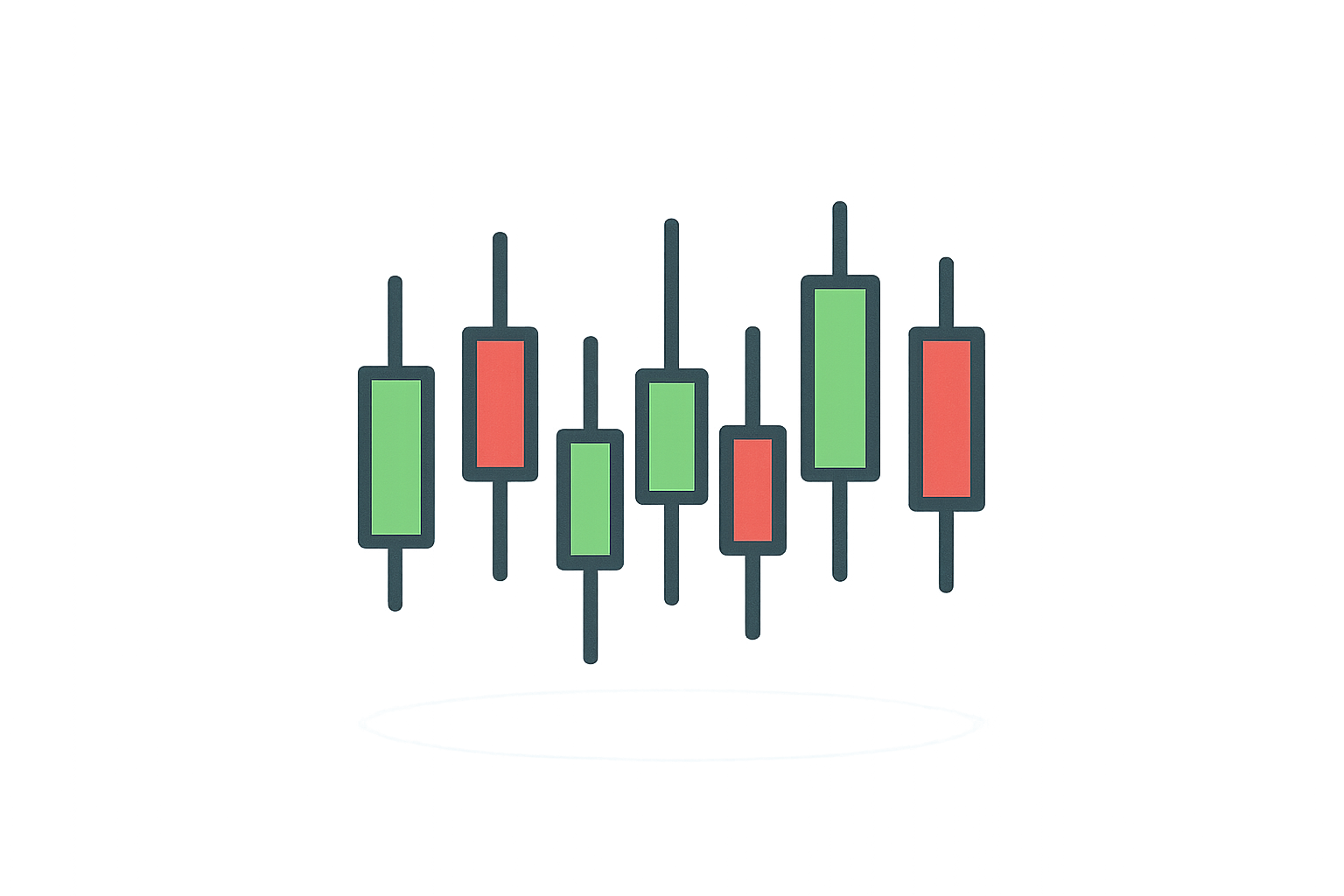
A candlestick graph is a price charting tool originating from 18th-century Japanese rice markets, visually displaying four key data points—open, close, high, and low prices—within a specific time period through the combination of rectangular bodies and upper/lower shadows. In the cryptocurrency trading domain, candlestick graphs have become a core instrument for technical analysis, helping traders identify price trends, market sentiment, and potential entry or exit opportunities. The color of each candle typically distinguishes bullish or bearish movements using red-green or black-white schemes: when the closing price exceeds the opening price, the body appears green or hollow, indicating an upward price movement during that period; conversely, a red or filled body represents a price decline. The shadow portions reflect the range of price volatility, with the upper shadow's peak corresponding to the highest price and the lower shadow's base to the lowest price. This visualization design enables traders to quickly capture market dynamics within a single graphic element and combine multiple candlestick formations (such as hammer patterns or engulfing patterns) for strategic judgment. In the highly volatile cryptocurrency market, candlestick graphs serve not only as price recording tools but also as bridges connecting historical data with future predictions, providing standardized data foundations for quantitative analysis, algorithmic trading, and risk management.
Core Features of Candlestick Graphs
-
Four-Dimensional Price Information Compression: A single candlestick simultaneously conveys four dimensions of information—open, close, high, and low prices—through body length, shadow length, and color. The body length directly reflects the intensity of bullish-bearish power dynamics: long bodies indicate clear directional conviction, while short bodies suggest market hesitation or consolidation. Shadow lengths reveal price probing behaviors; for instance, long upper shadows may signal heavy selling pressure above, whereas long lower shadows demonstrate strong support below.
-
Flexible Time Period Adaptability: Candlestick graphs can adjust time granularity according to trading needs, ranging from 1-minute or 5-minute short-period charts for intraday high-frequency trading to daily, weekly, or even monthly charts for medium to long-term trend analysis. The 24/7 trading characteristics of cryptocurrency markets enable candlestick graphs to seamlessly cover full-time price movements, with different period combinations constructing multi-dimensional analytical frameworks that help traders identify resonance between micro-fluctuations and macro-trends.
-
Pattern Recognition Capabilities: Combinations of multiple candlesticks form technically significant patterns validated by statistical analysis, such as classic reversal signals like morning star, evening star, and head-and-shoulders top formations, as well as continuation patterns including triangle consolidations and flag breakouts. These patterns have undergone extensive historical data verification in cryptocurrency markets, becoming critical input variables for quantitative trading models. By recognizing these patterns, traders can determine whether markets are experiencing trend continuation, reversal brewing, or oscillation adjustment, thereby adjusting position allocations and risk exposure.
-
Synergistic Effects with Technical Indicators: Candlestick graphs are commonly overlaid with technical indicators such as moving averages, Relative Strength Index (RSI), and Bollinger Bands. For example, when price candles break below key support levels while RSI enters oversold territory, it may signal short-term rebound opportunities; if candles run outside the upper Bollinger Band accompanied by volume expansion, it warns of overheating risks. This multi-dimensional verification mechanism filters false signals and enhances trading decision reliability.
Market Impact of Candlestick Graphs
As a globally standardized price display format in financial markets, the widespread application of candlestick graphs in cryptocurrency has profoundly influenced trading behaviors and market structures. First, the standardization characteristic of candlestick graphs reduces barriers for cross-platform data comparison, enabling unified analysis of price movements across different exchanges—this holds foundational significance for arbitrage strategies, liquidity aggregation, and market monitoring. Second, candlestick graphs have spawned extensive technical analysis communities and educational systems, with both amateur investors and professional institutions relying on candlestick patterns to formulate trading strategies. This consensus inversely reinforces the self-fulfilling effect of certain technical signals—when large numbers of participants execute consistent operations based on identical candlestick patterns, price movements may align with expectations due to collective behavior.
In algorithmic trading and quantitative investment fields, candlestick graph data serves as core training material for machine learning models. Through deep learning of historical candlestick sequences, artificial intelligence systems can identify complex nonlinear price patterns and execute high-frequency trades within milliseconds. This technology-driven trading approach now accounts for a substantial portion of cryptocurrency market volume, transforming the traditional ecology dominated by manual judgment. Additionally, the popularization of candlestick graphs has propelled derivatives market development, with pricing models for futures contracts and options products benchmarked against spot prices displayed in candlestick graphs, further enhancing market depth and liquidity.
Risks and Challenges of Candlestick Graphs
Despite being powerful analytical tools, candlestick graph applications carry inherent limitations and misuse risks. First, the effectiveness of technical analysis relies on the repeatability assumption of historical data—the belief that past price patterns will recur in the future. However, cryptocurrency markets are heavily influenced by sudden events (such as regulatory policies, hacker attacks, or project team rug pulls), and these irrational factors may invalidate candlestick patterns. For instance, a seemingly perfect bottom reversal formation could instantly collapse due to an exchange declaring bankruptcy, causing traders relying on candlestick signals to suffer significant losses.
Second, candlestick graph analysis easily falls into overfitting traps. Traders may discover patterns in historical charts with high win rates, but these patterns often underperform in real-time trading compared to backtesting results, as market structures and participant behaviors continuously evolve. Some aggressive traders even mystify candlestick graphs, attributing absolute predictive power to them while ignoring fundamental analysis, capital flows, and macroeconomic contexts, ultimately making erroneous decisions due to information bias.
Furthermore, candlestick graphs are susceptible to manipulation in low-liquidity markets. In certain small-cap cryptocurrencies, market makers can artificially create false candlestick patterns through wash trading and shake-out tactics to lure retail investors into chasing rallies or panic selling. Under such circumstances, traditional technical analysis theories may completely fail, requiring investors to conduct comprehensive judgments combining on-chain data, position distribution, and deeper information layers. Finally, excessive reliance on candlestick graphs may lead traders to neglect risk management principles, such as failing to set stop-loss levels or employing excessive leverage, resulting in irretrievable capital losses when market movements contradict expectations.
Conclusion
As the core interface connecting price data with trading decisions, candlestick graphs play an irreplaceable role in cryptocurrency markets. Their four-dimensional information compression capability, flexible time period settings, and synergistic effects with technical indicators enable traders to efficiently interpret market dynamics and formulate response strategies. However, candlestick graphs are not omnipotent tools—their effectiveness is constrained by market environment predictability, data quality, and user expertise. In practical application, investors should regard candlestick graphs as part of a multi-element analytical framework, combining fundamental research, on-chain data monitoring, and rigorous risk management systems to achieve long-term stable returns in highly volatile cryptocurrency markets. For beginners, while deeply studying candlestick graph principles, it is equally crucial to guard against over-interpretation and blind adherence to technical signals, cultivating independent thinking and holistic perspectives as the essential path toward successful trading.
Related Articles

Exploring 8 Major DEX Aggregators: Engines Driving Efficiency and Liquidity in the Crypto Market

What Is Copy Trading And How To Use It?
