
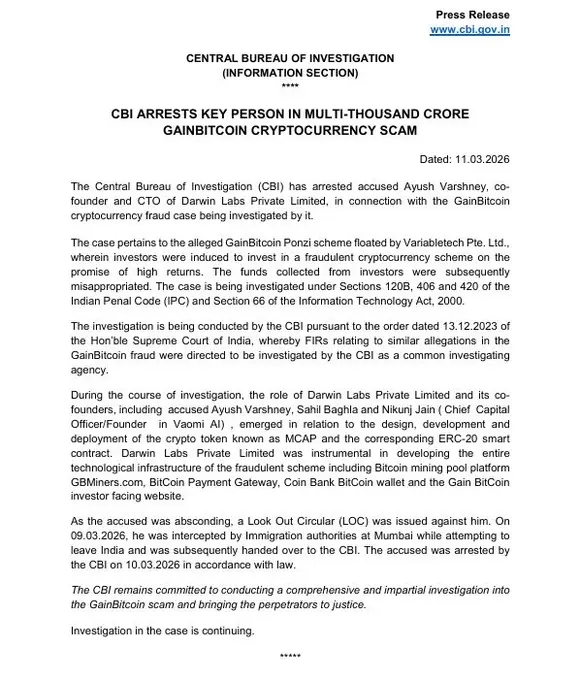
India’s Central Bureau of Investigation (CBI) intercepted Ayush Varshney at Mumbai Airport as he was attempting to board a flight to Sri Lanka. Varshney is the co-founder of Darwin Labs, and authorities accuse him of assisting in building the core technical system of the GainBitcoin Ponzi scheme, involving approximately 66 billion rupees (about $8 billion USD). The scam emerged around 2015, nearly ten years ago.
Rise and Collapse of GainBitcoin: A Bitcoin Scam Promising 10% Monthly Returns
 (Source: CBI)
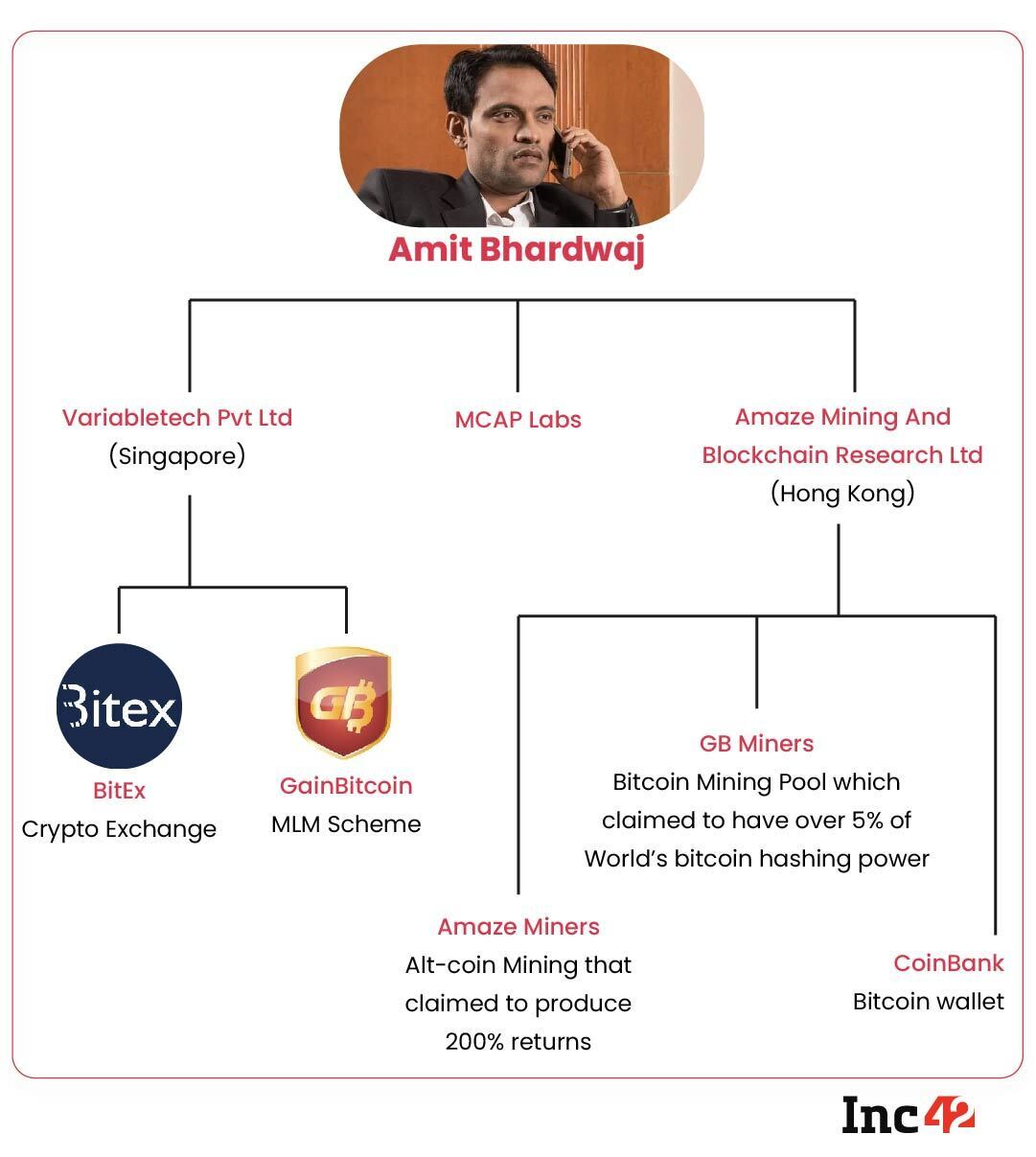
GainBitcoin quietly emerged around 2015, at a time when Bitcoin was still unfamiliar to many retail investors. The scam’s founder, Amit Bhardwaj, marketed the platform as a cloud Bitcoin mining investment opportunity, claiming investors could purchase mining contracts and earn 10% Bitcoin returns monthly over an 18-month period.
This promise spread rapidly through seminars, online promotions, and a referral commission system. Participants were encouraged to recruit new investors in exchange for multi-level commissions, forming a typical multi-level marketing structure. Investigators later confirmed that early “profit payments” mainly came from new investors’ deposits, a hallmark of a Ponzi scheme.
By 2017, this unsustainable structure began to collapse. The platform stopped paying investors in Bitcoin and instead issued a cryptocurrency called MCAP to delay the inevitable. Investors expecting Bitcoin profits suddenly received tokens with extremely limited liquidity and highly uncertain value, replacing their original Bitcoin holdings.
Mastermind’s Death, Key Technical Offender on the Run: Why Has the Prosecution Taken Nearly a Decade?
 (Source: Inc42)
The nearly ten-year delay in prosecuting the GainBitcoin case involves several key factors that complicated the legal process:
Death of the mastermind: Amit Bhardwaj was arrested in 2018 but was later released on bail; he died in 2022 from a heart attack. As the central planner of the scheme, his death created a significant gap in the prosecution chain.
Cross-border fund flows: The involved funds were transferred via cryptocurrency wallets, foreign exchanges, and international networks, making tracking extremely difficult.
Legal responsibility of technical developers: Compared to front-end promoters, the legal accountability of technical developers is harder to establish in court.
Flight risk: Varshney was not detained earlier but was under investigation; an arrest warrant indicated concerns he might leave the country. His attempt to exit ultimately triggered his arrest.
Ayush Varshney’s Role in the Scam and Subsequent Legal Consequences
According to investigators, Varshney played a primarily technical role in the GainBitcoin case—through Darwin Labs, he is suspected of helping build the infrastructure that supported the entire scam. His arrest is seen as potentially helpful in uncovering more details about the platform’s technical architecture, providing crucial clues about fund flows and system design.
Before his arrest, at least eight individuals, including several promoters, had been detained at various stages of investigation. If convicted in India of fraud and criminal conspiracy, Varshney could face several years to over a decade in prison.
Frequently Asked Questions
How did GainBitcoin scam investors out of up to $8 billion?
GainBitcoin exploited Bitcoin’s early limited recognition by packaging it as a “cloud mining investment,” promising 10% monthly returns over 18 months. This unsustainable high return was rapidly propagated through multi-level marketing, attracting thousands of investors. Investigators confirmed that early payouts mainly came from new investor funds, characteristic of a Ponzi scheme. When the system began to collapse around 2017, the platform replaced Bitcoin payments with MCAP tokens, which had very low liquidity and uncertain value, delaying collapse and shifting responsibility.
Why is Ayush Varshney’s technical role so significant?
Varshney is accused of helping build GainBitcoin’s core technical infrastructure, including wallet systems, platform architecture, and MCAP token contracts, via Darwin Labs. In Ponzi schemes, technical developers’ roles are often difficult to prosecute directly because building the “system” and orchestrating the fraud require different legal standards. Authorities believe that his arrest may help reveal more details about the technical architecture.
Why has the prosecution of the GainBitcoin case taken nearly ten years?
The lengthy process is mainly due to three factors: the death of the mastermind Amit Bhardwaj in 2022 while on bail, which significantly weakened the main prosecution chain; the involvement of cross-border cryptocurrency wallets and exchanges, making tracking complex; and multiple key suspects remaining at large within the country until an attempt to leave triggered urgent arrests.
Disclaimer: The information on this page may come from third parties and does not represent the views or opinions of Gate. The content displayed on this page is for reference only and does not constitute any financial, investment, or legal advice. Gate does not guarantee the accuracy or completeness of the information and shall not be liable for any losses arising from the use of this information. Virtual asset investments carry high risks and are subject to significant price volatility. You may lose all of your invested principal. Please fully understand the relevant risks and make prudent decisions based on your own financial situation and risk tolerance. For details, please refer to
Disclaimer.


