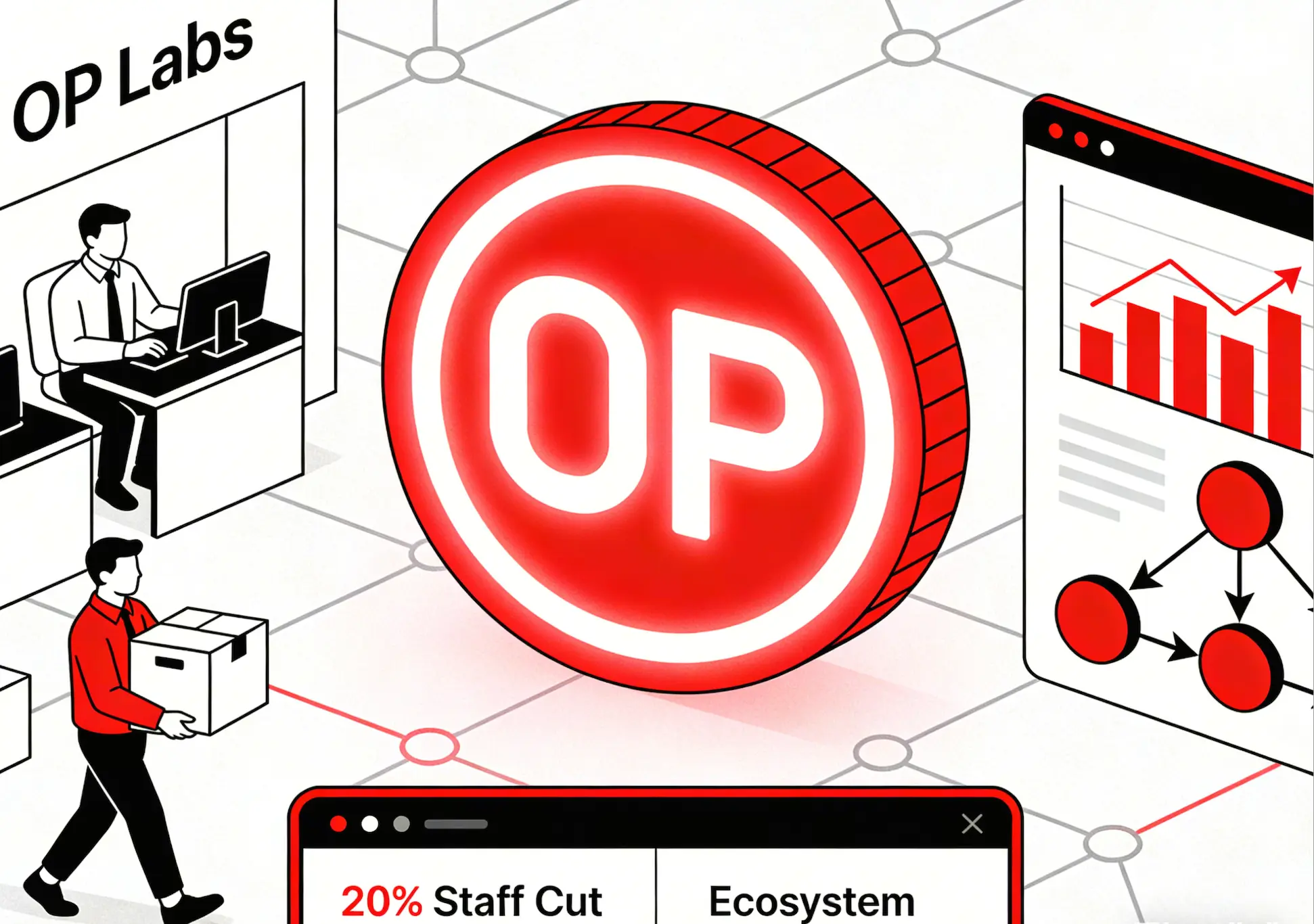
 OP Labs, the development company behind the Ethereum layer-2 network Optimism, has laid off approximately 20 employees—representing about 19.6 percent of its workforce—as part of an organizational restructuring aimed at narrowing strategic priorities and streamlining decision-making.
CEO Jing Wang emphasized that the reduction is not financially driven, stating the company remains “well capitalized with years of runway,” but reflects a strategic shift to “do fewer things well” amid ecosystem transitions and market pressures.
Layoff Details and Employee Compensation
Workforce Reduction Scope
The layoffs were announced internally on March 11, 2026, affecting employees across engineering, operations, and development roles. Internal communications confirm the team previously consisted of 102 members, with the reduction impacting approximately one-fifth of the workforce.
CEO Jing Wang described the affected staff as “talented engineers, operators, and builders who helped build Optimism into what it is today” and encouraged recruiters across the blockchain ecosystem to connect with those impacted.
Severance Package
Departing employees will receive a compensation package starting with three months of base salary, plus an additional month for each year of tenure, capped at five months total. Health insurance coverage will be extended for six months following departure, and employees will retain their company-issued laptops.
Wang has committed to personally leveraging her professional network to assist displaced workers in finding new roles across the crypto ecosystem.
Strategic Rationale and Financial Position
Purpose of Restructuring
In an internal memo, Wang clarified that “this is not about finances. OP Labs is well capitalized with years of runway. This is about doing fewer things well, making decisions faster, and reducing coordination overhead.” The restructuring reflects a deliberate narrowing of operational focus rather than crisis-driven cost-cutting.
Financial Independence
The company maintains substantial cash reserves with multiple years of operational runway, insulating it from immediate market pressures that have driven workforce reductions elsewhere in the crypto sector.
Ecosystem Transition and Market Pressures
Base’s Departure from OP Stack
The layoffs occur during a transitional period for the Optimism ecosystem. Last month, Base—the largest chain built on the OP Stack with billions in total value locked—announced it would shift to its own unified tech stack to pursue independent development. This departure raised market concerns about Optimism’s long-term sustainability and contributed to significant selling pressure on the OP token.
OP Token Performance
The OP token currently trades at approximately $0.12, representing a year-to-date decline exceeding 55 percent. Market capitalization stands at approximately $252 million. The token’s performance reflects broader bearish sentiment in the layer-2 sector and uncertainty following Base’s strategic pivot.
2026 Roadmap and Strategic Initiatives
Technical Development Goals
Despite ecosystem challenges, Optimism has established a comprehensive 2026 roadmap. Wang outlined multiple technical objectives including faster block times, native interoperability across the Superchain, custom compliance controls to accommodate varying regulatory environments, and zero-knowledge proof systems aligned with Ethereum’s quantum-resistant roadmap.
Token Buyback Program
In January 2026, OP token holders approved a proposal to allocate 50 percent of Superchain sequencer revenue to monthly OP token buybacks under a 12-month pilot program that launched in February. This mechanism aims to better align the OP token with Superchain ecosystem growth and potentially offset selling pressure.
Industry Context
Broader Crypto Sector Trends
OP Labs joins a growing list of crypto companies adjusting workforce levels amid shifting market conditions. Recent reductions span exchanges, DeFi protocols, and infrastructure providers, though 2025-2026 cuts are primarily linked to operational streamlining and strategic pivots rather than the crisis-driven reductions seen during the 2022 market collapse.
Positioning Within Layer-2 Landscape
Optimism remains one of Ethereum’s largest layer-2 scaling solutions, utilizing optimistic rollup technology. The OP Stack serves as open-source infrastructure for building customizable chains, with the Superchain concept unifying these networks through a shared bridge. While Base’s departure represents a significant ecosystem shift, Optimism continues to power multiple chains and maintain its role as the primary research, development, and engineering team driving protocol advancements.
FAQ: OP Labs Restructuring
Q: How many employees were affected by OP Labs’ layoffs?
A: OP Labs laid off approximately 20 employees, representing about 19.6 percent of its workforce. The team previously included 102 members.
Q: Why did OP Labs conduct layoffs if the company is financially healthy?
A: CEO Jing Wang stated the restructuring is strategic rather than financial. The company maintains years of operational runway and sufficient capitalization. The goal is to “do fewer things well,” accelerate decision-making, and reduce coordination overhead.
Q: What triggered the OP token’s recent price decline?
A: The OP token has fallen more than 55 percent year-to-date to approximately $0.12. The decline follows Base’s announcement that it would shift from the OP Stack to its own unified tech stack, raising market concerns about Optimism’s long-term ecosystem sustainability.
Q: What is Optimism’s 2026 roadmap?
A: Optimism’s 2026 technical roadmap includes faster block times, native interoperability across the Superchain, custom compliance controls, and zero-knowledge proof systems aligned with Ethereum’s roadmap. A token buyback program redirecting 50 percent of sequencer revenue to monthly OP purchases also launched in February.
Disclaimer: The information on this page may come from third parties and does not represent the views or opinions of Gate. The content displayed on this page is for reference only and does not constitute any financial, investment, or legal advice. Gate does not guarantee the accuracy or completeness of the information and shall not be liable for any losses arising from the use of this information. Virtual asset investments carry high risks and are subject to significant price volatility. You may lose all of your invested principal. Please fully understand the relevant risks and make prudent decisions based on your own financial situation and risk tolerance. For details, please refer to
Disclaimer.


