Bitcoin’s hashrate has slipped beneath the 1 zettahash per second (ZH/s) mark as miner income remains painfully thin, with the hashprice daily rate parked at $31 per petahash per second (PH/s).
Weak Hashprice and Lower Compute
While Bitcoin’s hashrate briefly clawed its way back above 1,000 exahash per second (EH/s)—the neat mathematical twin of 1 ZH/s—it has since slipped below that line again. The move arrives as the value of a single petahash of output sits at $31.11, roughly 11.64% lower than it was 30 days ago on Feb. 15, 2026.
While that revenue remains lean, it is still 12.88% higher than the $27.56 hashprice recorded on Feb. 24. At press time, the network’s hashrate hovers between 960 and 970 EH/s, stretching block intervals to roughly 10 minutes 42 seconds and likely setting the stage for a difficulty reduction scheduled for March 20, 2026.
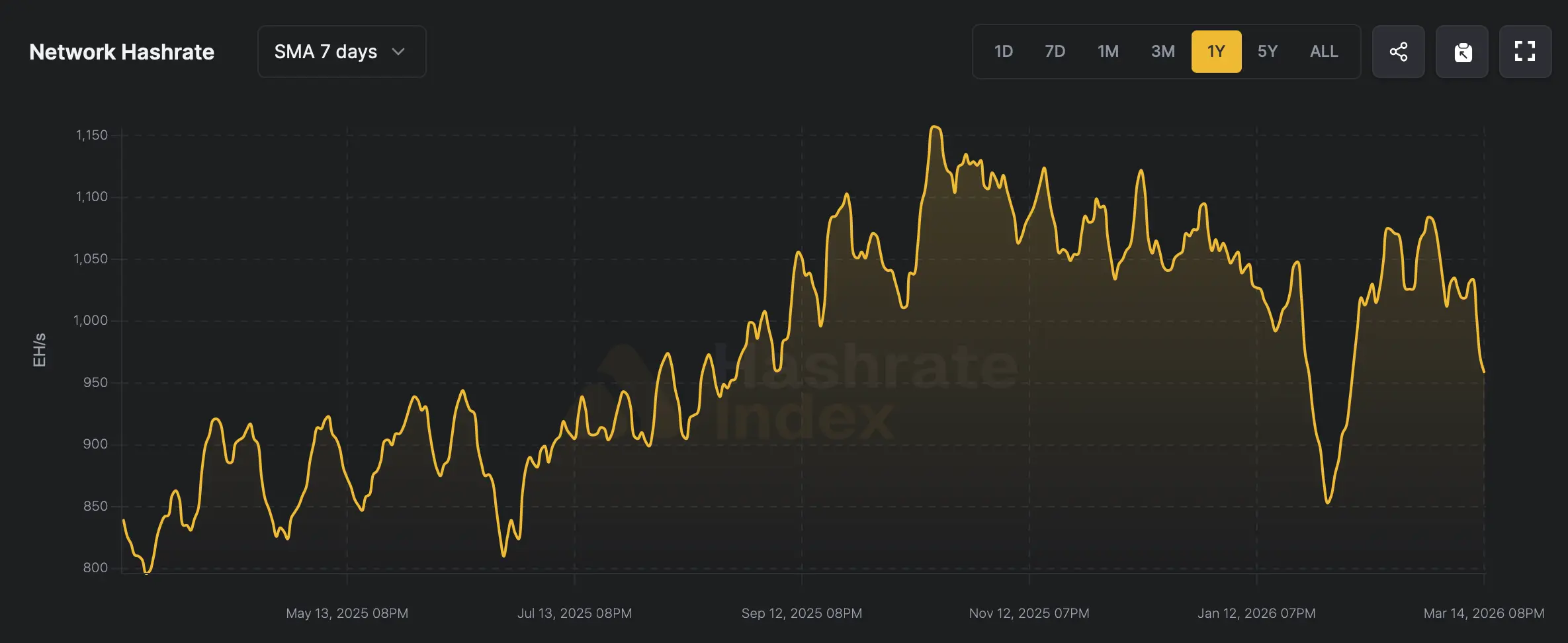 Image source: hashrateindex.com
That adjustment is currently estimated at about 6.57% lower than today’s level, though projections have a habit of changing their minds. Miners have already endured two back-to-back difficulty hikes, including the steepest increase since 2021. After that bruising 14.73% jump, difficulty crept up again on March 5 with a modest 0.45% rise. A pullback would take some of the heat off.
Image source: hashrateindex.com
That adjustment is currently estimated at about 6.57% lower than today’s level, though projections have a habit of changing their minds. Miners have already endured two back-to-back difficulty hikes, including the steepest increase since 2021. After that bruising 14.73% jump, difficulty crept up again on March 5 with a modest 0.45% rise. A pullback would take some of the heat off.
All told, 2026 has delivered paper-thin margins for bitcoin miners, with hashprice lingering below levels seen before 2016. If the projected difficulty cut holds, miners may finally catch a small breath after weeks of tight margins and volatile block production. Still, relief may prove temporary if hashpower quickly returns to the network once conditions improve.
For now, operators are navigating a delicate balance between operational costs, network competition, and the simple arithmetic of keeping machines running profitably.
FAQ 🔎
- Why did Bitcoin’s hashrate fall below 1 zettahash per second? Bitcoin’s hashrate dipped under 1 ZH/s as mining revenue weakened and some operators likely powered down less profitable machines.
- What does a Bitcoin hashrate under 1 ZH/s mean for the network? A hashrate below 1 ZH/s simply indicates less total computing power securing the Bitcoin network at that moment.
- Will Bitcoin mining difficulty change after the hashrate drop? If slower block times continue, Bitcoin’s next difficulty adjustment on March 20, 2026 could lower mining difficulty by about 6.5%.
- How does hashprice affect Bitcoin miners in 2026? With hashprice near $31 per petahash per second (PH/s), many Bitcoin miners are operating with very thin profit margins.
Disclaimer: The information on this page may come from third parties and does not represent the views or opinions of Gate. The content displayed on this page is for reference only and does not constitute any financial, investment, or legal advice. Gate does not guarantee the accuracy or completeness of the information and shall not be liable for any losses arising from the use of this information. Virtual asset investments carry high risks and are subject to significant price volatility. You may lose all of your invested principal. Please fully understand the relevant risks and make prudent decisions based on your own financial situation and risk tolerance. For details, please refer to
Disclaimer.


