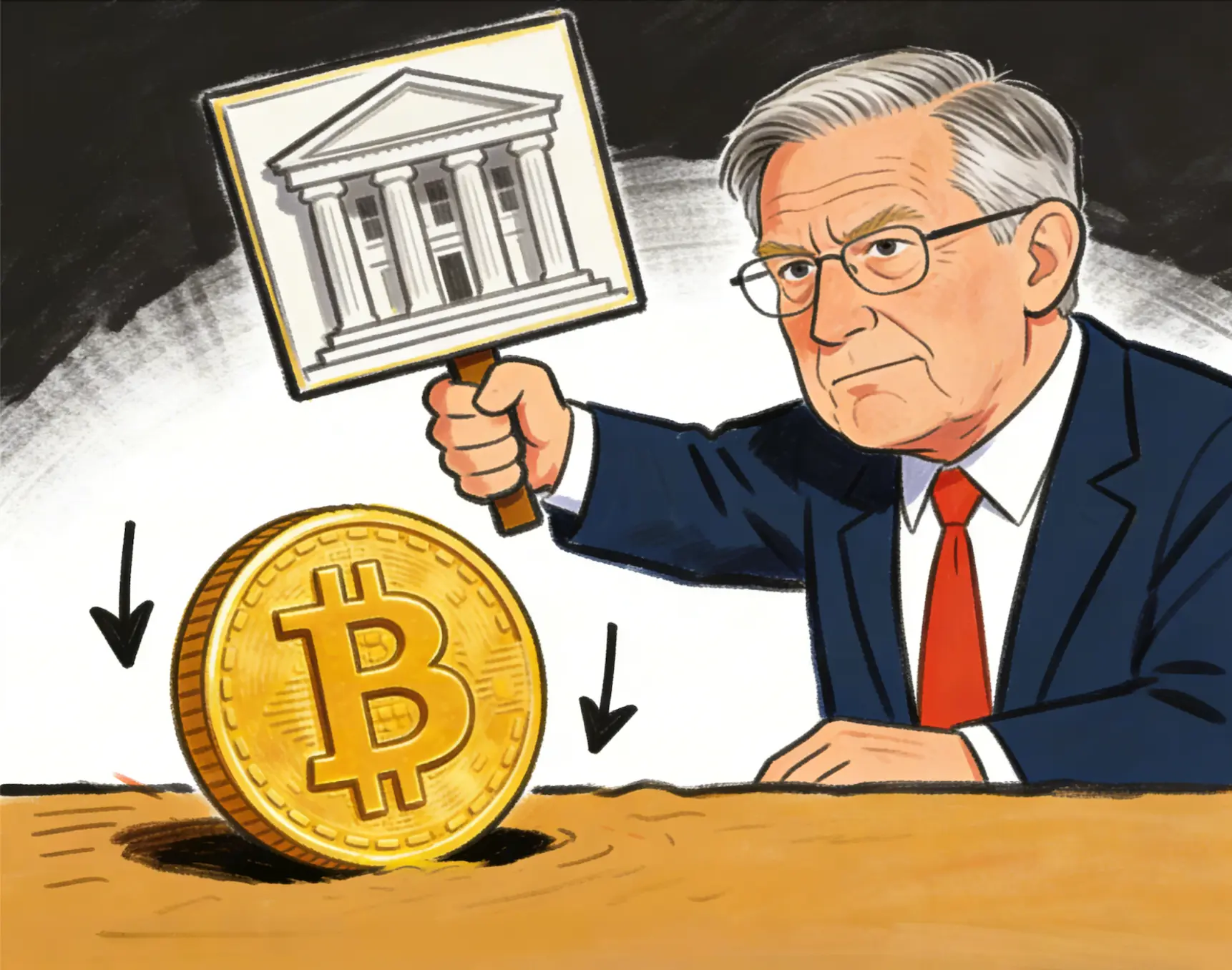
 The Federal Open Market Committee (FOMC) voted 11-1 on March 18, 2026, to maintain the federal funds target range at 3.50% to 3.75%, marking the second consecutive meeting with no change in borrowing costs as policymakers flagged uncertainty stemming from the Iran conflict and persistent inflation.
The decision, which included one dissenting vote for a 25-basis-point cut, reinforces a “higher for longer” policy stance that historically pressures crypto markets by strengthening the dollar and tightening liquidity conditions. Bitcoin traded near $70,500 following the announcement, down 3.6% over 24 hours after briefly touching $76,000 last week.
Federal Reserve Chair Jerome Powell indicated at his post-meeting press conference that rising oil prices—Brent crude climbed 3.8% to $107.38 per barrel following strikes on Iran’s South Pars gas field—have pushed near-term inflation expectations higher, though he noted it remains “too soon to know” the full economic impact of the Middle East conflict.
FOMC Decision and Policy Outlook
Rate Decision Details
The FOMC’s March 18 vote saw 11 members support maintaining rates at 3.50%-3.75%, while Fed Governor Stephen Miran dissented in favor of a 25-basis-point reduction. This marks the sixth consecutive policy meeting with a split vote, reflecting emerging divisions within the central bank over the appropriate policy path.
Forward Guidance
The Committee emphasized a data-dependent approach to future adjustments, signaling that any policy changes will rely on incoming economic information. The statement noted that “uncertainty about the economic outlook remains elevated” and explicitly cited developments in the Middle East as a factor whose implications for the U.S. economy remain uncertain.
Inflation and Employment Assessment
The FOMC characterized inflation as “somewhat elevated” while acknowledging that job gains have remained low, with the unemployment rate ticking up to 4.4% in February. This mixed picture complicates the Fed’s dual mandate of maximum employment and price stability.
Geopolitical Context: Iran Conflict and Oil Prices
Energy Market Impact
The ongoing conflict involving the U.S., Israel, and Iran has pushed energy prices significantly higher. On the day of the Fed’s announcement, reports emerged that Israel struck the South Pars gas field in Iran, sending oil prices higher and contributing to the sell-off in both equities and Bitcoin.
Brent crude rose 3.8% to $107.38 per barrel, reflecting supply disruptions and heightened geopolitical risk. Powell acknowledged that “near term measures of inflation expectations have risen in recent weeks, likely reflecting the substantial rise in oil prices caused by the supply disruptions in the Middle East.”
Economic Uncertainty
The FOMC explicitly incorporated geopolitical risk into its policy calculus, noting that the economic implications of the Middle East conflict remain unclear. This uncertainty constrains the Fed’s ability to provide clear forward guidance and reinforces the cautious, data-dependent posture.
Market Reactions
Bitcoin Price Response
Bitcoin traded around $70,500 following the announcement, down 3.6% over the previous 24 hours. The cryptocurrency had reached a one-month high near $76,000 last week but has since retraced as investors weigh inflation data and geopolitical uncertainties. Bitcoin recorded gains of 1.6% over the past week despite the pullback, maintaining a position above the psychologically significant $70,000 level.
Equities Correlation
Bitcoin fell in tandem with U.S. stocks following reports of the strike on Iran’s gas field, demonstrating continued correlation with traditional risk assets during periods of geopolitical stress. This correlation complicates the narrative of Bitcoin as a pure hedge against geopolitical uncertainty.
Powell’s Press Conference: Key Themes
Tariffs and Inflation
Powell highlighted the influence of tariffs on consumer prices, noting that “some big chunk of that, between a half and three-quarters, is actually tariffs.” This acknowledgment points to supply-side factors beyond the Fed’s direct control that may keep inflation elevated.
Neutral Rate Assessment
The Chair described the current federal funds rate range as within neutral territory—neither stimulating nor restricting economic growth—suggesting that the current level may be appropriate for prevailing conditions.
Central Bank Independence
Powell emphasized the importance of Fed independence: “Independence is what allows us to do our jobs, and stable prices is half of our mandate, it’s one of our two mandates—maximum employment being the other.” This statement comes as political pressure on the Fed has intensified.
Crypto Market Implications
Higher-for-Longer Pressure
The Fed’s reinforced “higher for longer” stance typically pressures crypto markets through two channels:
Dollar strength: Higher rates attract capital to dollar-denominated assets
Liquidity tightening: Reduced money supply constrains risk asset valuations
Historically, these conditions have been bearish for Bitcoin and broader crypto markets.
Countervailing Factors
However, geopolitical instability and oil-driven inflation could also revive Bitcoin’s narrative as a hedge against macro uncertainty and fiat currency debasement. The competing forces—monetary tightening versus geopolitical risk—create an uncertain outlook for crypto prices.
Analyst Perspective
Market observers note that the combination of higher energy costs, persistent inflation, and geopolitical uncertainty has prompted investors to reduce exposure to riskier assets, including Bitcoin. The extent to which Bitcoin’s “digital gold” narrative offsets these pressures remains a key question for traders.
Political Context: Powell’s Future
Term Expiration
Powell’s term as Fed Chair will conclude in May 2026, with former Fed Governor Kevin Warsh expected to succeed him if confirmed. Powell’s future on the Board of Governors remains undecided.
Chair’s Comments
Regarding his tenure, Powell stated: “I have no intention of leaving the board until the investigation is well and truly over, with transparency and finality.” This reference to ongoing matters suggests Powell may remain involved with the Fed even after stepping down as Chair.
Frequently Asked Questions
Why did the Federal Reserve hold rates steady?
The FOMC maintained rates at 3.50%-3.75% due to uncertainty surrounding the Iran conflict’s economic impact, persistent but “somewhat elevated” inflation, and mixed labor market signals. The Committee emphasized a data-dependent approach, noting it needs more clarity on how geopolitical developments and oil prices will affect the economy before adjusting policy.
What did Powell say about crypto and Bitcoin?
Powell did not directly address cryptocurrencies in his post-meeting remarks. However, his discussion of higher oil prices, tariffs, and persistent inflation provides context for crypto markets, which have historically been sensitive to interest rate expectations. The “higher for longer” rate environment typically pressures risk assets, including Bitcoin, by strengthening the dollar and tightening liquidity.
How did Bitcoin react to the Fed decision?
Bitcoin traded near $70,500 following the announcement, down 3.6% over 24 hours. The cryptocurrency fell in tandem with U.S. stocks following reports of strikes on Iran’s South Pars gas field, demonstrating continued correlation with traditional risk assets during geopolitical stress. Despite the pullback, Bitcoin remains above $70,000 and recorded weekly gains of 1.6%.


