Anthropic Launches Claude Code Channels Research Preview, Enabling AI Agents to Receive Real-Time Telegram and Discord Messages via MCP Server Architecture for Bidirectional Communication; Users Can Remotely Control On-Chain Monitoring Tasks Through Chat Messages.
(Background: Claude Usage Doubled! Anthropic Offers Limited-Time Promotion, Benefiting Taiwan Users Almost All Day)
(Additional Info: OpenClaw Next Week Update: Support for Claude Code and OpenAI Codex, Founder Steinberger Still Coding)
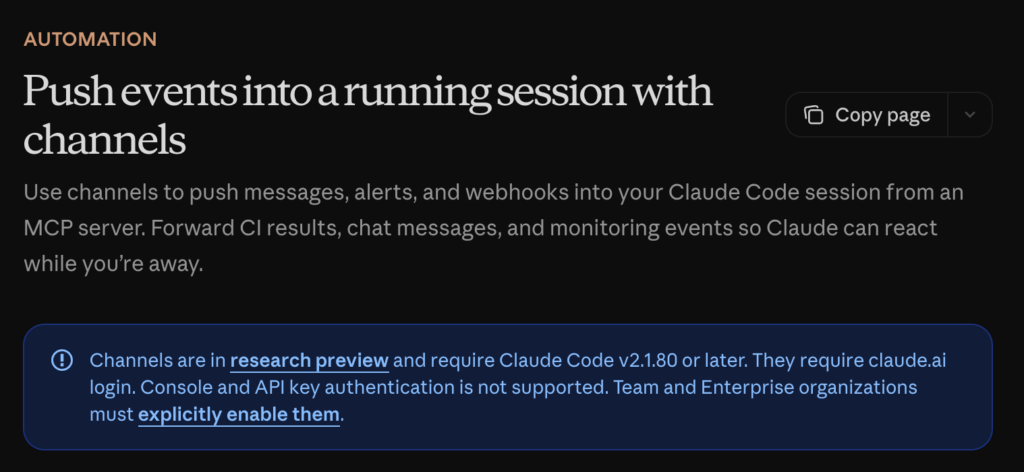
Anthropic’s Claude Code officially introduces the “Channels” feature today, solving a long-standing user pain point: AI agents must be monitored at the terminal. Now, developers can send a single Telegram message to remotely command Claude to continue working while on the go.
Channels essentially function as an MCP server. According to official Anthropic documentation, this architecture pushes external events into the active Claude Code session, allowing Claude to respond in real time to external stimuli rather than passively waiting for developer commands. Channels support bidirectional communication, enabling the AI agent to reply through the same channel, forming a complete dialogue loop.
Looking further, this new feature actually realizes one of OpenClaw’s advantages: integrating AI assistants into communication apps. Users can delegate social or physical tasks at any time and receive instant notifications upon completion, enjoying 24/7 persistent personal service.
Telegram and Discord Dual Integration, Three-Step Pairing
Currently, the research preview supports three channels: Telegram, Discord, and a local test fakechat (localhost:8787).
The installation process is straightforward:
- Developer creates a Telegram bot via BotFather and obtains a token
- Install the plugin with /plugin install telegram@claude-plugins-official
- After configuration, restart Claude Code with the --channels argument
- Complete account pairing and set up an allowlist (only paired accounts can push messages to Claude).
Discord setup is similar, with the difference that a bot must be created in the Developer Portal. Full instructions are available in the official documentation.
Security Architecture: Three Locks to Prevent Unauthorized Pushes
Anthropic adopts a cautious approach to security, implementing three layers of protection:
First, Sender allowlist — only Telegram or Discord accounts that have completed pairing can push messages to Claude; strangers cannot directly “invade” an active session.
Second, each startup must explicitly specify the --channels argument; Claude Code does not automatically enable any channels, reducing accidental exposure.
Third, external plugins are strictly whitelisted: currently, --channels only accepts plugins from Anthropic’s official allowlist; to test custom-developed channels, the --dangerously-load-development-channels flag must be added, with a clear warning about the risks.
For enterprise control, Team and Enterprise plans have Channels disabled by default and require manual activation by administrators; Pro and Max personal plans enable it by default but still require user opt-in each time.

Disclaimer: The information on this page may come from third parties and does not represent the views or opinions of Gate. The content displayed on this page is for reference only and does not constitute any financial, investment, or legal advice. Gate does not guarantee the accuracy or completeness of the information and shall not be liable for any losses arising from the use of this information. Virtual asset investments carry high risks and are subject to significant price volatility. You may lose all of your invested principal. Please fully understand the relevant risks and make prudent decisions based on your own financial situation and risk tolerance. For details, please refer to
Disclaimer.


