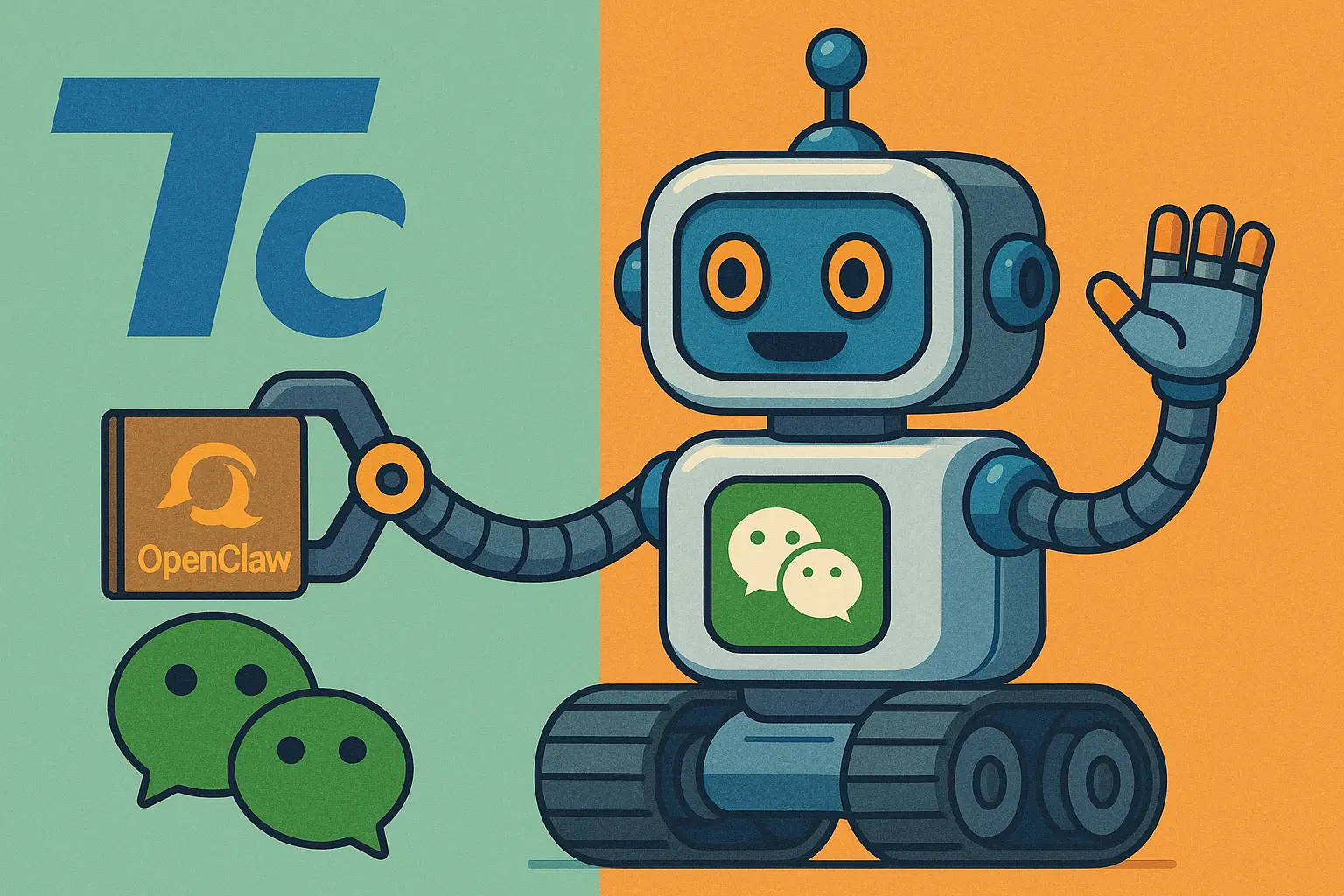
Tencent has launched ClawBot, which directly connects the WeChat platform with OpenClaw AI agents. Users can access AI agent services within the familiar WeChat chat interface, with application scenarios covering Q&A, customer support, and e-commerce processes. This release marks Tencent’s more proactive approach in the rapidly growing AI agent market in China, but whether it can translate into tangible benefits in advertising, fintech, and cloud services remains a key focus for market observers.
ClawBot’s Positioning: A New Entry Point for AI Agents in the WeChat Ecosystem
The core design of ClawBot is to leverage WeChat’s extensive existing user base rather than building a separate AI agent platform. By embedding OpenClaw’s capabilities within the WeChat chat interface, Tencent allows users to access AI services without switching applications, fundamentally lowering the adoption barrier.
In terms of Tencent’s own financial situation, the company’s full-year 2025 revenue is projected to reach 751.8 billion RMB, with a net profit of 224.8 billion RMB. However, recent management statements regarding AI investments have raised concerns among some investors about the relationship between AI capital expenditure and current revenue. The launch of ClawBot provides a more concrete point of observation for tracking Tencent’s progress in commercializing AI agents.
Business Potential and Core Risks: A Dual Perspective for Investors
User Feedback Scale Advantage: The integration of social and payment ecosystems within WeChat enables Tencent to collect large-scale real-world product feedback, allowing faster iteration compared to competitors lacking such platform integration.
Multiple Revenue Touchpoints: If ClawBot can promote more frequent interactions between users and brands or mini-programs, it could support Tencent’s profit margin improvements in payments, advertising, and cloud services.
Intense Competitive Landscape: Baidu and Alibaba have already deeply invested in the AI agent market, exerting direct pressure on ClawBot in terms of pricing, user acceptance, and differentiation.
Infrastructure Cost Pressure: As AI agent usage within WeChat expands, it will increase demand for GPUs and data centers. Chip supply constraints and electricity limitations are industry-wide challenges.
Key Follow-up Indicators: When Will Commercialization Materialize?
Currently, ClawBot lacks clear enterprise pricing or subscription models, which is a primary concern for analysts and investors. Tencent also has its own AI assistants like QClaw and WorkBuddy. The positioning and synergy between ClawBot and these tools will influence the overall assessment of Tencent’s AI agent strategy.
On the global stage, competitors like Meta and Alphabet are also actively advancing their AI agent initiatives. Their movements will help gauge Tencent’s relative position in the AI assistant race. The most valuable signals include: the speed of ClawBot’s user adoption, whether management begins to disclose specific commercial use cases (such as automated customer service or AI-assisted shopping), and whether identifiable paid models emerge from enterprises.
Frequently Asked Questions
Q: What is ClawBot, and how does it differ from general AI chatbots?
ClawBot is Tencent’s AI agent integration solution that embeds OpenClaw’s capabilities directly into WeChat chat. Unlike typical Q&A chatbots, it has agent attributes, enabling it to perform cross-service tasks such as customer support and e-commerce processes within the WeChat ecosystem, rather than just responding to single questions.
Q: What potential impact does ClawBot have on Tencent’s business model?
ClawBot adds AI agent capabilities to Tencent’s existing revenue streams in advertising, payments, and cloud services. However, there is no clear pricing or subscription model yet, and the path to commercialization remains to be further disclosed by management. Investors should monitor user engagement metrics and revenue conversion data.
Q: What are the main competitive pressures Tencent faces in the AI agent market?
In China, Baidu and Alibaba are the primary competitors, both heavily investing in AI agents. Globally, Meta and Alphabet are also actively developing their offerings. ClawBot’s advantage lies in WeChat’s social and payment ecosystem, but whether it can establish lasting barriers in pricing, user acceptance, and feature differentiation remains to be seen.
Disclaimer: The information on this page may come from third parties and does not represent the views or opinions of Gate. The content displayed on this page is for reference only and does not constitute any financial, investment, or legal advice. Gate does not guarantee the accuracy or completeness of the information and shall not be liable for any losses arising from the use of this information. Virtual asset investments carry high risks and are subject to significant price volatility. You may lose all of your invested principal. Please fully understand the relevant risks and make prudent decisions based on your own financial situation and risk tolerance. For details, please refer to
Disclaimer.


