Glassnode’s latest on-chain data shows that Bitcoin’s short-term holders’ cost basis has been settling toward the lower edge of the $60,000-$70,000 range. Accumulation signals are appearing, but the strength is still not enough.
(Background recap: BTC fell below $70,000, triggering a long position bloodbath and liquidating $300 million, with $14.16 billion in options expiring today to test the direction)
(Additional context: Glassnode: A comprehensive technical panorama of the Bitcoin market in early 2026)
Blockchain analytics firm Glassnode said in its latest report: “BTC is sitting at the lower bound of the new buyers’ cost basis range ($60,000-$70,000). Supply accumulation in this range is quite significant, but the accumulation density is lower than historical analogy scenarios that preceded equally strong rebound moves. The accumulation pattern is constructive in form, but the strength has not yet kept up.”
BTC sits at the lower bound of the new buyers’ cost basis range ($60k–$70k).
Supply accumulation in this range is notable, but the cluster is thinner than historical analogs that preceded a strong recovery.
The accumulation setup is constructive in form, not yet in magnitude.… https://t.co/fluZV6HzPO pic.twitter.com/PkXdzgxQgk
— glassnode (@glassnode) March 29, 2026
The heat map indicates an accumulation band is forming
From Glassnode’s heat map of the short-term holders’ cost basis distribution (from September 2025 to March 2026), the evolution of accumulation density can be seen clearly. In October 2025, BTC formed a large orange-red cluster of chips concentrated band at $120,000-$125,000—that was the main cost range of market participants at the time.
After that, the price kept sliding lower, and another clear red horizontal band appeared around $85,000, corresponding to heavy accumulation between November 2025 and January 2026.
After an accelerated decline in February 2026, BTC has come into the current $65,000-$70,000 consolidation range.
The heat map shows slight yellow and green accumulation signals at this location, but the color intensity is clearly weaker than the first two accumulation bands.
Accumulation of 429,000 BTC: Important, but still not enough
As of the end of February, more than 429,000 BTC has already been accumulated in the $60,000-$70,000 range, accounting for more than 8% of the circulating supply not held on exchanges. This number is not small; Glassnode’s weekly report (Week 12) also characterizes this range as a “high-confidence support zone,” and notes that there may still be volatility pressure above $70,000.
On the institutional front, Bernstein said in a report released on March 24 that Bitcoin “may have already bottomed,” maintaining a $150,000 target price; JPMorgan also believes Bitcoin has passed its “digital gold” qualification exam. However, these are mid- to long-term frameworks, offering limited guidance for short-term price action.
The options market provides another near-term reference point: market makers hold short Gamma positions in the $70,000-$75,000 range, meaning that if the price enters this zone, volatility could accelerate and amplify.
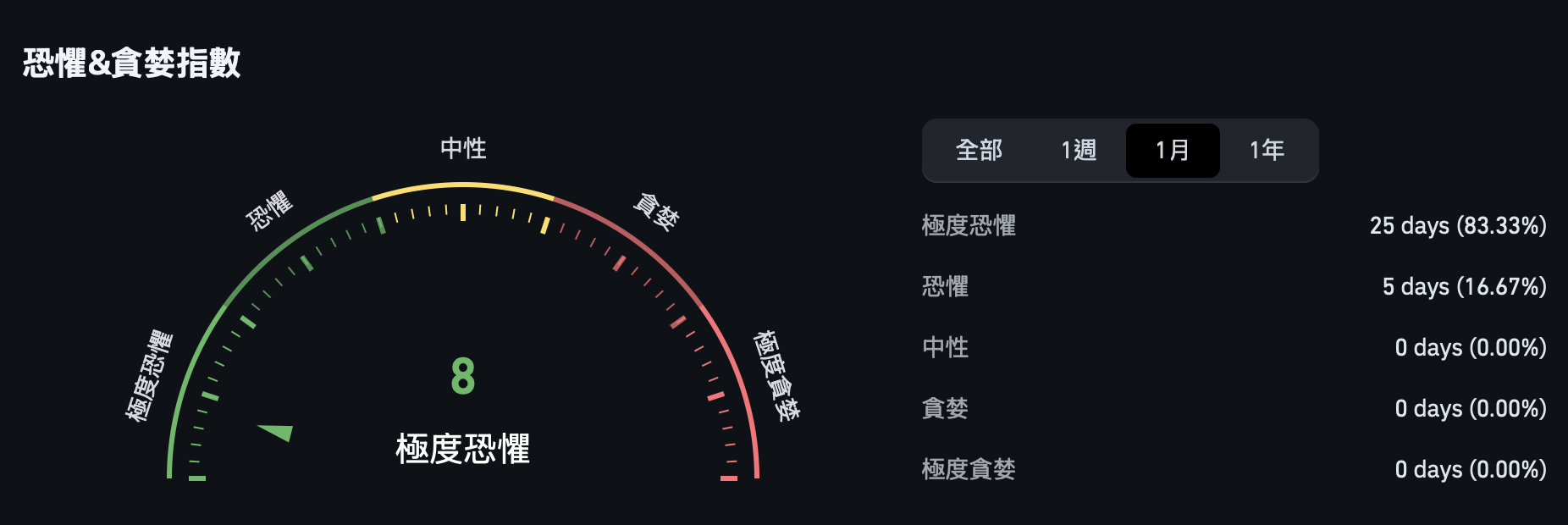
According to CoinGlass statistics, today (the 29th), the crypto market fear index is at 8, and in nearly the past two months it has hardly exceeded 20.
The above is not investment advice.

Disclaimer: The information on this page may come from third parties and does not represent the views or opinions of Gate. The content displayed on this page is for reference only and does not constitute any financial, investment, or legal advice. Gate does not guarantee the accuracy or completeness of the information and shall not be liable for any losses arising from the use of this information. Virtual asset investments carry high risks and are subject to significant price volatility. You may lose all of your invested principal. Please fully understand the relevant risks and make prudent decisions based on your own financial situation and risk tolerance. For details, please refer to
Disclaimer.


