
As of March 29, the number of U.S. military personnel in the Middle East has exceeded 50,000, but no ground troops have been confirmed to have entered Iranian territory. Meanwhile, the “When Will Soldiers Enter Iran” contract on the prediction market Polymarket has accumulated a trading volume of $49.6 million, with the probability of U.S. forces entering Iran by April 30 at 71%, and by the end of the year at 78%.
Current Status of U.S. Military Gathering in the Middle East: Raiding Plans Prepared, Orders Not Yet Issued
Since the U.S.-led coalition launched airstrikes against Iran on February 28, the buildup of U.S. forces in the Middle East has continued, with the conflict entering its fifth week. Confirmed troop increase dynamics include: Reuters reports that the U.S. plans to send several thousand more soldiers; Axios revealed that the White House and the Pentagon are considering deploying at least one additional combat unit; The Wall Street Journal and Iran International Radio indicated that if all troop increase plans are approved, the total number of U.S. forces in the region could increase by over 17,000.
More than 1,000 soldiers from the Marine Corps, Army infantry, and the 82nd Airborne Division are on standby; the amphibious assault ship USS Tripoli, carrying 3,500 personnel, has entered the area of responsibility and is prepared to execute potential ground combat missions.
The Washington Post reported on March 28 that Pentagon planners are drafting an emergency plan for limited ground raids on Kharg Island (which handles about 90% of Iran’s oil exports) and coastal facilities in the Strait of Hormuz, involving coordinated assault operations with special operations forces and infantry. However, these remain contingency plans and have not reached the level of operational orders, nor have they received approval from the highest levels.
Polymarket Contract Data: Probability Distribution Across Three Time Windows
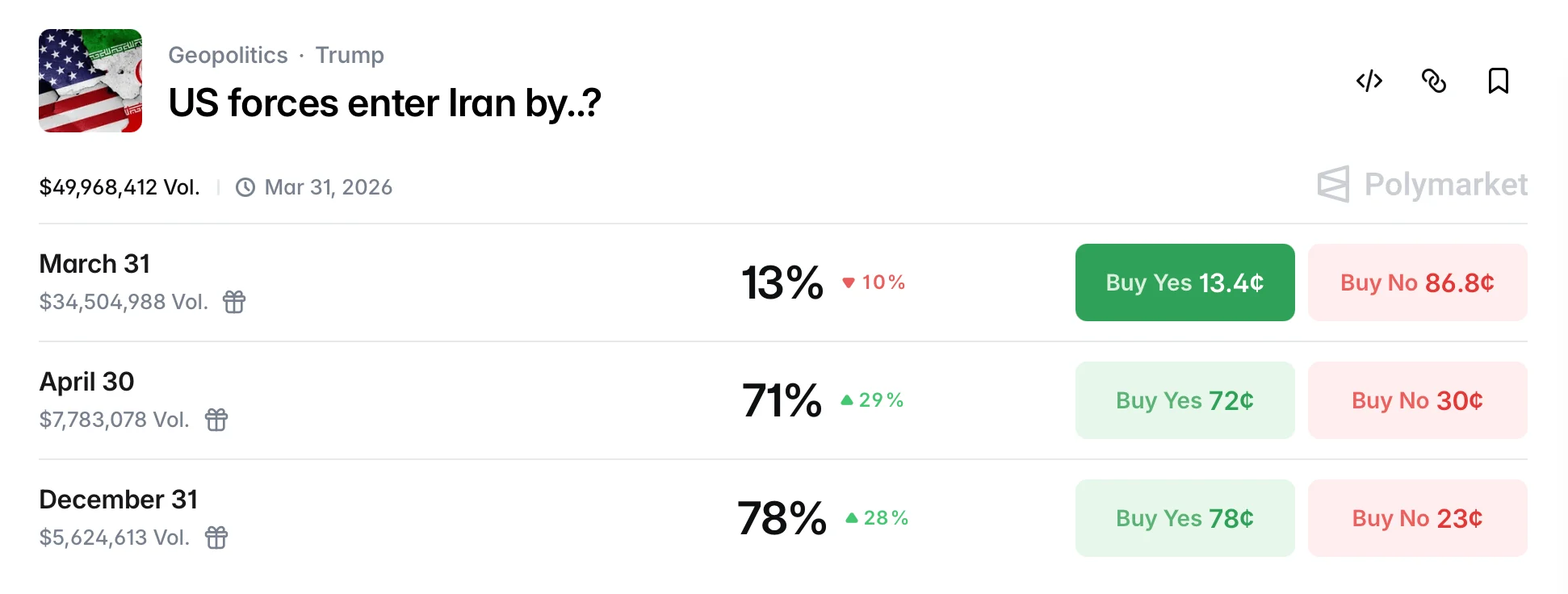 (Source: Polymarket)
The ground war contract related to Iran on the Polymarket platform has become one of the most traded geopolitical prediction assets, with market pricing for various time windows as follows:
Entering Iran by March 31: Probability 13%, corresponding contract trading volume reaches $34.5 million
Entering Iran by April 30: Probability 71%
Entering Iran by December 31: Probability 78%
The short-term contract for March 31 alone contributed $34.5 million in trading volume, reflecting that a large amount of capital is betting on the possibility of very short-term ground operations. Comments on the platform indicate that traders are closely tracking the movements of special forces; some large trades are attributed to a single account’s concentrated operations, raising industry concerns about the use of undisclosed information. In recent weeks, contracts related to Iran on prediction markets have been scrutinized for possible information asymmetry linked to the timing of airstrikes, but no formal investigation results have been released to date.
Tehran’s Dual Response: Battlefield Warnings and Market Manipulation Accusations
Iranian Parliament Speaker Mohamad Bagher Ghalibaf issued two warnings on the X platform: on the military front, he stated that Iranian forces are “waiting for ground troops to enter so that they can be incinerated”; on the market front, he accused the headlines surrounding the U.S.-Iran conflict of being “deliberately staged” to allow specific participants to profit ahead of market movements, urging traders to adopt counter-trend strategies—shorting when positive headlines drive prices up and going long when negative headlines trigger price drops.
Currently, diplomatic negotiation channels using Pakistan as a third-party intermediary are being secretly advanced, and whether the conflict can be resolved through diplomatic means before formal ground action orders are issued remains the core variable most closely watched by the market.
Frequently Asked Questions
Have U.S. military personnel entered Iranian territory as of now?
According to reliable reports as of March 29, 2026, no U.S. military personnel have been confirmed to have entered Iranian territory. Existing deployments still belong to the buildup of forces within the Middle East region and the Pentagon’s emergency plan formulation phase, with operational orders not yet approved.
Is there a risk of market manipulation for contracts related to Iran on Polymarket?
Contracts on Iranian-related prediction markets have drawn industry attention in recent weeks due to potential information asymmetry linked to the timing of airstrikes. Some large single transactions have been attributed to personal accounts, raising concerns about the use of undisclosed information, but no formal investigation results have been released to date, and related reviews are still ongoing.
What is the strategic significance of Kharg Island for Iran’s oil exports?
Kharg Island handles about 90% of Iran’s oil exports and is the most critical node in its energy infrastructure. If raiding operations are successful, it would directly cut off Iran’s main source of oil revenue, causing immediate and significant impacts on global oil prices and energy markets, while the shipping security in the Strait of Hormuz would also face heightened risks.
Disclaimer: The information on this page may come from third parties and does not represent the views or opinions of Gate. The content displayed on this page is for reference only and does not constitute any financial, investment, or legal advice. Gate does not guarantee the accuracy or completeness of the information and shall not be liable for any losses arising from the use of this information. Virtual asset investments carry high risks and are subject to significant price volatility. You may lose all of your invested principal. Please fully understand the relevant risks and make prudent decisions based on your own financial situation and risk tolerance. For details, please refer to
Disclaimer.


