
On-chain analyst Darkfost’s data shows that the net inflow of stablecoins to mainstream centralized exchanges (CEX) reached $2.4 billion, marking a reversal in capital flow trends in the cryptocurrency market. However, research institution 10x Research’s data synchronously reveals a contradiction: despite the massive return of stablecoins to trading platforms, spot trading volume plummeted from a peak of $81 billion to only $3.5 billion, indicating that traders are not converting this into actual positions.
Reversal of Stablecoin Net Flow: Capital Signals Behind $2.4 Billion
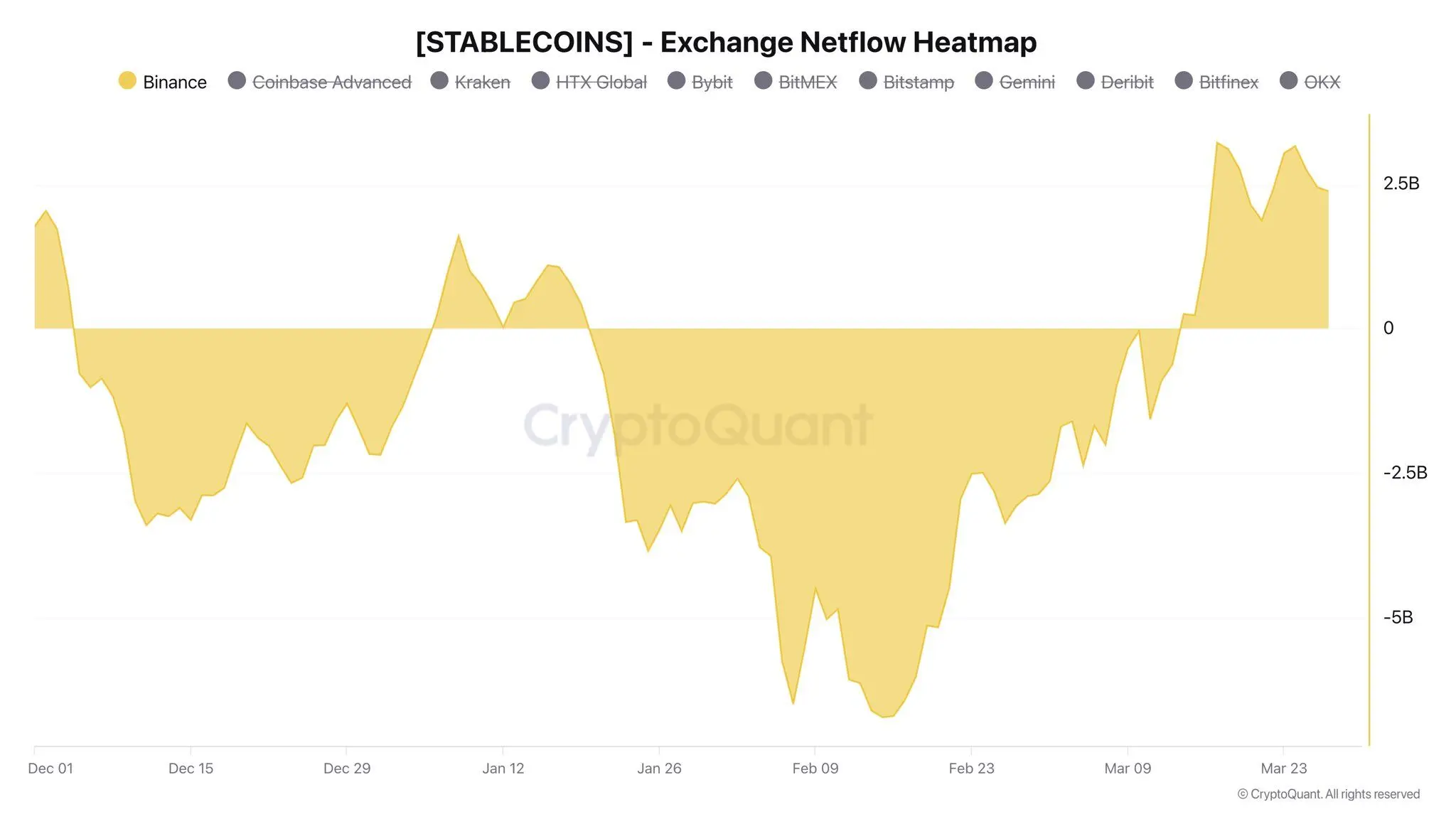 (Source: CryptoQuant)
Stablecoins are widely regarded as “deployable funds” within the cryptocurrency ecosystem, and inflows to exchanges are typically interpreted as a positive forward-looking signal that traders are preparing to build positions. This positive net flow occurred after a series of significant outflows, representing a notable reversal.
Major Stablecoin Withdrawal Records Before the Inflow Turnaround
December 11, 2025: Net outflow of $3.4 billion in a single day
February 15, 2026: Net outflow of $6.7 billion in a single day— the largest single-day outflow in recent times
March 2026: Net flow reversed to +$2.4 billion, marking a turning point in the trend of capital returning
This data reversal represents a significant amount of capital re-entering the market, with Darkfost noting that it is an important signal of a “significant change” in the liquidity environment. However, the crux of the issue lies in the fact that the movement of these returning funds has not yet been reflected in actual trading activity.
Liquidity Returns but Action Stalls: Market Vulnerability is Accumulating
10x Research’s analytical data reveals a deeper contradiction. Despite the continuous inflow of stablecoins to trading platforms, spot trading volume has experienced a shocking contraction—from a peak of $81 billion at the beginning of 2025 to currently only $3.5 billion, a decline of over 95%.
This creates a clear market disconnection: investors are transferring stablecoins to trading platforms but are not converting them into actual positions. On-paper liquidity is increasing, but risk appetite has not kept pace. Analysts warn that this state itself poses potential risks: “Liquidity support is weakening, and as a new gamma distribution gradually forms, price breaks through key levels may exacerbate volatility and trigger sharp price reactions. The sluggish liquidation activity and weak trading volume mask the market’s underlying vulnerabilities.”
The macro backdrop further intensifies the wait-and-see sentiment. The ongoing US-Iran conflict continues to disrupt global markets, oil prices have surged, stock markets are under pressure, and recession risk expectations are heating up. Darkfost points out: “While the cryptocurrency market has shown relative resilience in recent weeks, it has not escaped unscathed.”
In this environment, the reversal of stablecoin net flow from significant outflows to inflows is a positive signal of capital re-entering; however, before a noticeable rebound in spot trading activity occurs, the information presented by the data is closer to a cautious wait-and-see rather than a firm market sentiment to enter.
Frequently Asked Questions
Why is the inflow of stablecoins to cryptocurrency exchanges seen as a market turning signal?
Stablecoins represent “funds that can be deployed at any time” within the cryptocurrency ecosystem. Traders holding stablecoins have not yet built positions, and when stablecoins flow significantly into exchanges, it usually indicates that potential buying power is accumulating, serving as one of the leading indicators of a market sentiment shift.
What does the drop in spot trading volume from $81 billion to $3.5 billion signify?
The significant contraction in spot trading volume reflects a severe decline in market participation—funds may have entered the platform, but traders are choosing to hold stablecoins rather than actively building positions. This state of “money entering but action stalling” typically suggests in technical analysis that the market is waiting for clearer directional signals before taking action.
Why might increased liquidity lead to market vulnerability?
When a large amount of stablecoins accumulates on trading platforms but is not converted into positions, a shift in market sentiment could lead these funds to rapidly enter and exit the market, causing extreme price volatility. Analysts point out that the current low liquidation activity and weak trading volume mask this accumulated market instability.
Disclaimer: The information on this page may come from third parties and does not represent the views or opinions of Gate. The content displayed on this page is for reference only and does not constitute any financial, investment, or legal advice. Gate does not guarantee the accuracy or completeness of the information and shall not be liable for any losses arising from the use of this information. Virtual asset investments carry high risks and are subject to significant price volatility. You may lose all of your invested principal. Please fully understand the relevant risks and make prudent decisions based on your own financial situation and risk tolerance. For details, please refer to
Disclaimer.


