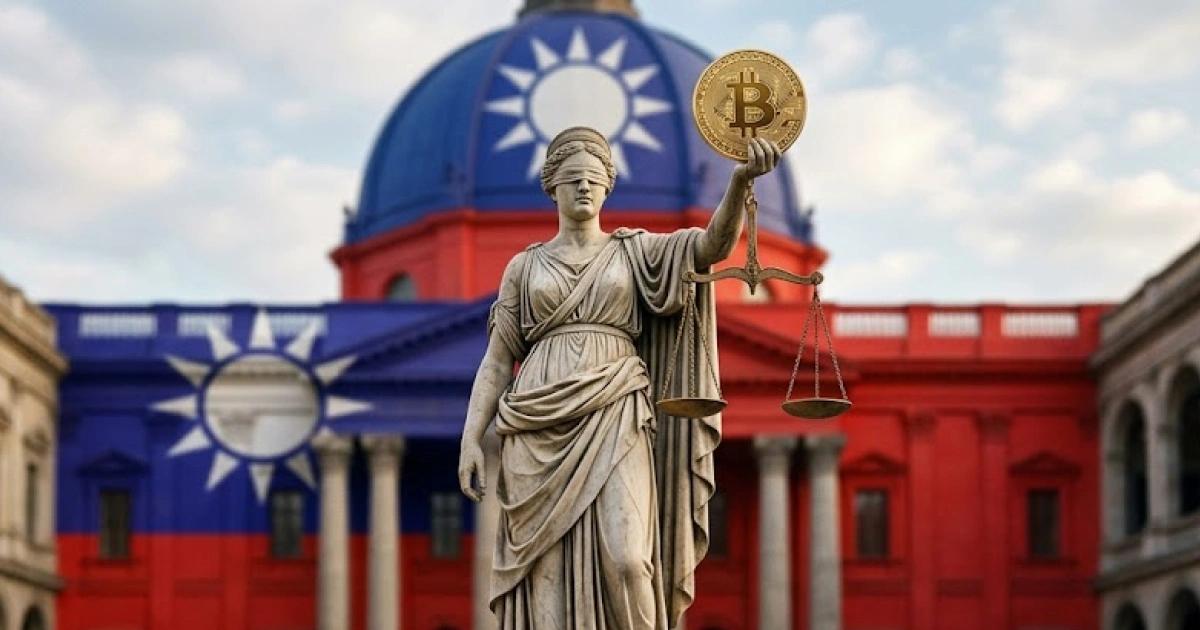
The Executive Yuan is now set to finalize a draft bill of the “Virtual Assets Services Act.” The new version explicitly states that in the initial phase, stablecoins may only be issued by banks, with interest payments prohibited; if a stablecoin is issued without authorization, the maximum penalty will be 100 million yuan. Additionally, concerns over competition and Chinese-funded capital arising from offshore crypto platforms establishing operations in Taiwan have also become focal points.
A revised draft of the Virtual Assets Services Act is expected to be approved at today’s Executive Yuan meeting
According to a report by the Economic Daily News, last year the Financial Supervisory Commission (FSC) formulated and submitted a draft of the “Virtual Assets Services Act” to the Executive Yuan. It is scheduled to be approved today (4/2) and has been designated as a priority bill for this legislative session, aiming to complete legislation as early as 2026.
The FSC’s goal in promoting Taiwan’s specialized crypto legislation is to fully incorporate virtual asset service providers (VASPs) into the financial regulatory system, establish a licensing framework aligned with international standards, promote healthy industry development, reduce risks, benchmark global trends, and attract blockchain talent.
In the draft of the “Virtual Assets Services Act,” VASPs are categorized into seven types, adopting a two-stage licensing system. Operators must obtain licenses according to their business type before commencing operations.
As of April 2, the list of legally registered virtual asset service providers (VASPs) in Taiwan, ordered by stroke count, is as follows:
- Hoya Digital Technology (HOYA BIT)
- Opener Digital Technology (ZONE Wallet)
- Modern Wealth Technology (MaiCoin, MAX Exchange)
- Weight Technology (KryptoGO)
- Fusheng Digital Technology (TWEX)
- Cross-chain Technology (Chainss)
- Bit Trust Technology (BitoPro)
- Linko Co., Ltd. (XREX Exchange)
Revised draft: Stablecoins are prohibited from paying interest and yields
In the draft version released by the FSC in March 2025, the main regulation states that stablecoin issuers must obtain approval to issue stablecoins. Conditions for approval include maintaining reserve assets independent of the issuer’s own assets, with regular audits conducted.
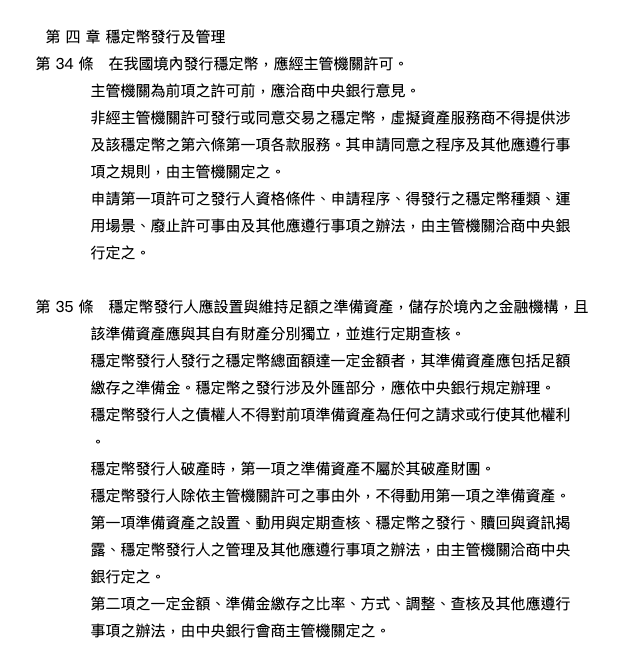
Source: The FSC announcement “Draft of the Virtual Assets Services Act” on the Legal Sources and Laws database
In the new version expected to be approved today, to align with the U.S. “GENIUS Act,” adjustments have been made to stablecoin management.
The new version of the “Virtual Assets Services Act” introduces two additional regulations:
- Stablecoin issuers must issue and redeem stablecoins at face value, and absolutely must not refuse redemption requests from holders
- Stablecoin issuers are fully prohibited from paying any interest or yields
Furthermore, the initial issuance of stablecoins will be strictly limited to banks. Penalties remain consistent with previous standards: unauthorized issuance can result in up to 7 years’ imprisonment and a fine of up to 100 million New Taiwan dollars.
Crypto-specific law expected to be enacted this year; legislators and local industry express concern over offshore platform entry
Beyond stablecoin regulations, legislators and domestic industry stakeholders are highly concerned about the impact of offshore cryptocurrency platforms establishing operations in Taiwan.
Legislator Lin Dai-hua previously pointed out that currently only 8 entities are legally registered across Taiwan, but there are as many as 30 unregulated “black” entities. Local industry fears that the entry of offshore giants will create unfair competition for domestic firms that have already invested in compliance. Concerns over the Chinese-funded backgrounds of several offshore platforms have also become a focus.
Binance, which the Economic Daily News reports intends to establish a presence in Taiwan, stated in an interview with Now Jukuan (This Week) magazine that its Asia-Pacific head, SB Seker, mainly comes from Singapore and other regions; if licensed in Taiwan, it will provide localized services strictly according to regulations.
- Related report: Binance intends to establish in Taiwan! Industry worries about impact on local crypto platforms; will Chinese funding affect national security?
Using traditional finance as a reference, the FSC has imposed numerous restrictions on foreign-invested companies to balance the competitiveness of Taiwan’s local banking sector. Citigroup has exited Taiwan’s consumer finance market; Star (with DBS) acquired the consumer finance business. The three major foreign banks—DBS, HSBC, and Standard Chartered—mainly focus on corporate banking and wealth management. Meanwhile, foreign securities firms have experienced downsizing and withdrawal waves: from 2020 to 2025, Morgan Stanley, Macquarie Capital, and Societe Generale Securities have successively ceased proprietary securities operations.
Additionally, Taiwan maintains strict criteria for identifying Chinese-funded entities. When reviewing VASP registration applications, the FSC conducts background checks on responsible persons and ultimate beneficial owners. How to balance industry growth with risk prevention will be a major challenge moving forward.
Disclaimer: The information on this page may come from third parties and does not represent the views or opinions of Gate. The content displayed on this page is for reference only and does not constitute any financial, investment, or legal advice. Gate does not guarantee the accuracy or completeness of the information and shall not be liable for any losses arising from the use of this information. Virtual asset investments carry high risks and are subject to significant price volatility. You may lose all of your invested principal. Please fully understand the relevant risks and make prudent decisions based on your own financial situation and risk tolerance. For details, please refer to
Disclaimer.


