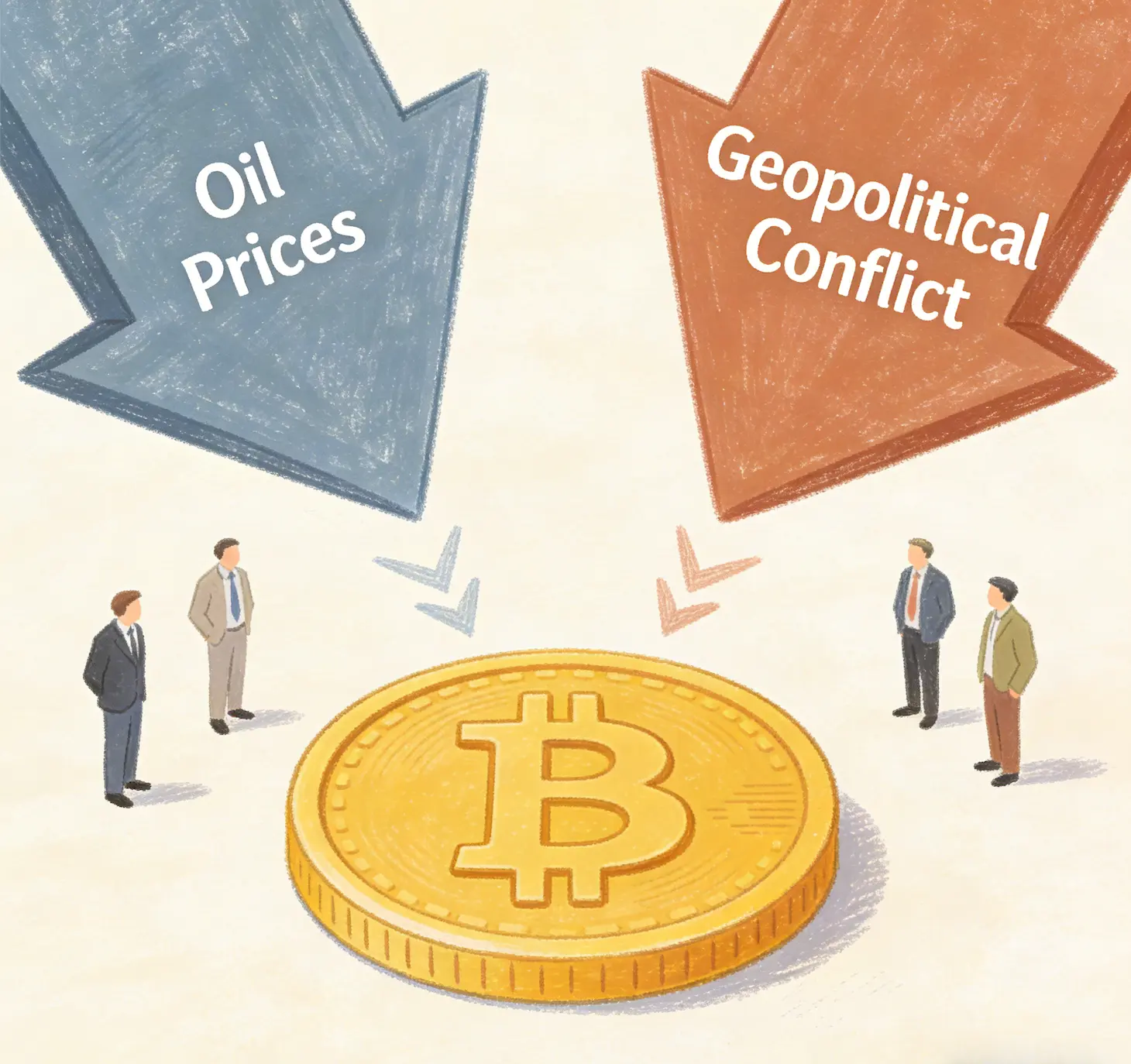
 Grayscale, a crypto asset manager, reported on April 2, 2026 that geopolitical tensions in the Middle East and a sharp oil price shock have delayed rate-cut expectations and kept investors cautious, even as crypto valuations have held relatively steady compared to other risk assets.
The firm noted that while the conflict has disrupted an otherwise improving macro backdrop, crypto has shown resilience with modest inflows and rising derivatives activity, suggesting a more durable bottom may be forming and potentially offering an entry point for long-term investors.
Macro Uncertainty from Iran Conflict and Oil Prices Weighs on Risk Assets
 (Source: GrayScale)
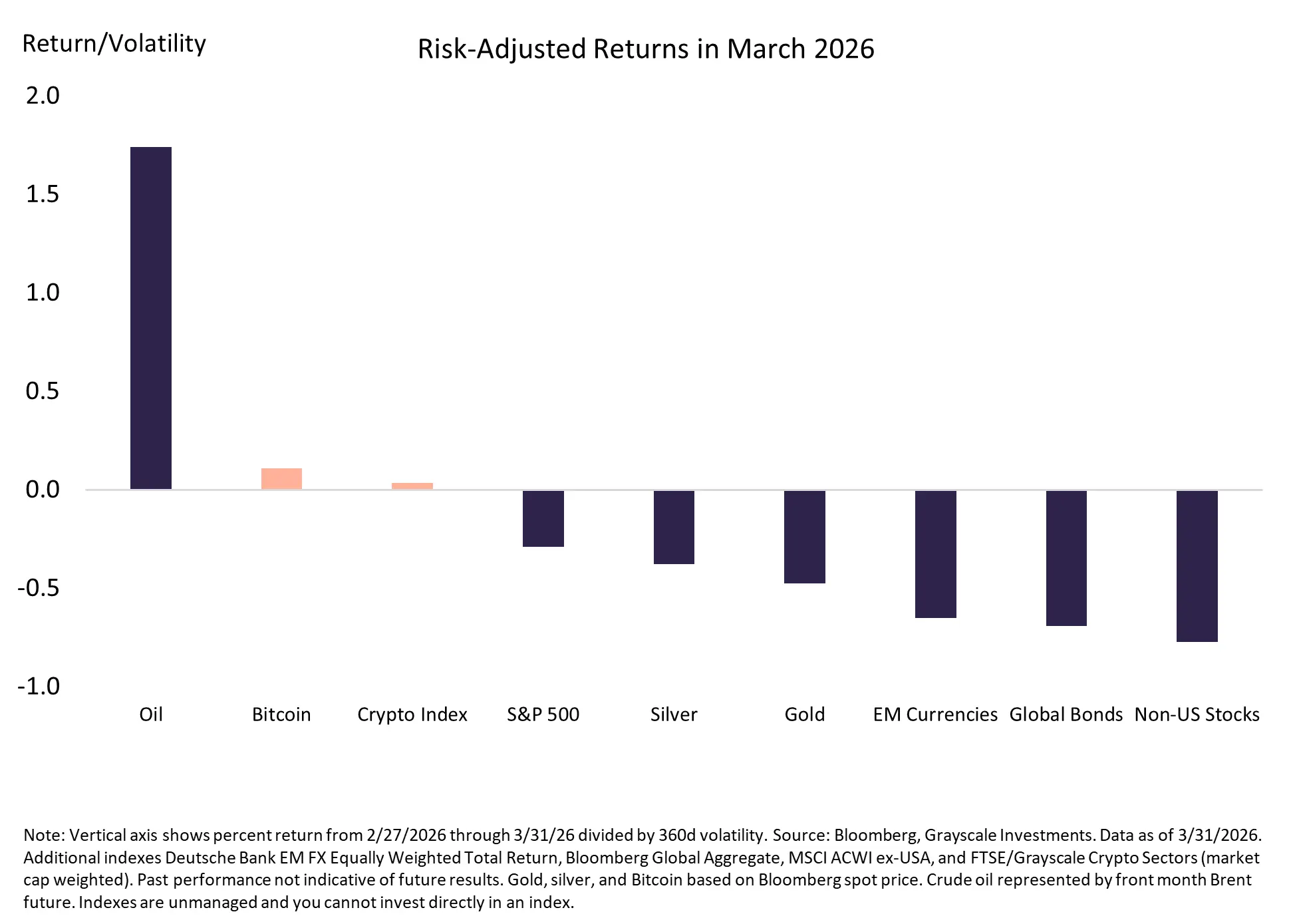
The war in Iran overshadowed virtually all other market developments in March 2026, according to Grayscale’s research team. Before the conflict escalated, global growth appeared to be strengthening and central banks were leaning toward rate cuts. However, the outbreak of war triggered a meaningful oil price shock, with spot oil prices rising approximately $46 per barrel (a 63% increase) and longer-dated futures moving higher as traders anticipated extended supply disruptions.
(Source: GrayScale)
The war in Iran overshadowed virtually all other market developments in March 2026, according to Grayscale’s research team. Before the conflict escalated, global growth appeared to be strengthening and central banks were leaning toward rate cuts. However, the outbreak of war triggered a meaningful oil price shock, with spot oil prices rising approximately $46 per barrel (a 63% increase) and longer-dated futures moving higher as traders anticipated extended supply disruptions.
The resulting inflation concerns have pushed interest rate expectations higher across major economies, weighing on risk assets. Broad equity indexes, government bonds, and precious metals all moved lower. Despite the turbulence, crypto assets eked out a small gain in March, with Bitcoin roughly flat since the start of the war and even outperforming equities at times.
Bitcoin initially dropped into the mid-$60,000s on the first escalation, then rebounded toward the low-$70,000s before slipping back as the conflict dragged on. More recently, renewed escalation pushed Bitcoin down approximately 10% from March highs, alongside declines in Ether and other tokens. Grayscale expects many market participants to remain on the sidelines until geopolitical risks clear.
SEC and CFTC Issue Joint Guidance Clarifying Crypto Asset Classification
Mid-March, the Securities and Exchange Commission (SEC) issued new interpretive guidance on the application of federal securities laws to crypto assets, developed in conjunction with the Commodity Futures Trading Commission (CFTC). The guidance put to rest several long-standing questions for crypto entrepreneurs.
The SEC categorized crypto assets into five distinct groups. Digital securities are securities. Stablecoins can be securities if they are not GENIUS Act-compliant and offer security-like elements. All other crypto assets are not securities. Most tokens are not securities, but even non-security tokens can be subject to an “investment contract” under standard Howey test logic if investors reasonably expect profits based on the efforts of an issuer. The guidance also clarified that mining, staking, wrapped assets, and airdrops are generally not considered securities transactions.
Grayscale noted that the joint guidance reduces regulatory tail risks and may stimulate new investment activity, potentially driving value back to underlying networks and their native assets including ETH, SOL, SUI, BNB, and AVAX.
CLARITY Act Remains Uncertain as Stablecoin Yield Debate Continues
The fate of the CLARITY Act in the U.S. Senate remains uncertain, with a Polymarket contract putting the odds of passage around 50%. Stablecoin rewards have emerged as a central point of debate, threatening certain bank revenues.
On March 20, senators announced an agreement in principle to advance the bill out of the Senate Banking Committee. By March 24, a framework was introduced that would prohibit yield on purely passive stablecoin holdings while permitting limited activity-based rewards tied to payments or platform usage. The proposal was intended to address banks’ concerns around deposit displacement while preserving room for innovation. Industry participants have since organized around a counterproposal seeking more flexible treatment of rewards. Negotiations continue, with the goal of enabling a committee markup in April and potential passage as early as May.
Hyperliquid and Bittensor Stand Out as Top Performers in March
 (Source: Artemis)
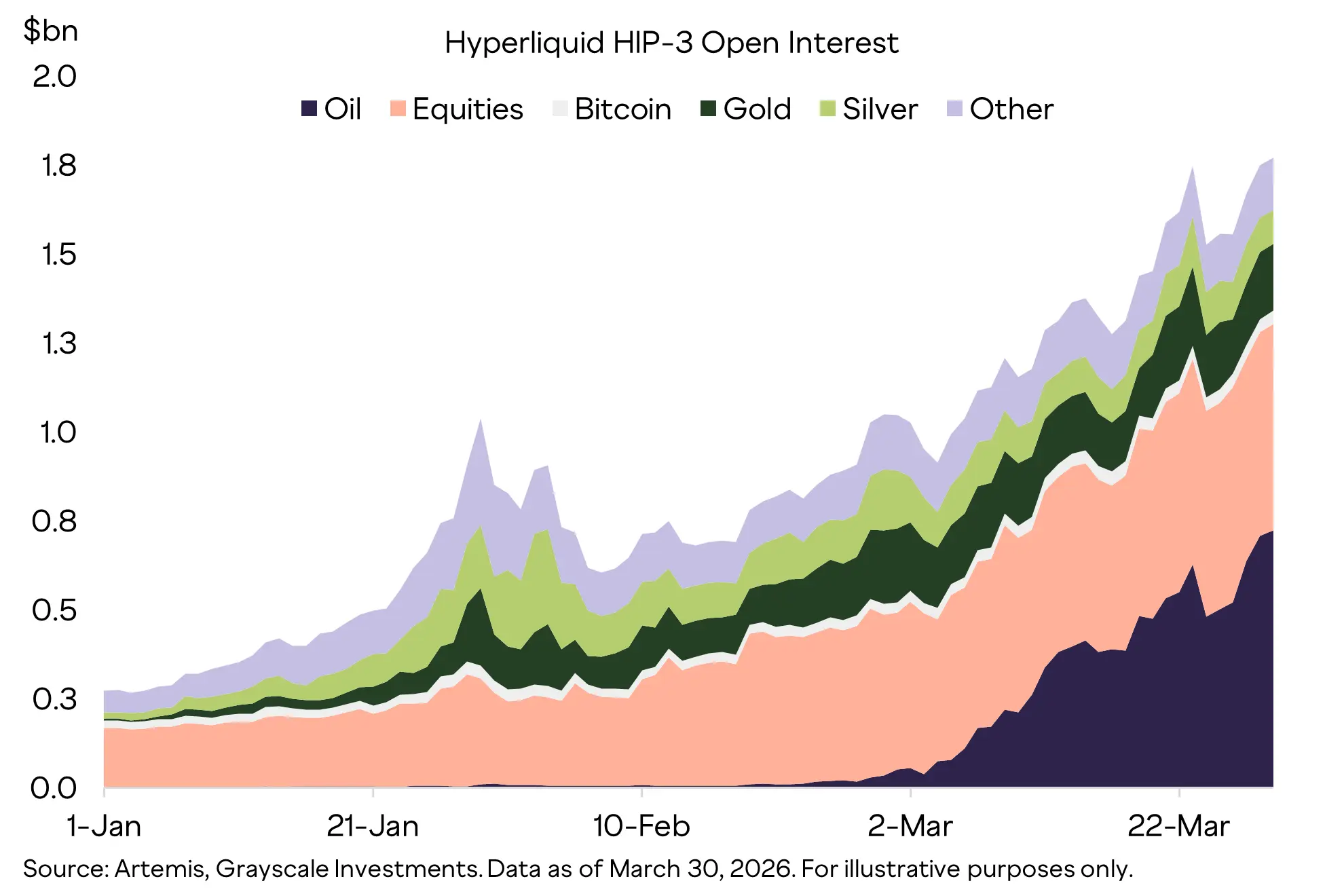
Financials were the best-performing crypto sector during March, led by Hyperliquid. The platform’s growth has been driven largely by HIP-3, which enables 24/7 trading of traditional assets including equities and commodities. TradeXYZ, an HIP-3 deployer, partnered with S&P Dow Jones Indices to launch the first officially licensed S&P 500 perpetual contract on Hyperliquid. The long-anticipated HIP-4 upgrade also gained traction as interest in prediction markets continued to accelerate.
(Source: Artemis)
Financials were the best-performing crypto sector during March, led by Hyperliquid. The platform’s growth has been driven largely by HIP-3, which enables 24/7 trading of traditional assets including equities and commodities. TradeXYZ, an HIP-3 deployer, partnered with S&P Dow Jones Indices to launch the first officially licensed S&P 500 perpetual contract on Hyperliquid. The long-anticipated HIP-4 upgrade also gained traction as interest in prediction markets continued to accelerate.
The AI narrative gained momentum, with Bittensor emerging as a notable beneficiary. TAO was up 71% in March as investors focused on the convergence of blockchain and AI technologies. On March 10, a Bittensor subnet announced that it trained a 72 billion parameter large language model using a permissionless network of nodes, demonstrating that decentralized infrastructure can support AI development at scale. Bittensor also drew attention following a mention on the All-In Podcast during an interview with Nvidia CEO Jensen Huang.
Outlook: Reduced Macro Uncertainty Needed for Sustained Rebound
Grayscale maintains that the long-term drivers of the asset class, including growing adoption of stablecoins and tokenized assets, remain intact. The stablecoin market has expanded rapidly, with total supply rising from approximately $20 billion in 2020 to more than $300 billion by 2025, and currently around $315 billion. The sector added roughly $100 billion in 2025 alone.
If the active conflict ends soon and oil prices come down, markets could again price in a favorable macro backdrop. If not, a sustained increase in oil prices may weigh on growth and delay recovery. Grayscale believes now is a good time for longer-term crypto investors to build positions, noting that valuations have held since the start of the war, suggesting a more durable bottom may be in place.
FAQ
What is keeping crypto investors on the sidelines according to Grayscale?
Geopolitical tensions in the Middle East, particularly the Iran war, and a sharp oil price shock have delayed rate-cut expectations and increased inflation concerns. This macro uncertainty has weighed on risk assets and kept investors cautious, despite crypto showing relative resilience compared to traditional markets.
What regulatory clarity did the SEC and CFTC provide in March 2026?
The SEC and CFTC issued joint guidance clarifying that most digital assets are not securities, while providing a taxonomy for crypto assets. The guidance also clarified that mining, staking, wrapped assets, and airdrops are generally not considered securities transactions, reducing regulatory tail risks for the industry.
Which crypto projects stood out as top performers in March 2026?
Hyperliquid led the financials sector, driven by HIP-3 enabling 24/7 trading of traditional assets and a partnership with S&P Dow Jones Indices for an S&P 500 perpetual contract. Bittensor was a standout in the AI narrative, with TAO up 71% following news of decentralized AI model training and a mention by Nvidia’s CEO.
Disclaimer: The information on this page may come from third parties and does not represent the views or opinions of Gate. The content displayed on this page is for reference only and does not constitute any financial, investment, or legal advice. Gate does not guarantee the accuracy or completeness of the information and shall not be liable for any losses arising from the use of this information. Virtual asset investments carry high risks and are subject to significant price volatility. You may lose all of your invested principal. Please fully understand the relevant risks and make prudent decisions based on your own financial situation and risk tolerance. For details, please refer to
Disclaimer.


