


Earnings Far Exceed Expectations: How AI Infrastructure Drives Record-Setting Quarters
On June 1, 2026, HPE released its fiscal Q2 2026 earnings report, posting revenue of $10.7 billion—a 40% year-over-year increase and well above Wall Street’s consensus estimate of $9.8 billion. Non-GAAP earnings per share reached $0.79, up 108% year-over-year and significantly beating the market’s $0.53 forecast. On the profit side, GAAP gross margin rose from 28.4% a year ago to 36.5%, while adjusted gross margin hit 36.9%, expanding by 750 basis points year-over-year.
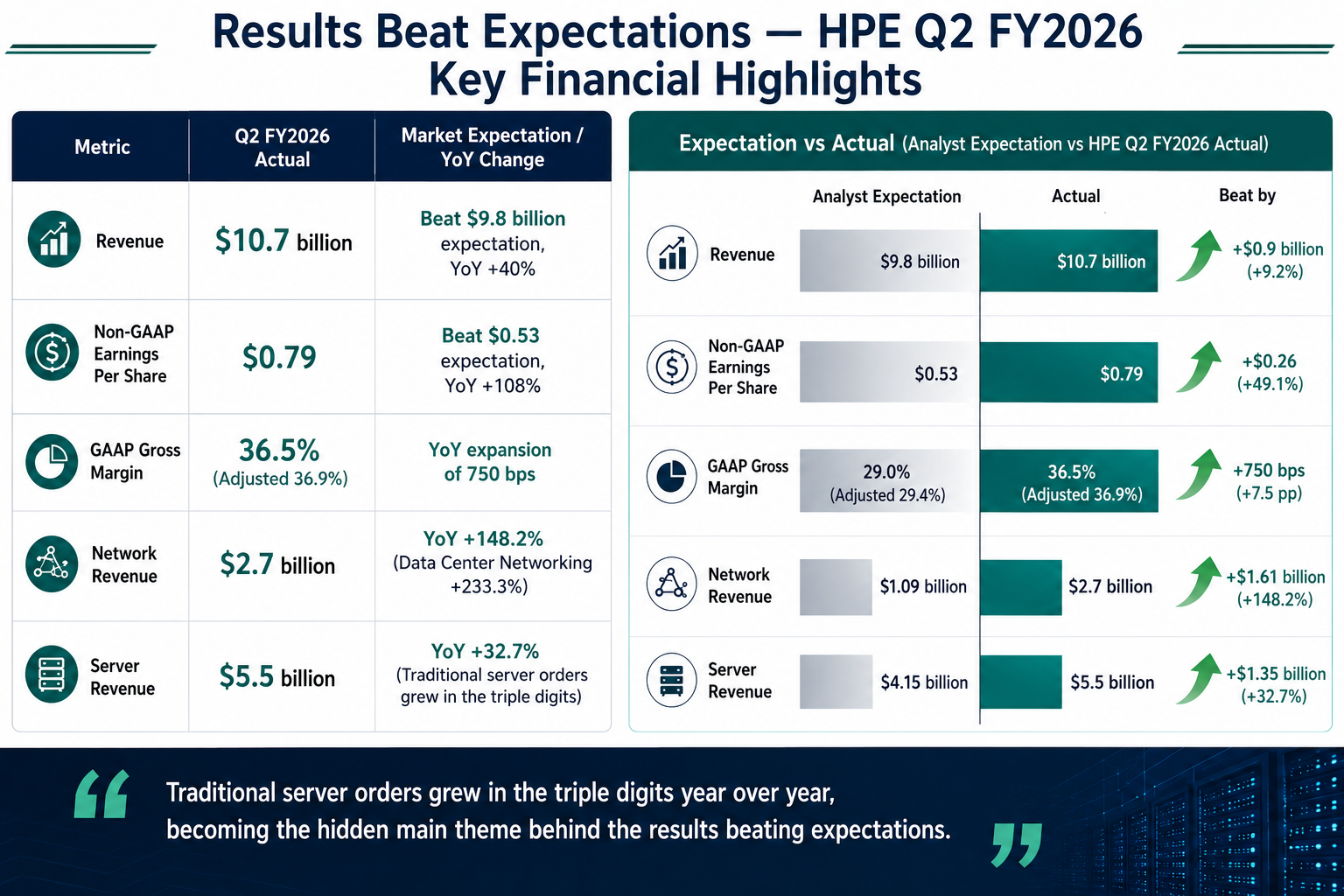
Earnings Beat Expectations—Snapshot of HPE Q2 FY2026 Core Financials
Within the revenue mix, networking delivered the most impressive growth. Following the integration of Juniper Networks, networking revenue reached $2.7 billion, up 148.2% year-over-year. Campus and branch revenue grew 50.2%, data center networking soared 233.3%, and security business rose 155.1%. The cloud and AI segment generated $7.7 billion in revenue, up 22.9% year-over-year, with server revenue at $5.5 billion—a 32.7% increase.
A notable structural shift emerged this quarter: traditional server business saw triple-digit year-over-year order growth. This defies conventional wisdom—while much of the market focuses on GPU-accelerated computing and cloud hyperscaler purchases, traditional CPU servers are benefiting from AI inference workloads migrating to on-premises enterprise environments, becoming a core driver of HPE’s growth.
Upwardly Revised Guidance: Why HPE Hit Two-Year Targets Ahead of Schedule
Following the earnings release, HPE sharply raised its full-year FY2026 guidance, increasing expected revenue growth from 17–22% to 29–33% and boosting adjusted full-year EPS from $2.30–$2.50 to $3.35–$3.45. For Q3, the company projects revenue of $11.5–$12.1 billion and adjusted EPS of $0.88–$0.93.
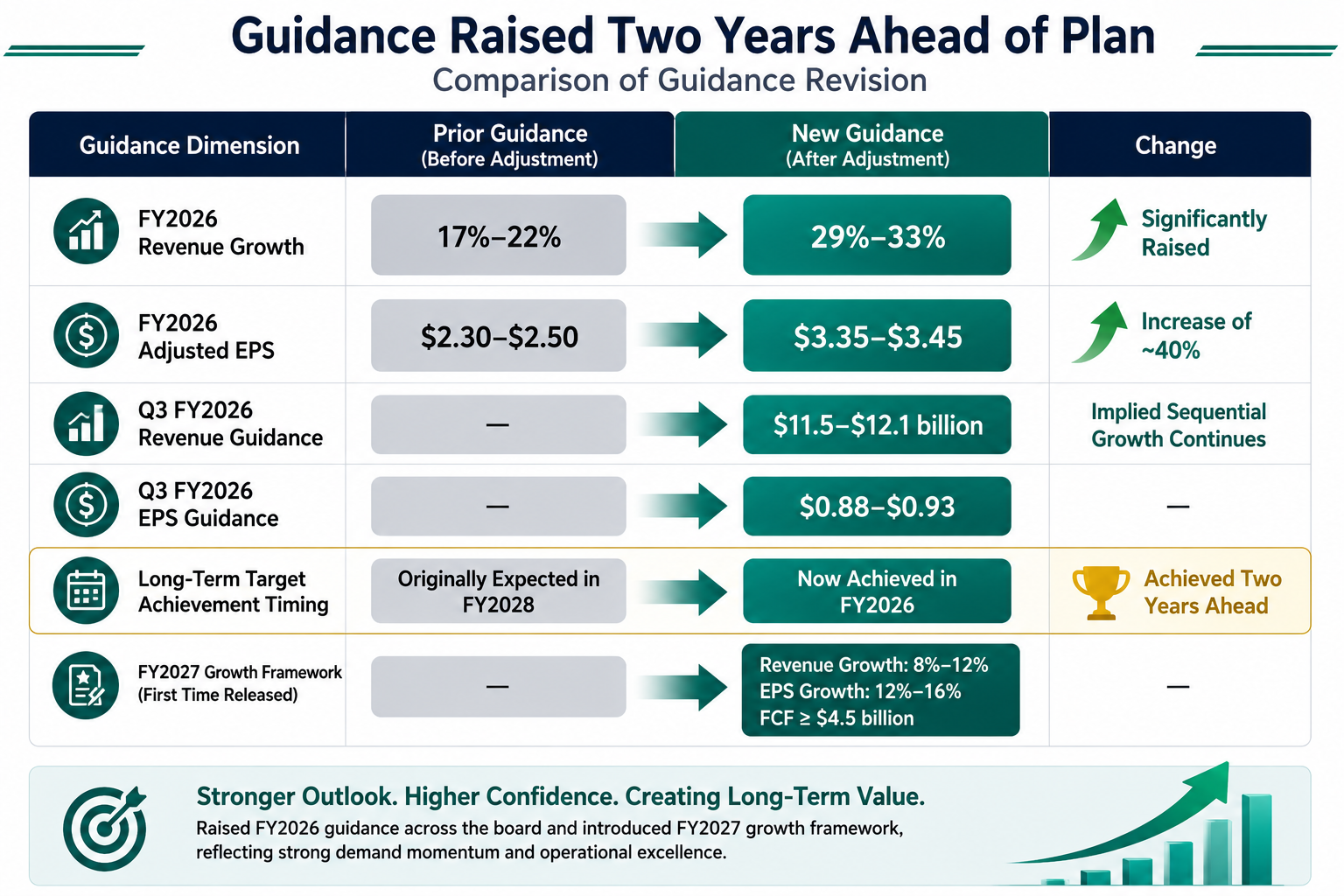
Delivering Two Years Early—Comparison of Guidance Upgrades
Crucially, HPE revealed that its revised FY2026 adjusted EPS and free cash flow targets now surpass levels it previously expected to reach by FY2028. In effect, HPE has delivered on its long-term financial goals two years ahead of schedule. The company also issued its first growth framework for FY2027, projecting 8–12% revenue growth, 12–16% adjusted EPS growth, and free cash flow of at least $4.5 billion.
Such magnitude and pace of upward revisions are rare among traditional IT hardware giants, highlighting the visibility and certainty of HPE’s AI-related order pipeline—well beyond what the market had anticipated.
Record Order Backlog: What Are the Structural Features of AI Demand?
Order data provides the clearest lens into HPE’s explosive performance. The company reported total order volume more than doubled year-over-year, with backlog reaching a record high. In the AI segment, Q2 saw $1.8 billion in new AI system orders, bringing cumulative AI system orders to $16.4 billion and AI-related backlog to $5.9 billion. With the integration of networking, HPE raised its cumulative AI networking order target to at least $2 billion.
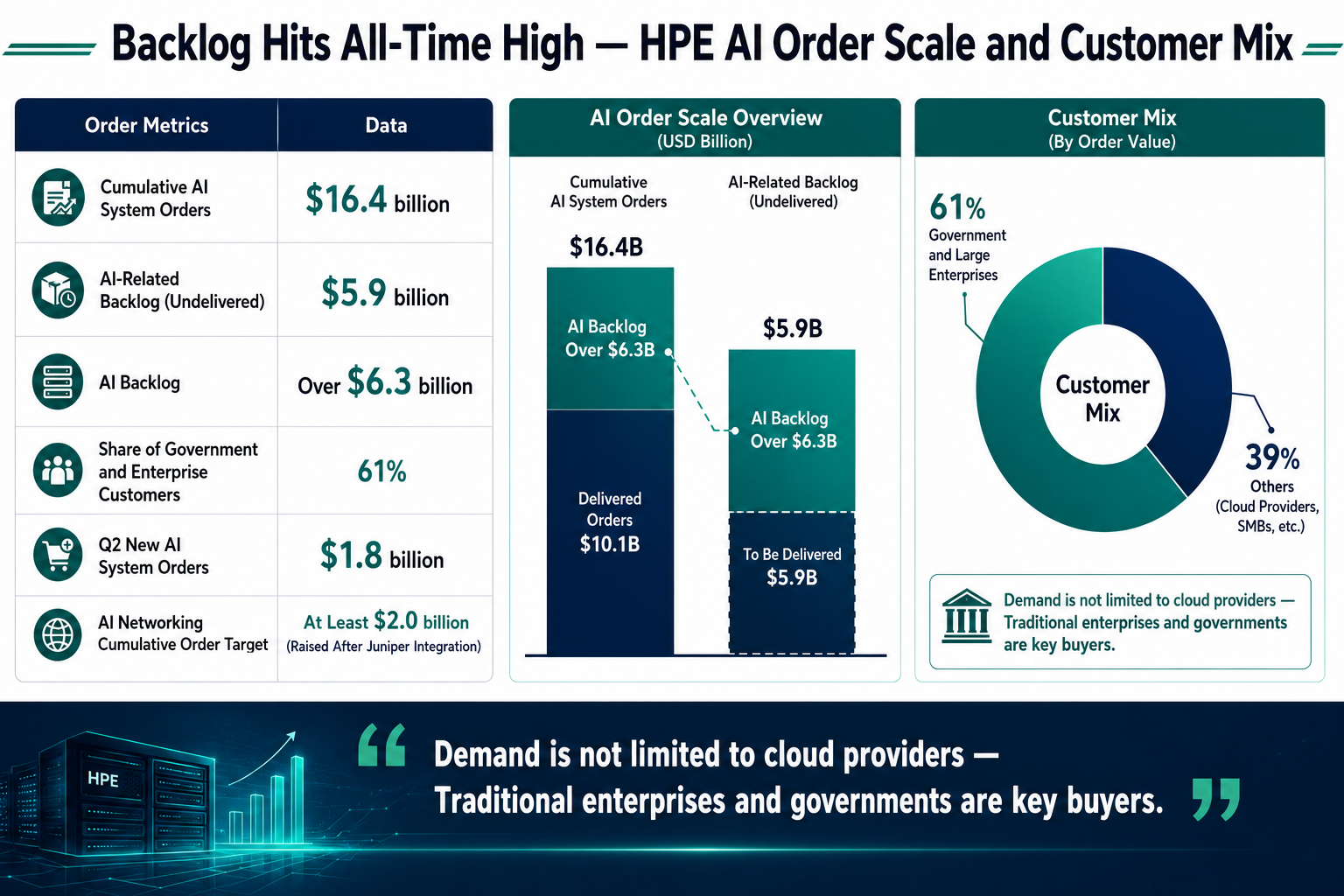
Record-High Backlog—HPE AI Order Volume and Customer Mix
Order structure is also noteworthy. HPE stated that total AI backlog now exceeds $6.3 billion, with 61% coming from government and large enterprise customers. This indicates that demand for AI infrastructure isn’t limited to cloud hyperscalers—government agencies and traditional enterprises are also major buyers. CEO Antonio Neri emphasized during the earnings call that industries with high security requirements are rapidly deploying AI on-premises rather than relying solely on the cloud.
Enterprise willingness to invest in AI infrastructure is also significant. HPE noted that the AI data center buildout shows no signs of cooling, and enterprise customers are not cutting budgets in response to higher prices. On the contrary, many are accelerating purchases out of fear of falling behind in the AI race. As Neri put it, "No one wants to be left behind when it comes to deploying AI."
Accelerating Strategic Transformation: From Asset Restructuring to Cutting-Edge Technology
Over the past two months, HPE completed a series of major strategic moves. In May 2026, the company finalized the sale of its remaining 19% stake in H3C Technologies, realizing approximately $986.8 million from the sale of a 13.8% stake. This marks a structural overhaul of HPE’s China business and brings in substantial cash flow.
During the same period, HPE named Ingram Micro and TD SYNNEX as global distribution partners, integrating the channel system following last year’s Juniper Networks acquisition and establishing a unified global distribution model.
On the technology front, HPE continues to deepen its strategic partnership with NVIDIA. In March 2026, HPE launched the HPE AI Grid end-to-end solution, built on NVIDIA’s inference architecture, designed to securely connect regional and remote edge AI factories with distributed inference clusters—transforming fragmented AI facilities into unified intelligent systems. On June 1, at COMPUTEX, HPE announced the HPE ProLiant Compute DL394 Gen12 server featuring NVIDIA Vera CPUs, purpose-built for agent-based AI and reinforcement learning workloads, with availability expected in fall 2026.
Shifting Compute Market Landscape: Why Enterprise Inference Is the New Growth Engine
The backdrop to HPE’s breakout quarter is a structural transformation in the global compute market in 2026. A full-spectrum compute shortage—spanning chips, cloud, servers, and data center components—is sweeping the industry. On the demand side, agent technology is rapidly commercializing, with AI moving from chat to work and entering real-world production at scale. IDC forecasts the number of active agents worldwide will soar from 28.6 million in 2025 to 2.216 billion by 2030.
On the supply side, this shortage isn’t a traditional cyclical fluctuation, but a chain-wide, locked-in scarcity driven by simultaneous structural reinforcement of both demand and supply. Compute architecture is entering a reconstruction phase: GPU-centric systems are gradually giving way to multi-architecture, heterogeneous environments. Inference workloads now demand lower latency, higher throughput, and lower per-token costs. CPUs are becoming increasingly vital in inference pipelines, taking on greater roles in scheduling, memory access, and system coordination—explaining the triple-digit order growth in HPE’s traditional server business this quarter.
Enterprise demand for local inference systems is intensifying. HPE management noted robust demand for on-premises AI systems, with the company’s CPU-based servers securely running inference workloads locally, rather than relying entirely on cloud compute. This shift is opening up new growth opportunities for traditional hardware vendors able to deliver secure, on-premises infrastructure for enterprise and government clients.
Institutional Assessments and Market Debate: Where Are the Limits of HPE’s Revaluation?
After the earnings release, multiple Wall Street banks sharply raised their HPE price targets. Morgan Stanley increased its target from $33 to $71, Bank of America Securities from $38 to $80, UBS from $25 to $65, Barclays from $28 to $67, and Raymond James from $29 to $74.
However, there are still differing views. Morgan Stanley’s report pointed out that the sustainability of enterprise demand beyond FY2027 remains uncertain, and after a major re-rating, the key debate is whether this marks the start of a true multi-year upcycle. UBS, while raising its target to $65, maintained a neutral rating, noting that HPE’s share price has already seen a significant revaluation and is now on its overvalued watchlist.
HPE is also proactively managing risk. To address cost pressures from rising DRAM and NAND memory prices, the company has secured long-term supply contracts through 2027 and began passing on costs to customers via price adjustments since late last year. CFO Marie Myers expressed optimism about AI delivery volumes and conversion rates for the coming quarters, expecting a peak in Q4.
Conclusion
HPE’s roughly 95% surge over the past month and record highs signal an industry-wide shift as enterprise AI compute demand expands from cloud providers to broader infrastructure layers. The company’s Q2 revenue of $10.7 billion (up 40% year-over-year) and $16.4 billion in cumulative AI system orders highlight sustained enterprise investment in AI inference, agent-based AI, and on-premises deployment. The pervasive compute shortage is reshaping valuation logic for IT hardware suppliers. Whether HPE can continue converting its order backlog into revenue and profit amid supply bottlenecks and valuation pressures will determine the depth of this revaluation cycle.
FAQ
What are the main drivers behind HPE’s 95% surge over the past month?
The immediate catalyst was the Q2 earnings release on June 1, 2026—$10.7 billion in revenue (up 40% year-over-year) and sharply raised full-year guidance. The deeper driver is the migration of AI inference workloads to on-premises enterprise environments, with the traditional server business seeing explosive order growth as a direct result.
What are HPE’s main competitive advantages in AI infrastructure?
HPE stands out by offering a comprehensive portfolio of AI servers, networking, storage, and on-premises systems—especially valued by enterprise and government clients for security and trust. Its AI networking capabilities, strengthened by the Juniper Networks integration, and deep collaboration with NVIDIA on cutting-edge solutions like AI Grid, further reinforce its edge.
What are the main risks facing HPE?
Key risks include supply bottlenecks and rising costs for critical components like memory, the possibility of valuation correction after the stock’s sharp rally, and uncertainty over whether enterprise AI demand growth can be sustained beyond FY2027.
How large is HPE’s AI-related order book?
As of the Q2 report, HPE’s cumulative AI system orders reached $16.4 billion, with $5.9 billion in AI-related backlog. After integrating networking, the cumulative AI networking order target was raised to at least $2 billion. Over 60% of AI backlog comes from government and large enterprise customers.
What role does the traditional server business play in the AI wave?
Traditional CPU servers are handling an increasing share of AI inference workloads. Inference scenarios demand lower latency, higher throughput, and lower costs, prompting enterprises to run inference tasks securely on-premises instead of relying solely on the cloud. This trend positions traditional servers as a new growth engine for AI infrastructure alongside GPU-accelerated computing.


