Apple Inc. trades on The Nasdaq Stock Market LLC under the ticker symbol AAPL. Apple also pays a cash dividend, which makes dividend treatment an important topic for users who buy or hold Apple stock through Gate. The key question is not only whether Apple pays dividends. It is how a Gate Stocks position is recorded, whether the holding qualifies for dividend-related treatment, and what rights are available under the current product rules.
Buying Apple stock on Gate refers to accessing Apple Inc. stock exposure through Gate Stocks using USDT settlement, subject to Gate account eligibility, regional availability, product rules, market liquidity, and corporate action handling.
What Does Buying Apple Stock on Gate Mean?
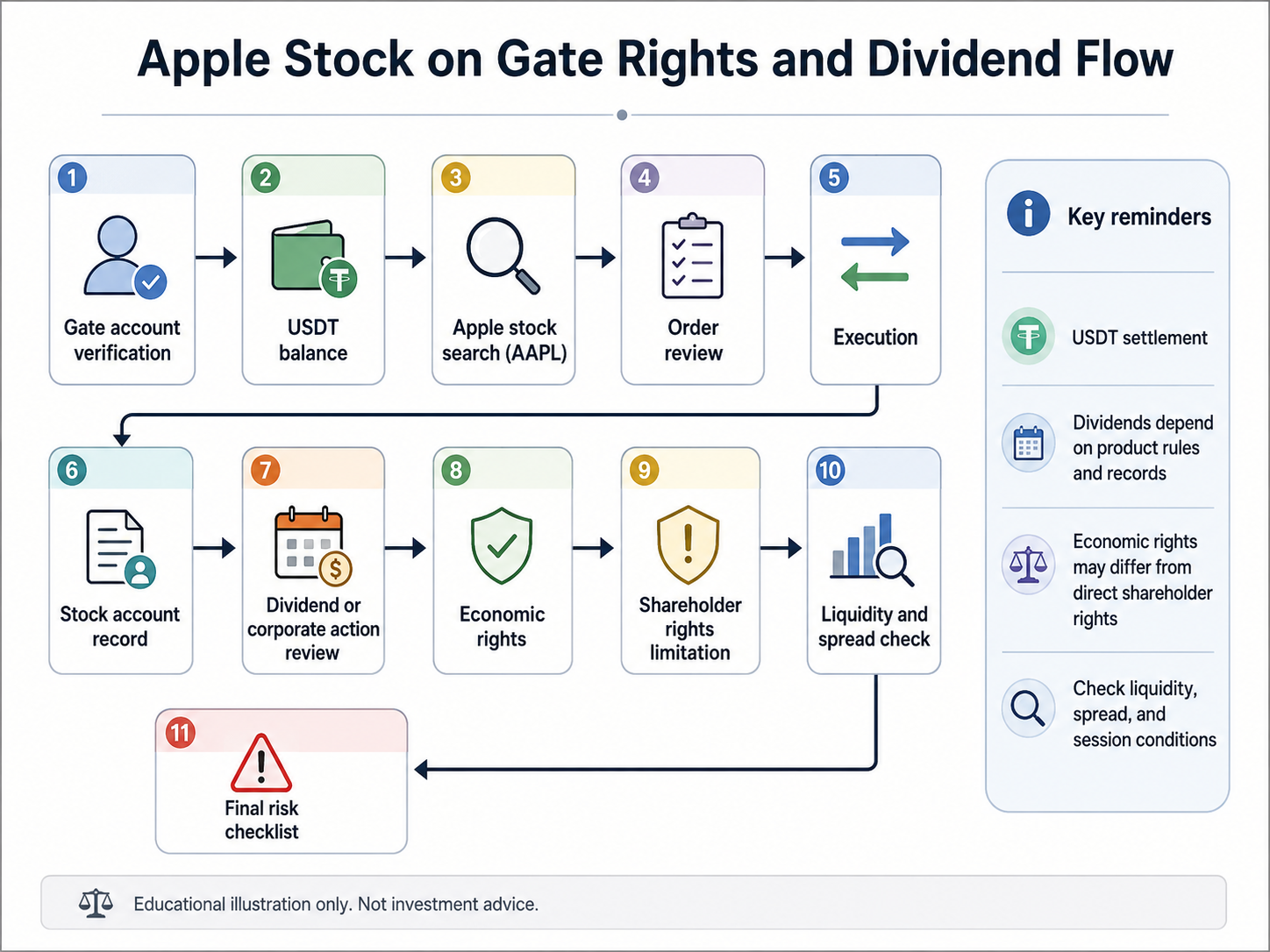
Buying Apple stock on Gate is a USDT-settled stock access workflow. Instead of first opening a separate traditional brokerage account, an eligible user may use a Gate account, complete required checks, hold USDT, enter Gate Stocks, search for Apple or AAPL, and review the live order page before placing an order.
The product-specific path is covered in buying Apple stock with USDT on Gate, while the broader mechanism is easier to understand through buying U.S. stocks with USDT. The first topic focuses on Apple. The second explains the general stock-access model, including USDT balance preparation, product checks, order confirmation, and account review.
USDT is the settlement asset. This means the user’s cost, proceeds, and account records are viewed through a USDT-based platform interface rather than a traditional fiat brokerage path. That can feel familiar to crypto users, but Apple stock remains an equity-linked asset. Its price may move because of company results, product cycles, service revenue, interest rates, sector sentiment, regulatory updates, and broader U.S. market conditions.
A simple analogy helps. Gate Stocks is like entering a stock-market access lane from inside a crypto platform. The doorway is different from a broker’s doorway, but the asset still connects to stock-market rules, trading sessions, liquidity, corporate actions, and risk.
How Do Apple Stock Dividends Work on Gate?
Apple stock dividends on Gate should be understood as a corporate action and account-record process, not simply as a headline from Apple Investor Relations. Apple pays a cash dividend, but whether a Gate Stocks user participates in dividend-related economic treatment depends on Gate’s product rules, holding record, eligibility requirements, and corporate action processing.
A dividend is not only a payment. It is a sequence of market and record events. The company announces the dividend, the stock has an ex-dividend date, eligible holders are determined through recordkeeping, and payment is processed later. On Gate, users need to check how the platform reflects these events in the stock account.
For users who want to understand why Apple-related news can affect the stock, reading AAPL earnings reports and market reactions is useful context. Earnings releases, dividend updates, buyback information, revenue guidance, and product-cycle signals may all affect market pricing.
| Dividend item |
What it means |
What Gate users should check |
| Dividend declaration |
Apple announces dividend information |
Whether Gate posts a related product or corporate action notice |
| Ex-dividend date |
Buyers after this point generally do not receive the upcoming dividend |
Whether the holding was recorded before the relevant cutoff |
| Record handling |
Eligible holders are identified through position records |
Gate stock account record and product rules |
| Payment processing |
Dividend value is distributed or credited later |
Account credit, settlement asset, and any displayed adjustment |
| Deductions or withholding |
Some dividend flows may involve taxes or other deductions |
Platform notice and applicable rules |
| Account evidence |
User checks whether the event appears in account history |
Stock account records and transaction history |
This table matters because dividend participation is not only about Apple paying a dividend. For Gate users, the practical question is whether the specific Gate Stocks holding qualifies and how the dividend is reflected in the account.
What Is the Apple Stock Dividend and Corporate Action Timeline?
The Apple stock dividend and corporate action timeline helps users understand what to check before and after holding AAPL exposure on Gate. The exact dates can change with each dividend or corporate action, so users should rely on the current Apple announcement and Gate product notice when an event occurs.
A typical dividend flow has four checkpoints:
| Timeline stage |
Meaning |
Practical user check |
| Declaration date |
Apple announces dividend details |
Read the event details and confirm whether Gate displays a related notice |
| Ex-dividend date |
The stock begins trading without the right to the upcoming dividend for new buyers |
Confirm whether the position was held before the required cutoff |
| Record date |
Eligible holders are identified through records |
Check Gate stock account records and product eligibility rules |
| Payment date |
Dividend value is distributed through the relevant process |
Review account credit, settlement record, and any deduction note |
Corporate actions can also include stock splits, special distributions, symbol changes, or other issuer events. Apple’s past stock splits show why corporate action handling matters. When an issuer event occurs, a user should not rely only on a news headline. The safer process is to verify how Gate records the position, adjusts the account if needed, and communicates the event.
This timeline also prevents a common misunderstanding. Buying before Apple announces a dividend is not the same as qualifying for the dividend. Eligibility depends on the relevant dates, the position record, the product rules, and the platform’s corporate action process.
Do Apple Stock Buyers on Gate Get Shareholder Rights?
Apple stock buyers on Gate should separate economic rights from direct shareholder rights. Economic rights generally relate to price exposure, dividend-related treatment, and corporate action handling under the product rules. Direct shareholder rights usually refer to registered shareholder status, voting, proxy materials, transfer-agent services, and direct communication with the issuer.
This distinction is especially important for Apple. Apple’s investor materials distinguish registered shareholder services, transfer agent records, brokerage-held shares, proxy materials, and annual meeting participation. A Gate Stocks position may provide Apple-related economic exposure, but users should not assume it provides the same direct rights as registered ownership or traditional broker-held shares.
The practical rule is simple: do not assume voting, proxy participation, share transfer, or transfer-agent services unless the current Gate Stocks product terms clearly support them. If rights are not shown or are limited, users should treat the Gate position as economic exposure handled through the platform’s product structure.
This does not make the product better or worse than a broker. It makes the structure different. Users who care about voting, direct registration, share transfer, or official shareholder communications should check those rights before choosing an account route.
How Is Apple Stock on Gate Different from a Traditional Broker?
Apple stock on Gate and Apple stock through a traditional broker can both give users exposure to AAPL price movement, but the account structure, funding route, settlement display, and rights handling can differ.
| Comparison area |
Apple stock on Gate |
Traditional broker |
| Funding asset |
USDT inside a Gate account |
Fiat balance through bank or broker rails |
| Account path |
Gate account, identity checks, product eligibility, regional access |
Brokerage onboarding and securities account setup |
| Settlement view |
USDT-based platform record |
Broker statement, usually fiat-based |
| Dividend handling |
Based on Gate Stocks product rules and records |
Based on broker custody and market rules |
| Shareholder services |
Must be verified in Gate product terms |
Often handled by broker or transfer agent route |
| Trading session |
Depends on Gate Stocks support and active session |
Depends on broker, account type, market, and region |
| Transfer options |
Subject to Gate product rules |
Depends on broker and share custody structure |
This comparison helps prevent a common mistake. Gate may make Apple stock access operationally easier for users who already hold USDT, but convenience does not make the structure identical to a traditional brokerage account. Users comparing account models can review traditional brokers vs crypto platforms for U.S. stocks and USDT stock trading without a traditional brokerage account.
Another difference is product type. Users should not confuse Gate Stocks with stock futures, CFDs, or other leveraged products. A user comparing formats should keep U.S. stock spot vs futures on Gate separate from Apple stock exposure through Gate Stocks.
What Should Users Check Before Buying Apple Stock on Gate?
Before buying Apple stock on Gate, users should check the ticker, product type, account eligibility, USDT balance, region, trading session, order type, spread, fees, dividend treatment, and rights limitations.
Start with the ticker. Apple trades under AAPL, but users should still confirm the product name, market label, order page, and account notice before placing any order. Stock-related products may have similar names but different structures. A spot-style stock product, a stock future, and a CFD should not be treated as the same instrument.
Trading session awareness also matters. Gate U.S. stocks are not full 24/7 trading. Gate’s extended-hours model provides a 16×5 weekday trading window for supported U.S. stocks and ETFs, including regular, pre-market, and after-hours sessions. The selected stock must still be available during the active session, and execution conditions may differ outside regular market hours. Users can understand this better through Gate U.S. stocks extended-hours trading.
Liquidity is another key check. The last displayed price is only a reference. The live bid, ask, spread, order size, and execution estimate may affect the actual USDT amount paid or received. A wider spread can make the effective buy or sell price less favorable, especially during thinner sessions. The mechanics are explained in Gate U.S. stock liquidity, spread, and slippage.
Before confirming an Apple stock order on Gate, users should check:
-
Whether Apple or AAPL is supported in their account and region.
-
Whether the product is Gate Stocks, not a derivative or another stock-linked instrument.
-
Whether the current session supports the intended order.
-
Whether the live spread is reasonable for the order size.
-
Whether the order type provides enough price control.
-
Whether the displayed fee and estimated USDT amount are clear.
-
Whether dividend and corporate action rules are visible.
-
Whether voting, transfer, or shareholder service limitations are disclosed.
-
Whether the final order confirmation matches the intended quantity and USDT cost.
What Is a Practical Example of an Apple Stock Rights Review?
Assume a user holds USDT in a Gate account and wants Apple stock exposure. The user enters Gate Stocks, searches AAPL, opens the Apple stock page, and checks whether the product is available for the account and region.
Before placing an order, the user reviews the displayed price, bid-ask spread, active session, order type, estimated USDT cost, and any fee or product notice. If the order is placed during pre-market or after-hours trading, the user checks whether liquidity is thinner or the spread is wider than during the main U.S. session. The user then confirms the order only after reviewing the final estimate.
After the order is filled, the user checks the stock account record. If Apple later announces a dividend, the user does not assume automatic treatment from the headline alone. The user checks Gate’s corporate action notice, eligibility requirements, holding record, possible deductions, settlement method, and account credit record.
This example shows the central lesson. Buying Apple stock on Gate is not only a buy-button action. It is a full review process covering order execution, USDT settlement, corporate action treatment, and rights limitations.
Summary
Buying Apple stock on Gate gives eligible users a USDT-based route to Apple stock exposure through Gate Stocks. The practical workflow includes account verification, USDT balance preparation, AAPL search, order review, execution check, and position record review.
Dividends and corporate actions should be understood through Gate’s current product rules. Apple pays a cash dividend, but how a Gate user participates depends on eligibility, holding records, platform handling, settlement treatment, and the specific corporate action process.
The most important distinction is economic exposure versus direct shareholder rights. Users should verify whether voting, proxy participation, transfer-agent services, or share transfer options are available before assuming the same rights as a traditional brokerage account.
Stock investing involves market risk, and prices may fluctuate significantly. Please make decisions carefully based on your own risk tolerance. This article does not constitute investment advice.
FAQs
What does Buying Apple Stock on Gate mean?
Buying Apple Stock on Gate means using USDT to access Apple Inc. stock exposure through Gate Stocks, subject to Gate account eligibility, regional availability, and product rules. Users should verify AAPL details, trading session, order conditions, dividend handling, and rights limitations before placing an order.
Does Buying Apple Stock on Gate give dividends?
Buying Apple Stock on Gate may allow eligible holdings to participate in dividend-related economic treatment according to Gate Stocks product rules. Users should check the relevant corporate action notice, position record, settlement method, and any deduction or withholding information.
Does Buying Apple Stock on Gate give voting rights?
Buying Apple Stock on Gate should not be assumed to provide direct voting rights unless the current product rules clearly support them. Voting, proxy participation, transfer-agent services, and direct shareholder communication may differ from registered share ownership or traditional broker-held shares.
Is Apple stock on Gate the same as buying AAPL through a broker?
Apple stock on Gate is not necessarily the same as buying AAPL through a traditional broker. Gate uses a USDT-based product workflow, while brokers usually use securities accounts, fiat settlement, broker custody, and established shareholder-service processes.
What should users check before buying Apple stock on Gate?
Users should check the AAPL ticker, product type, USDT balance, account eligibility, region, trading session, spread, order type, fees, dividend rules, and shareholder-right limitations. The final order confirmation page should be treated as the operational reference before submission.
Can Apple stock on Gate be traded outside regular U.S. market hours?
Apple stock on Gate may be available outside regular U.S. market hours only if Gate Stocks supports that session for the selected product and user account. Extended-hours trading may involve thinner liquidity, wider spreads, and different execution conditions.







