Arm Holdings (ARM) is recognized as a pivotal stock not only for its revenue model, but also because the ARM architecture serves as a fundamental pillar within the chip ecosystem. The ARM stock business model has already outlined its ecosystem attributes; this article specifically explains why the architecture itself is critical.
What problems does the ARM architecture address?
ARM architecture first gained prominence by meeting demands for low-power computing, with the primary objective of enabling devices to perform sufficient computing tasks while minimizing energy consumption. This efficiency is especially important for mobile devices, embedded systems, and battery-powered endpoints.
| Application Scenario |
ARM’s Role |
Outcome |
| Smartphones and tablets |
Reduces power consumption |
Extends battery life, reduces heat generation |
| Automotive electronics |
Provides stable computing power |
Supports vehicle control and auxiliary systems |
| IoT devices |
Manages energy costs |
Suitable for large-scale deployment |
| Edge AI |
Enhances efficiency |
Enables local inference and lightweight computing |
ARM’s low-power advantage has allowed it to expand from mobile applications to a wide array of terminal scenarios. Its impact is not limited to individual chips, but is evident in the widespread, sustained adoption of its architecture across numerous endpoints.
Why does the ARM architecture foster ecosystem development?
ARM’s ecosystem strength stems from compatibility and standardization. Developers, chip manufacturers, and device makers can build toolchains around a unified architecture, reducing adaptation and migration costs.
| Ecosystem Factor |
Manifestation |
Benefit |
| Toolchain |
Mature compilers, SDKs, and debugging tools |
Lowers development barriers |
| Software compatibility |
Easier migration of applications and systems |
Drives higher adoption rates |
| Supply chain collaboration |
Chip manufacturers cooperate around a unified architecture |
Increases ecosystem stickiness |
Once the ecosystem is established, new endpoints and scenarios are more likely to continue using ARM rather than switching to another architecture. This path dependency is a key driver of ARM’s long-term value.
How does ARM expand beyond mobile applications?
ARM’s expansion is incremental, moving from low-power endpoints to automotive, industrial control, edge computing, and select cloud workloads. Each new scenario increases the pool of potential approbation targets and royalty touchpoints for ARM.
The essence of ARM’s growth lies not in “replacing all architectures,” but in “maintaining a presence in enough high-value scenarios.” As long as ARM delivers efficiency and compatibility across multiple sectors, its ecosystem position remains secure.
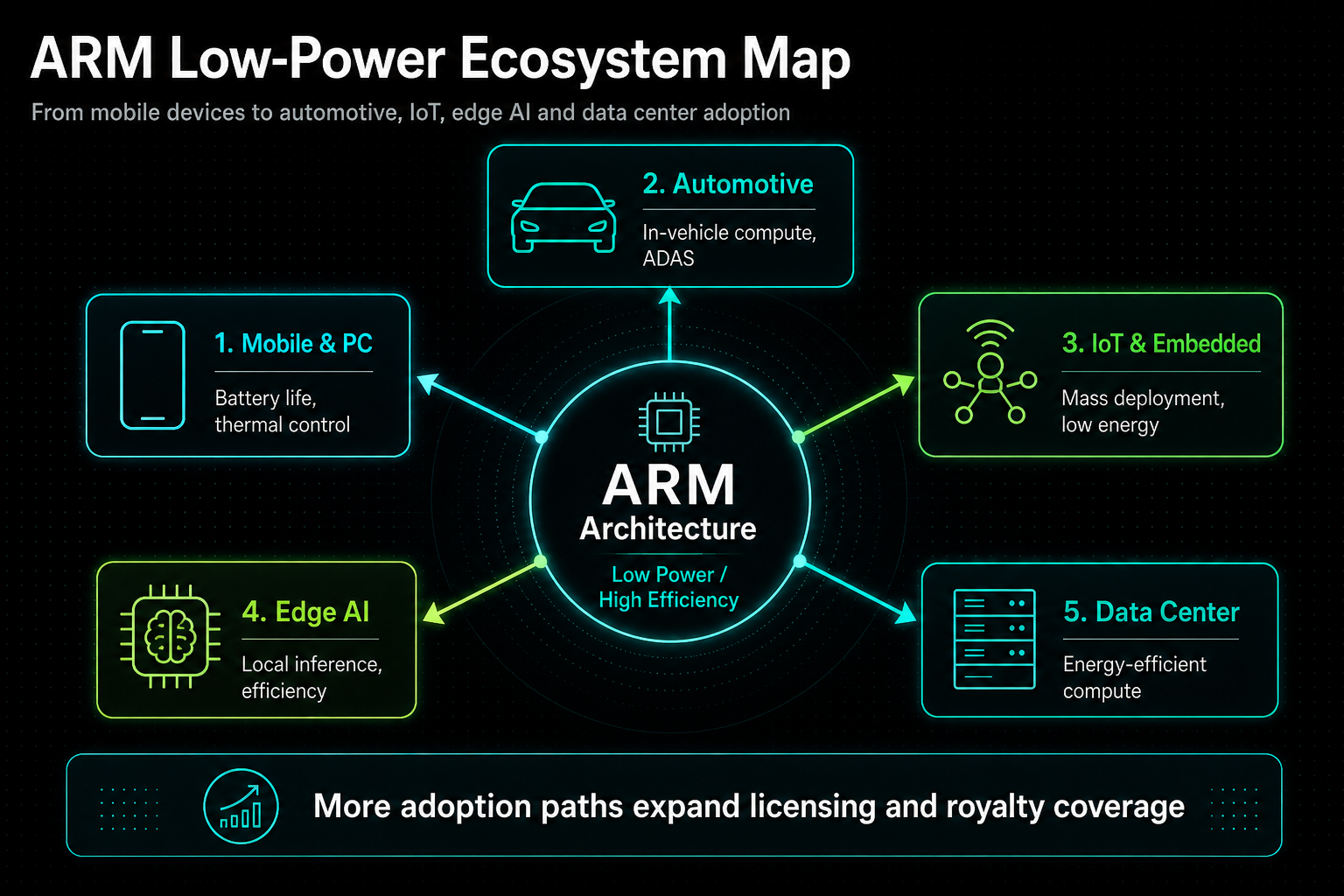 Figure 1. ARM low-power ecosystem map: expansion path from mobile devices to automotive, IoT, edge AI, and data centers.
What are the limitations of the ARM architecture?
ARM’s limitations primarily stem from architectural competition and the challenges of ecosystem migration. Although ARM excels in energy efficiency and mobile environments, other architectures may retain advantages in general-purpose computing, legacy software compatibility, or specialized high-performance workloads.
| Limitation |
Manifestation |
Impact |
| Ecosystem fragmentation |
Coexistence of diverse platforms |
Migration costs remain high |
| Performance trade-offs |
Preferences vary by scenario |
Not all tasks are optimal |
| Competing architectures |
x86, RISC-V, and others continue to advance |
Ongoing need for competitiveness |
ARM’s significance lies not in “the absence of competitors,” but in its sustained high adoption rate within its core advantage scenarios.
How do ARM’s technical strengths influence stock research?
For investors, ARM’s technical strengths must ultimately translate into commercial outcomes. If ARM’s low-power designs continue to drive adoption in new scenarios, its approbation and royalty coverage will likely expand.
When analyzing ARM, it is essential to connect technical advantages, ecosystem growth, and financial performance, rather than focusing solely on individual technical metrics. The critical question is whether ARM remains one of the industry’s default architecture choices.
Summary
The value of the ARM architecture is rooted in low power consumption, compatibility, and ecosystem path dependency. ARM influences not only mobile devices, but is also becoming a foundational architecture in automotive, IoT, edge computing, and certain data center applications.
FAQ
What differentiates the ARM architecture from x86?
ARM typically prioritizes low power consumption and energy efficiency, while x86 has dominated general-purpose computing and the PC ecosystem. Their ecosystems and application areas differ, so performance should not be evaluated by a single metric.
Why is ARM ideal for low-power devices?
ARM’s architectural design emphasizes energy efficiency, making it well-suited for battery-powered or high-density deployment scenarios. This is particularly important for smartphones, IoT, and automotive systems.
Is ARM exclusive to smartphones?
No. ARM has expanded into automotive electronics, IoT, edge AI, and certain data center applications.
What are the limitations of the ARM architecture?
ARM’s limitations include ecosystem fragmentation, architectural competition, and performance trade-offs across different workloads. While not optimal for every scenario, ARM’s strengths in low power consumption and broad adaptability are significant.