Although both companies operate in tire manufacturing, Goodyear and Michelin differ significantly in product strategy, market layout, and profitability models. In the tire industry, competitiveness stems not only from manufacturing capabilities but also from brand influence, distribution networks, and service systems. Different business models affect revenue structure, market share, and long-term growth direction, so understanding these differences provides a more comprehensive view of the global tire industry competitive landscape.
Definition of GT and Michelin
GT (Goodyear) and Michelin are two of the most iconic companies in the global tire industry. Both have over a century of history and have long served the global automotive supply chain. Although tire manufacturing is the core business for both, they differ markedly in market positioning, brand strategy, and business model, making them a frequent subject of comparison among investors and industry observers.
Goodyear was founded in 1898 and is headquartered in the United States. It is one of the most influential tire brands in North America. Goodyear's business covers passenger cars, SUVs, light trucks, commercial transport vehicles, and aviation tires. Its business model is built on a dual strategy: the original equipment manufacturer (OEM) market and the replacement tire market. Broad product coverage and an extensive distribution network allow Goodyear to serve automakers, logistics companies, and end consumers simultaneously.
Michelin was founded in 1889 and is headquartered in France. It is one of the world's largest tire manufacturers. Compared to Goodyear, Michelin places greater emphasis on high-end brand positioning and technological innovation. Its products are widely used in luxury cars, high-performance vehicles, commercial transport, and specialized industrial fields. Beyond tire sales, Michelin actively expands into fleet management, digital services, and mobility solutions, aiming to boost overall profitability through service offerings.
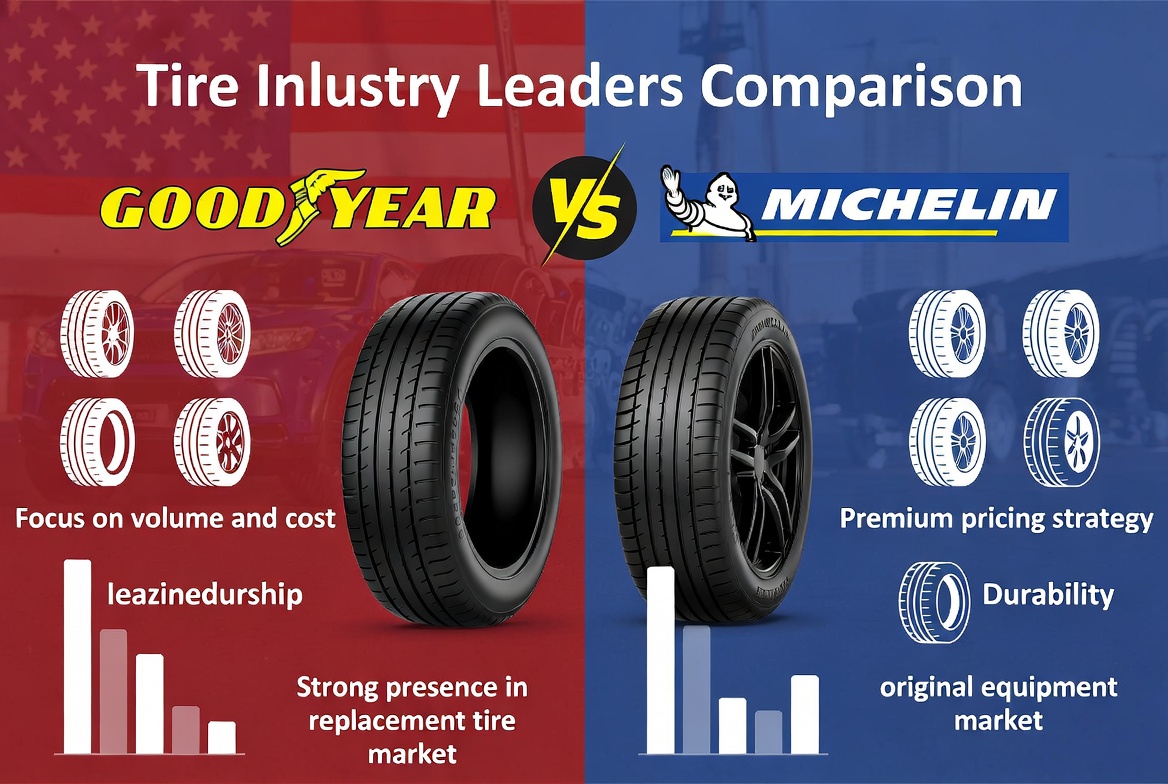
From an overall positioning perspective, Goodyear emphasizes market coverage and scale-driven sales, while Michelin focuses on brand premium and high-value services. Both are key players in the global tire industry, but their growth logic and competitive advantages differ, laying the groundwork for distinct product structures, market strategies, and business models.
Product Structure Differences Between GT and Michelin
From a product structure perspective, both Goodyear and Michelin cover passenger and commercial vehicle markets, but their focus areas differ.
Goodyear adopts a more balanced product strategy, serving the mass consumer market as well as commercial transport and aviation. Its product portfolio emphasizes broad coverage and market scale, meeting needs across various price points and usage scenarios.
Michelin, on the other hand, concentrates on high-performance, high-value-added tire markets. Whether in luxury cars, sports vehicles, or new energy vehicle segments, Michelin highlights product technology and brand premium capability.
| Comparison Dimension |
GT (Goodyear) |
Michelin |
| Market Positioning |
Comprehensive market coverage |
High-end market oriented |
| Product Strategy |
Multi-tier product portfolio |
High-value-added products |
| OEM Business |
Important revenue source |
Important revenue source |
| Replacement Market |
Core revenue source |
Core revenue source |
| Service Business |
Continuously expanding |
Relatively mature |
This difference means Goodyear prioritizes market scale, while Michelin focuses more on product profit margins and brand value.
Global Market Layout Differences Between GT and Michelin
Global presence is a critical factor in tire industry competition.
Goodyear's traditional stronghold is North America. The large U.S. car population and mature replacement tire market provide a stable demand base. At the same time, the company has built production and sales systems in Europe, Latin America, and Asia-Pacific.
Michelin has a more globally balanced presence. As one of Europe's largest tire brands, Michelin has deep roots in Europe while maintaining high market shares in North America, China, and other emerging markets.
From a regional perspective, Michelin is more internationally diversified, whereas Goodyear wields stronger brand influence in North America.
Brand Positioning Differences Between GT and Michelin
Brand positioning is one of the most notable distinctions between the two companies.
Goodyear has long emphasized reliability, safety, and broad applicability. For average consumers, Goodyear is often perceived as a comprehensive tire brand offering wide coverage and good value.
Michelin is more closely associated with high performance, premium quality, and the high-end market. Many luxury car brands and high-performance models use Michelin tires as original equipment, reinforcing its upscale brand image.
Brand positioning differences affect not only product pricing but also consumer purchasing decisions.
For tire companies, a high-end brand commands stronger pricing power, while a mass-market brand helps expand market reach.
Commercial Vehicle Business Differences Between GT and Michelin
The commercial transport market is a major revenue driver for the tire industry.
Goodyear has long served logistics, long-haul freight, and large fleet customers, boosting customer loyalty through tire maintenance and management services. As digital operations gain traction, Goodyear has also expanded into fleet management and tire monitoring.
In the commercial vehicle space, Michelin places greater emphasis on comprehensive solutions. Beyond tire sales, Michelin offers fleet operation optimization, predictive maintenance, and mobility services.
This model enables Michelin to transition from a pure tire supplier to a transportation efficiency service provider.
Thus, while both companies serve the commercial vehicle market, Michelin generates a higher share of revenue from services, whereas Goodyear remains focused on tire product sales.
Application Scenario Differences Between GT and Michelin
Both Goodyear and Michelin are widely used in the automotive industry, but their primary scenarios differ.
Goodyear's products cover family cars, SUVs, light trucks, logistics vehicles, and aviation, giving it broad market coverage. For the mass market, Goodyear meets most everyday driving needs.
Michelin has a strong presence in high-performance cars, luxury brands, new energy vehicles, and specialized transport. Many consumers prioritize Michelin products when seeking driving experience, handling, and comfort.
From an application standpoint, Goodyear leans toward comprehensive coverage, while Michelin focuses on high-end and niche markets.
This difference ultimately shapes the two companies' distinct business models and brand strategies.
Summary
Although Goodyear and Michelin are both leading global tire manufacturers, their business models differ significantly. Goodyear emphasizes broad market coverage, generating revenue through OEM operations, replacement markets, and commercial transport services. Michelin focuses on high-end brand positioning and enhances profitability through high-value-added products and services. The two companies represent two distinct paths in the tire industry: scale-driven and value-driven.
FAQ
Are GT and Michelin both tire manufacturers?
Yes. GT (Goodyear) and Michelin are both leading global tire manufacturers, with products covering passenger cars, commercial vehicles, and various specialized fields.
What is the biggest difference between Goodyear and Michelin?
The biggest difference lies in brand positioning. Goodyear emphasizes broad market coverage, while Michelin focuses on the high-end market and high-value-added products.
Which company has an advantage in the North American market?
Goodyear has long been deeply established in North America, giving it strong brand influence and market presence in the U.S. and Canada.
Why is Michelin considered a high-end tire brand?
Michelin has consistently focused on high-performance tire R&D and has partnerships with many luxury car brands, building a strong high-end brand image.
Do both companies serve the commercial vehicle market?
Yes. Both Goodyear and Michelin provide tire products and related services to logistics companies and large fleets.
Will electric vehicles affect the development direction of both companies?
Yes. New energy vehicles demand higher tire performance, driving both Goodyear and Michelin to continuously develop new tire products specifically for electric vehicles.