How Does Morpho Work? A Detailed Guide to DeFi Lending Mechanisms and P2P Optimization

Last Updated 2026-04-02 08:22:04
Reading Time: 5m
Morpho combines peer-to-peer P2P matching with liquidity pools to achieve more efficient interest rate matching. Building on traditional lending models, it introduces yield optimization mechanisms that allow both lenders and borrowers to access more competitive rates.

In the decentralized finance DeFi ecosystem, lending protocols typically rely on liquidity pools to match supply and demand. While this model provides strong stability and liquidity, it often results in lower yields for depositors and higher borrowing costs in practice, revealing room for improvement in capital efficiency.

Against this backdrop, Morpho emerges as an optimization layer built on top of major lending protocols. By introducing a new matching mechanism, it improves the interest rate structure without compromising the security of the underlying protocols. Through more precise capital matching, Morpho enhances user experience and has gradually become a key innovation in the DeFi lending space.

Overview of How Morpho Works

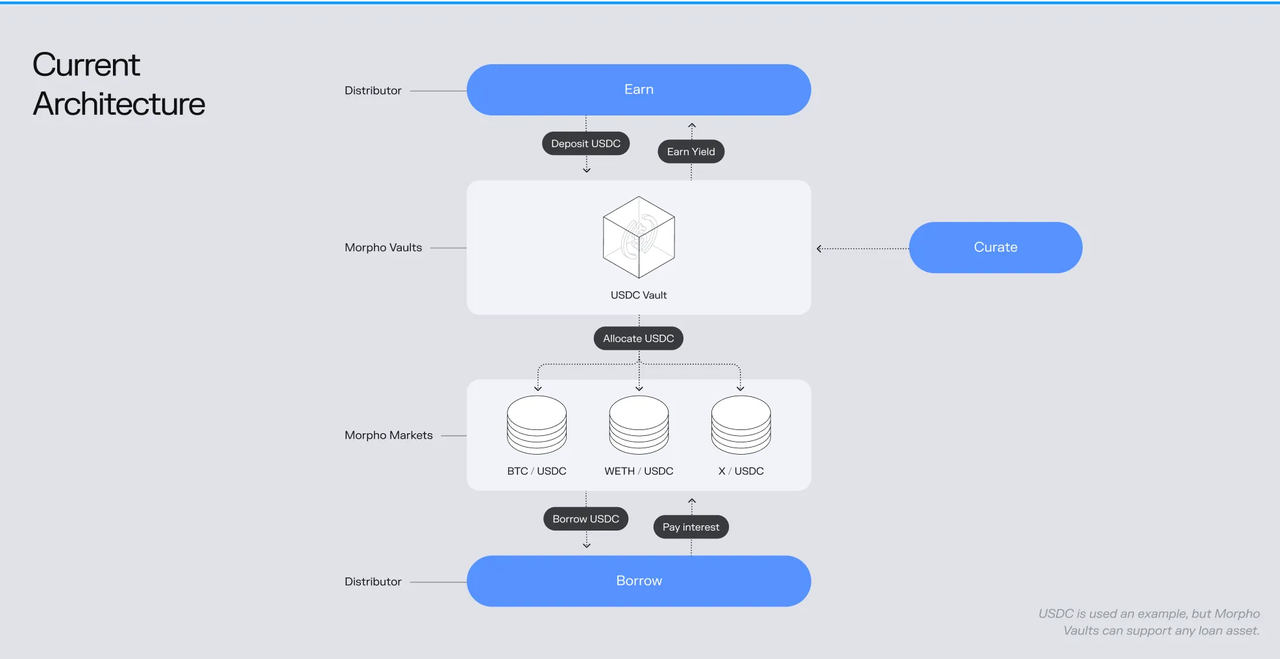
At its core, Morpho can be understood as adding an intelligent matching layer on top of traditional lending protocols. When users deposit or borrow funds, the system first attempts to match lenders and borrowers directly instead of immediately routing funds into a liquidity pool.

Overview of How Morpho Works

The key elements of this mechanism include:

  • Prioritized P2P matching

  • Unmatched funds fall back to the pool

  • Security guaranteed by underlying protocols throughout

This approach allows Morpho to optimize interest rates and capital efficiency without altering the existing infrastructure.

Core Mechanisms of Morpho

Morpho’s efficiency comes from the coordinated design of multiple mechanisms rather than a single improvement. To optimize interest rates while maintaining liquidity and security, Morpho breaks down the traditional lending process into several components and refines each one. Together, these mechanisms form its unique lending framework.

Core Mechanisms of Morpho

Morpho’s core system is built on four pillars: P2P matching, pool fallback, yield optimization, and its next-generation architecture, all working together to fundamentally improve lending efficiency.

Peer-to-Peer (P2P) Matching Model

P2P matching is one of Morpho’s most important innovations. In this model, lenders and borrowers are directly paired, bypassing the uniform interest rates of traditional liquidity pools.

In this setup:

  • Lenders can earn higher yields than pool deposit rates

  • Borrowers can pay lower costs than pool borrowing rates

Essentially, Morpho creates a middle rate range between the two, allowing both sides to benefit.

Pool Fallback Mechanism

While P2P matching improves efficiency, real-world markets rarely achieve perfect supply and demand balance. To address this, Morpho introduces a pool fallback mechanism.

In cases where:

  • Borrowing demand is insufficient

  • Or deposits exceed borrowing needs

Unmatched funds are automatically allocated to liquidity pools such as Aave or Compound.

This ensures:

  • Continuous liquidity for users

  • Uninterrupted protocol operation even when matching fails

Morpho Optimizer

Morpho Optimizer is one of the protocol’s early core products, designed to enhance yields on top of existing lending platforms.

It works by:

  • Automatically identifying P2P matching opportunities

  • Dynamically allocating funds between P2P and pool

  • Selecting the optimal strategy under different rate conditions

This allows users to achieve better returns or lower borrowing costs without manual intervention.

Morpho Blue (Next-Generation Architecture)

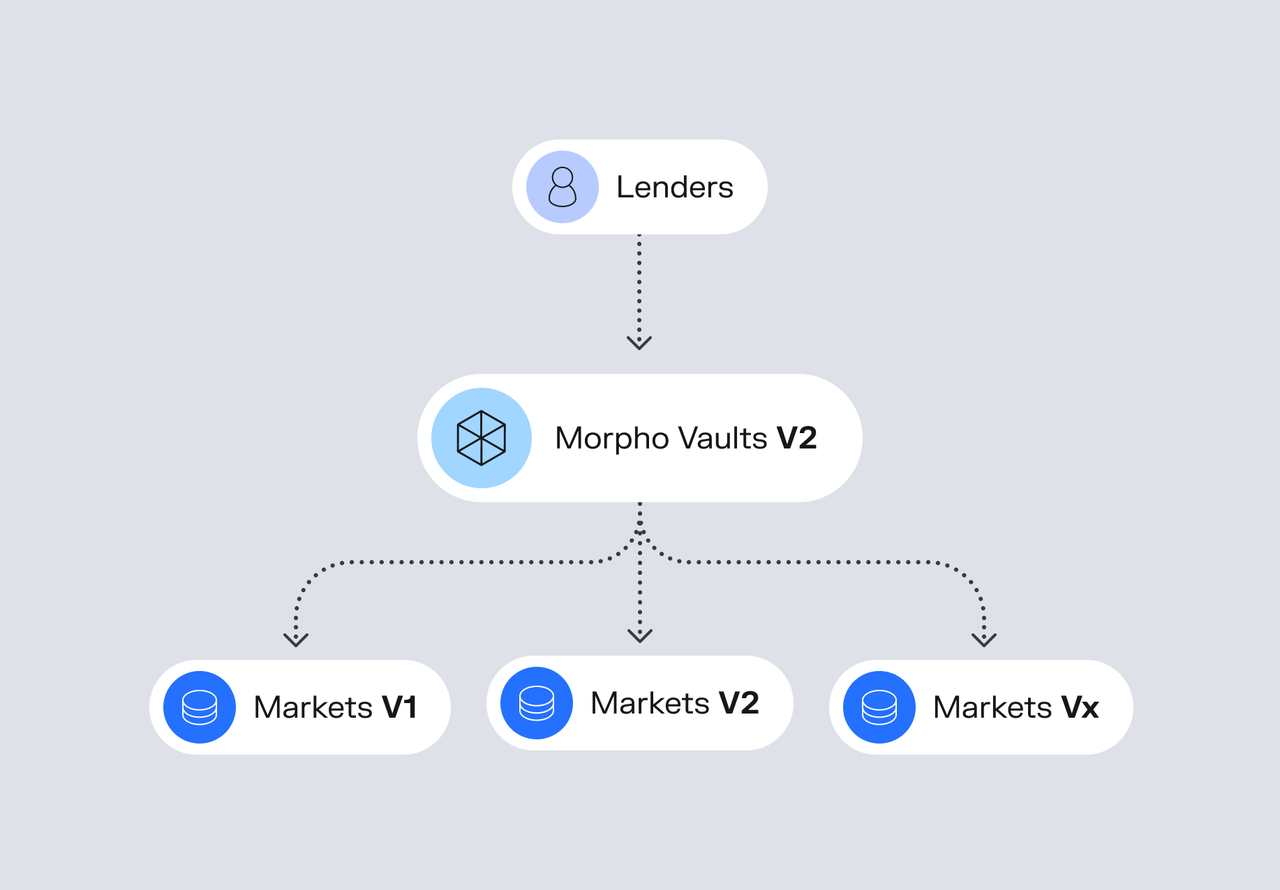
Morpho Blue represents the protocol’s next stage, moving toward a modular lending framework.

In this architecture:

This shift gradually transforms Morpho from an optimization layer into a more flexible and scalable lending infrastructure.

Advantages of Morpho’s Mechanism

Morpho’s design focuses on improving capital efficiency, with benefits across several dimensions.

First, P2P matching narrows the spread between lending and borrowing rates, making the market more efficient. Second, the pool fallback mechanism ensures stable liquidity, allowing the system to function even under extreme conditions.

Additionally, the introduction of Morpho Optimizer and Morpho Blue provides automatic optimization and modular scalability, enabling the protocol to adapt to the evolving DeFi landscape.

Potential Limitations and Risks of Morpho

Despite its advantages, Morpho’s design also comes with certain limitations.

P2P matching depends on market supply and demand, and its effectiveness may be limited when imbalances occur. Furthermore, because Morpho is built on top of underlying lending platforms, its security partially depends on those infrastructures.

As the system becomes more complex, new users may face a learning curve in understanding how it works, which could affect broader adoption.

Conclusion

By combining P2P matching with liquidity pools, Morpho offers a more efficient solution for DeFi lending. Its mechanism represents a shift from pooled matching to intelligent matching, allowing both lenders and borrowers to achieve better outcomes within a single system.

With the development of architectures like Morpho Blue, this model is evolving from an optimization tool into a more flexible and scalable lending infrastructure.

FAQs

What is Morpho’s core mechanism?

It combines peer-to-peer P2P matching with a pool fallback system.

What is pool fallback?

When P2P matching cannot be completed, funds are automatically routed into underlying liquidity pools to ensure liquidity.

What is the difference between Morpho Blue and Morpho Optimizer?

Optimizer is a yield optimization tool, while Blue is a modular lending architecture.

Does Morpho rely on Aave or Compound?

In its early stages, it relies on these protocols as sources of underlying liquidity.

How does Morpho improve yields?

By enabling more efficient interest rate matching, allowing both lenders and borrowers to access better rates.

Author: Jayne
Translator: Jared
Reviewer(s): Ida
Disclaimer
* The information is not intended to be and does not constitute financial advice or any other recommendation of any sort offered or endorsed by Gate.
* This article may not be reproduced, transmitted or copied without referencing Gate. Contravention is an infringement of Copyright Act and may be subject to legal action.

Share

Crypto Calendar
Tokens Unlock
Wormhole will unlock 1,280,000,000 W tokens on April 3rd, constituting approximately 28.39% of the currently circulating supply.
W
-7.32%
2026-04-02
Tokens Unlock
Pyth Network will unlock 2,130,000,000 PYTH tokens on May 19th, constituting approximately 36.96% of the currently circulating supply.
PYTH
2.25%
2026-05-18
Tokens Unlock
Pump.fun will unlock 82,500,000,000 PUMP tokens on July 12th, constituting approximately 23.31% of the currently circulating supply.
PUMP
-3.37%
2026-07-11
Tokens Unlock
Succinct will unlock 208,330,000 PROVE tokens on August 5th, constituting approximately 104.17% of the currently circulating supply.
PROVE
2026-08-04
sign up guide logosign up guide logo
sign up guide content imgsign up guide content img
Sign Up

Related Articles

In-depth Explanation of Yala: Building a Modular DeFi Yield Aggregator with $YU Stablecoin as a Medium
Beginner

In-depth Explanation of Yala: Building a Modular DeFi Yield Aggregator with $YU Stablecoin as a Medium

Yala inherits the security and decentralization of Bitcoin while using a modular protocol framework with the $YU stablecoin as a medium of exchange and store of value. It seamlessly connects Bitcoin with major ecosystems, allowing Bitcoin holders to earn yield from various DeFi protocols.
2026-03-24 11:55:44
The Future of Cross-Chain Bridges: Full-Chain Interoperability Becomes Inevitable, Liquidity Bridges Will Decline
Beginner

The Future of Cross-Chain Bridges: Full-Chain Interoperability Becomes Inevitable, Liquidity Bridges Will Decline

This article explores the development trends, applications, and prospects of cross-chain bridges.
2026-03-24 11:52:54
Solana Need L2s And Appchains?
Advanced

Solana Need L2s And Appchains?

Solana faces both opportunities and challenges in its development. Recently, severe network congestion has led to a high transaction failure rate and increased fees. Consequently, some have suggested using Layer 2 and appchain technologies to address this issue. This article explores the feasibility of this strategy.
2026-03-24 11:54:39
Sui: How are users leveraging its speed, security, & scalability?
Intermediate

Sui: How are users leveraging its speed, security, & scalability?

Sui is a PoS L1 blockchain with a novel architecture whose object-centric model enables parallelization of transactions through verifier level scaling. In this research paper the unique features of the Sui blockchain will be introduced, the economic prospects of SUI tokens will be presented, and it will be explained how investors can learn about which dApps are driving the use of the chain through the Sui application campaign.
2026-03-24 11:54:36
Navigating the Zero Knowledge Landscape
Advanced

Navigating the Zero Knowledge Landscape

This article introduces the technical principles, framework, and applications of Zero-Knowledge (ZK) technology, covering aspects from privacy, identity (ID), decentralized exchanges (DEX), to oracles.
2026-03-24 11:53:01
What is Tronscan and How Can You Use it in 2025?
Beginner

What is Tronscan and How Can You Use it in 2025?

Tronscan is a blockchain explorer that goes beyond the basics, offering wallet management, token tracking, smart contract insights, and governance participation. By 2025, it has evolved with enhanced security features, expanded analytics, cross-chain integration, and improved mobile experience. The platform now includes advanced biometric authentication, real-time transaction monitoring, and a comprehensive DeFi dashboard. Developers benefit from AI-powered smart contract analysis and improved testing environments, while users enjoy a unified multi-chain portfolio view and gesture-based navigation on mobile devices.
2026-03-24 11:52:42