Although both companies hail from Asia and have long been at the core of the global automotive industry, their growth trajectories, organizational structures, and technology decision-making logic are not entirely aligned. As the industry enters the era of electrification and software-driven transformation, this divergence is becoming increasingly pronounced. Understanding the difference between Hyundai Motor and Toyota is not merely about comparing two companies—it is about recognizing two distinct upgrade paths emerging in the global automotive industry.
For a long time, competition in the automotive industry revolved around manufacturing capabilities. Now, the competitive landscape has expanded to include software, energy systems, data capabilities, and long-term ecosystem building. Both Hyundai Motor and Toyota are responding to this shift, but their approaches differ. The former tends to accelerate transformation through organizational synergy and technology upgrades, while the latter emphasizes steady evolution and system efficiency.
What Positions Do Hyundai Motor and Toyota Occupy in the Global Automotive Industry Chain?
Although both are vehicle manufacturers, their roles in the industry chain differ significantly.
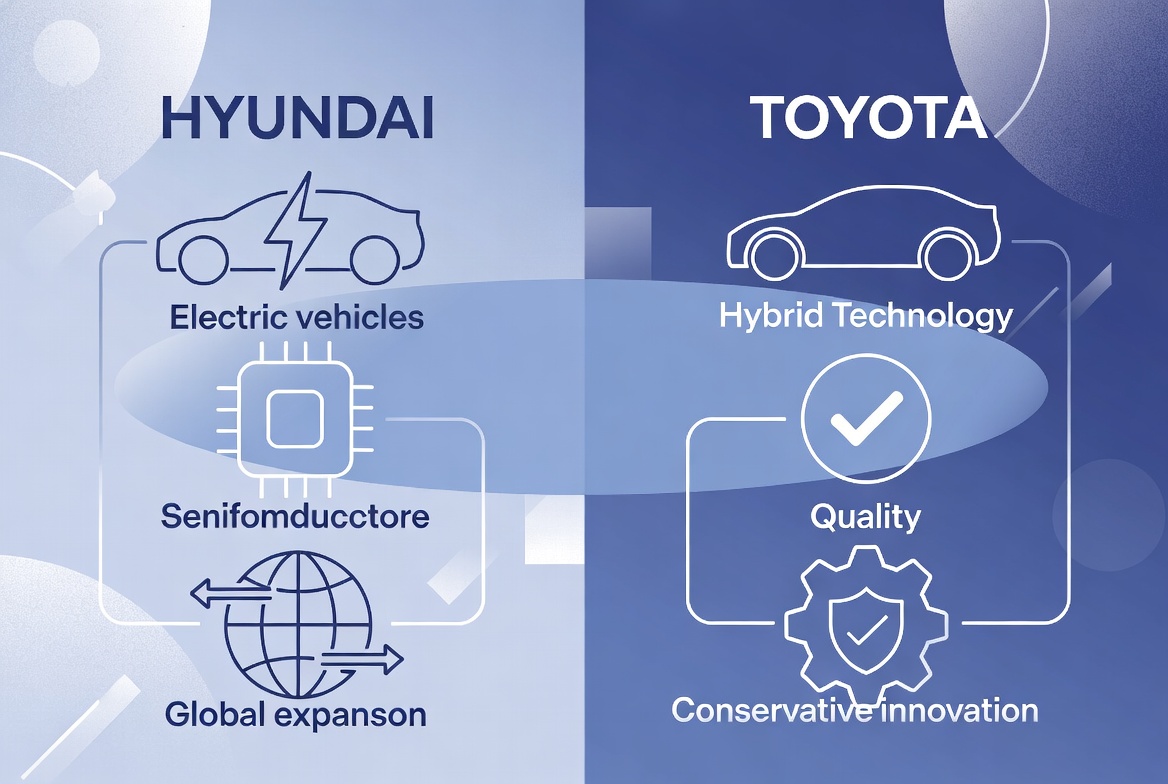
Hyundai Motor's development path is closer to "vertical capability integration." The company engages in both vehicle design and production while continuously strengthening EV platforms, supply chain synergies, software capabilities, and future mobility initiatives. Compared to traditional automakers, Hyundai Motor places greater emphasis on connecting multiple capability layers simultaneously, aiming to build long-term competitiveness through synergy.
Toyota, on the other hand, has long been built on a foundation of manufacturing system excellence. Its core competitiveness stems not only from sales volume but also from organizational efficiency, global operational capabilities, and mature production processes. Toyota is widely regarded in the industry as a benchmark for standardization and scalability, with its production system having long influenced the global automotive industry.
This difference means that although the two companies produce similar products, their industry positions are not identical.
Hyundai Motor emphasizes cross-layer capability synergy, aiming to participate in both manufacturing and technology upgrades simultaneously. Toyota, by contrast, focuses on migrating its stable manufacturing capabilities into the new cycle, maintaining competitive advantage through long-term accumulation.
From an industry perspective, neither model is inherently superior—they represent development logics shaped by different historical stages.
Core Differences in Business Models
Many users tend to view automotive companies as purely vehicle sellers, but the revenue structures of Hyundai Motor and Toyota have clearly expanded beyond traditional manufacturing logic.
In recent years, Hyundai Motor has steadily diversified its revenue sources. Beyond vehicle sales, its business has expanded into automotive finance, digital services, software capabilities, and long-term user engagement. This means that vehicle sales increasingly serve as the entry point for building user relationships, rather than being a one-time transaction.
At the same time, Hyundai Motor is advancing its premium brands, EVs, and future mobility capabilities, aiming to create a higher-value-added structure.
In comparison, Toyota has long relied on its mature manufacturing system for profitability. Scale advantages, global channels, and high operational efficiency form its core business foundation. While its profit structure remains heavily dependent on vehicle sales and long-term service systems, its strength lies in strong operational stability.
From the perspective of automotive industry profit models, the two companies reflect different directions: Hyundai Motor emphasizes capability expansion, while Toyota emphasizes capability amplification. This distinction determines each company's future resource allocation, organizational structure, and growth path.
Electrification is often understood as a powertrain shift, but for large automotive groups, its real impact lies in organizational transformation. Hyundai Motor demonstrates a strong platform-oriented mindset. By unifying foundational capabilities, strengthening its new energy product portfolio, and advancing software capability building, it aims to shorten technology upgrade cycles.
This model emphasizes flexible adjustment capabilities.
The company must constantly coordinate resource allocation between traditional fuel systems and new energy systems while maintaining market responsiveness. Toyota's path is markedly more cautious. For a long time, Toyota has emphasized technological diversity, believing that future energy structures may coexist for an extended period. Therefore, its transformation process focuses more on system stability and scale adaptability.
This difference does not imply that one is transforming faster—it reflects different risk management approaches. Hyundai Motor emphasizes proactive adjustment, while Toyota emphasizes long-term validation. From an industry evolution standpoint, the future global automotive industry may accommodate multiple technology routes, and a company's capabilities will ultimately be tested by the market.
How Does Global Supply Chain Capability Affect Long-Term Competition?
The automotive industry has never been about single-point technology competition; it is about the ability to coordinate complex supply networks. In recent years, Hyundai Motor has continuously advanced global production capacity building, hoping to mitigate external fluctuations through regional synergies. This model emphasizes flexible layout and resource deployment, enabling the company to adapt to different market structures.
At the same time, Hyundai Motor is strengthening upstream and downstream industry synergies, aiming to extend its supply capabilities into new energy and intelligent domains. Toyota, in contrast, has long been renowned for supply chain efficiency.
Its manufacturing system not only focuses on cost control but also emphasizes organizational synergy and long-term stable operation. Through highly standardized processes, Toyota has developed strong scale advantages. Both companies emphasize global supply chains, but with different focuses: Hyundai Motor emphasizes dynamic synergy, while Toyota emphasizes system efficiency. As the automotive industry upgrades, supply chain capabilities will continue to determine a company's long-term competitive position.
How Will Software Capability Change Future Automotive Competition?
If past automotive competition primarily took place in factories, future competition will increasingly occur at the system level. Hyundai Motor is advancing software-defined vehicle (SDV) capabilities, aiming to transform vehicles into continuously updated platforms. Through in-vehicle systems, over-the-air upgrades, and intelligent services, the vehicle lifecycle is being redefined.
This model means that competition is shifting from hardware capabilities to long-term software operations. In comparison, Toyota's software upgrade pace is typically more measured. Its strategy emphasizes reliability and system consistency over rapid iteration.
Behind this difference lies a fundamental divergence in organizational culture. Hyundai Motor seeks to accelerate entry into the next competitive cycle, while Toyota aims to gradually complete upgrades within its existing system.
Core Model Comparison: Hyundai Motor vs. Toyota
For Hyundai Motor, the goal of the software-defined vehicle strategy is not merely to add in-car features but to establish a unified capability platform at the foundational level.
This platform-oriented approach means that multiple vehicle models share electronic architectures, software systems, and upgrade capabilities, thereby reducing redundant development and improving product iteration efficiency. Once the underlying system is unified, the company can complete feature expansions at a lower cost and rapidly deploy capabilities across different markets.
At the same time, software capabilities will also affect the revenue structure.
In the past, automotive revenue was highly concentrated in vehicle sales. In the future, companies may gradually develop a combination model of "vehicle revenue + digital services revenue + long-term operations revenue." For example, users may continuously receive feature updates, intelligent subscriptions, vehicle capability expansions, and cross-device service experiences.
This means that software is beginning to change how the automotive industry makes money, not just the user experience. Compared to this, Toyota's software upgrade path is typically more measured.
| Dimension |
Hyundai Motor |
Toyota |
| Core Positioning |
Technology-upgraded global automotive group |
Manufacturing-efficiency global automotive group |
| Business Model |
Manufacturing + software + diversified capabilities |
Manufacturing + scale operations |
| EV Route |
Platform-based transformation |
Multi-technology routes |
| Global Supply Chain |
Regional synergy capability |
High-efficiency system |
| Software Capability |
Continuously strengthening SDV |
Steadily advancing digitalization |
| Long-Term Direction |
Intelligent mobility ecosystem |
Global manufacturing upgrade |
Hyundai Motor places greater emphasis on the speed of technology migration, aiming to drive overall corporate upgrades through software capabilities. Toyota emphasizes long-term system strength, seeking to gradually complete digital transformation on the basis of its existing manufacturing advantages.
Therefore, future competition among automotive companies will likely not just be about "who makes better cars," but about who can continuously operate vehicles, upgrade capabilities, and extend user relationships over time.
Summary
Although both Hyundai Motor and Toyota are core participants in the global automotive industry, they represent different development models. Hyundai Motor emphasizes technology upgrades, multi-capability synergy, and expansion into future mobility ecosystems, aiming to connect manufacturing, software, and new energy capabilities simultaneously.
Toyota, on the other hand, emphasizes scale efficiency, organizational systems, and long-term manufacturing advantages, driving technology upgrades through a steady approach. From a broader industry perspective, both models reflect the ongoing transformation of the automotive industry from industrial manufacturing to intelligent transportation. Understanding Hyundai Motor and Toyota is not about judging which company is stronger, but about recognizing the different possible evolutionary paths for the global automotive industry in the future.
FAQ
Are Hyundai Motor and Toyota the same type of automotive company?
Both are global automotive groups, but their strategic focuses differ. Hyundai Motor emphasizes technology transformation and capability synergy, while Toyota emphasizes manufacturing systems and scale efficiency.
Why hasn't Toyota fully transitioned to pure electric vehicles?
Toyota has long adopted a multi-path technology strategy, aiming to maintain flexibility in different market environments.
Is Hyundai Motor developing software-defined vehicles?
Yes. Hyundai Motor is continuously advancing software-defined vehicle (SDV) capabilities and strengthening digitalization.
Will the two companies directly compete in the future?
Yes, but the scope of competition has already expanded from simply selling cars to software, energy, and long-term ecosystem capabilities.