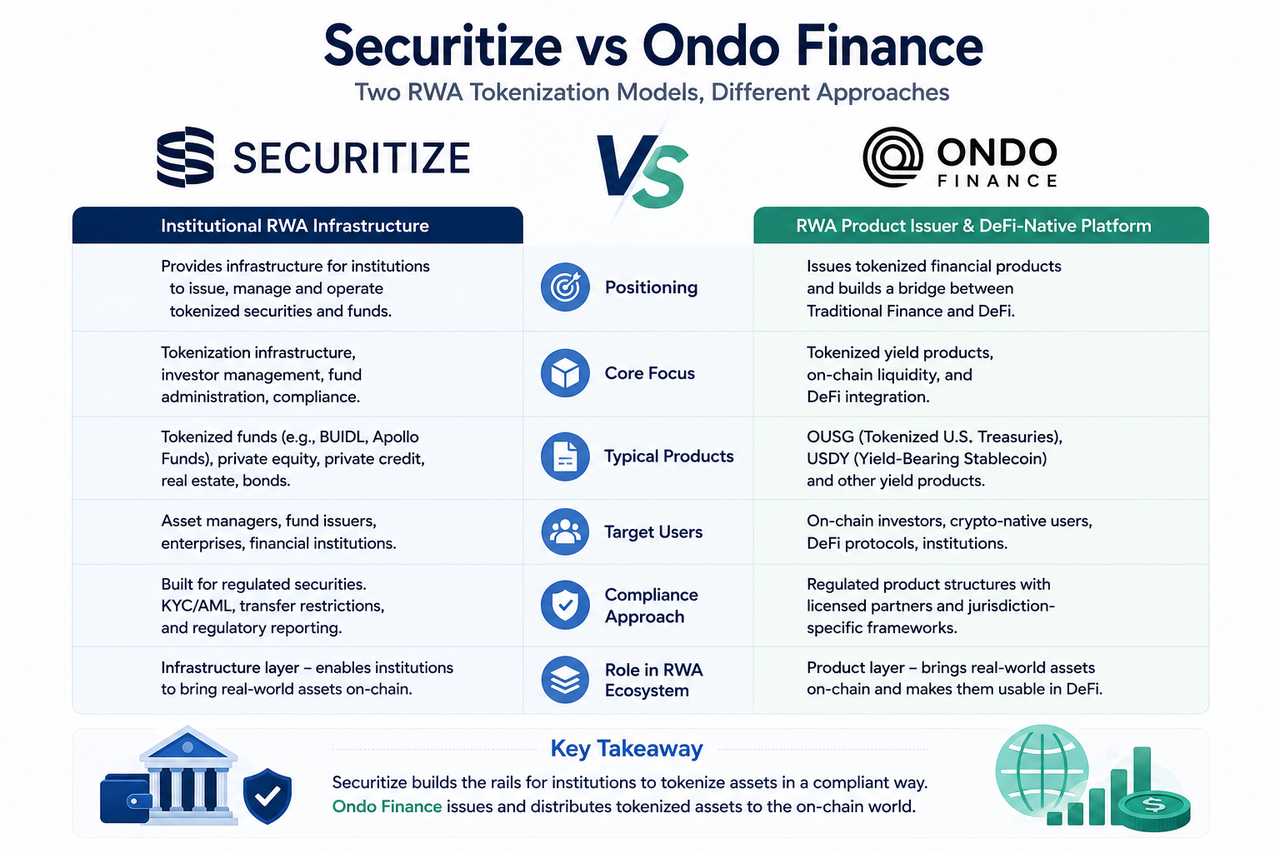
As more traditional financial institutions enter the blockchain space, the RWA market has formed several specialized tracks, including infrastructure, asset issuance, on-chain liquidity, and DeFi applications. Securitize and Ondo Finance represent two distinct models within this landscape: one focuses on helping institutions tokenize assets, while the other emphasizes issuing on-chain investment products and bridging the crypto-financial ecosystem.
What Is Securitize?
Securitize is an institutional-grade real-world asset (RWA) tokenization infrastructure platform. It provides asset managers, fund companies, and corporations with services such as digital security issuance, investor management, securities registration, and fund administration.
Securitize functions more like a digital infrastructure layer within traditional capital markets. Its core strength lies in helping institutions manage the full lifecycle of assets—from issuance to operations—rather than simply issuing a single tokenized product.
Currently, multiple institutional projects, including BlackRock’s BUIDL and Apollo, rely on Securitize’s infrastructure.
What Is Ondo Finance?
Ondo Finance is an RWA platform specializing in the issuance of tokenized financial products. Its core business involves packaging real-world assets, such as U.S. Treasuries, into on-chain investment products that can be used within the blockchain ecosystem.
Compared to infrastructure building, Ondo Finance places greater emphasis on product design and on-chain applications. For example, tokenized assets like OUSG and USDY allow investors to access U.S. Treasury yield products more easily, while gradually expanding into institutional-grade financial networks.
Thus, Ondo Finance is closer to an asset issuer and financial product provider than a comprehensive securities infrastructure platform.
How Does Their Positioning Differ?
The biggest difference between the two companies lies in their market positioning.
Securitize primarily serves fund managers, asset management institutions, and large financial organizations, providing them with the infrastructure needed to issue and operate digital securities.
Ondo Finance, on the other hand, is centered around tokenized financial products. It connects traditional financial assets with the digital asset market by designing on-chain yield products.
| Comparison Dimension |
Securitize |
Ondo Finance |
| Core Positioning |
RWA Infrastructure Platform |
RWA Product Issuance Platform |
| Primary Clients |
Asset managers, fund companies |
On-chain investors, institutions, protocols |
| Core Capability |
Securities issuance, fund operations |
Yield product design and issuance |
| Business Model |
Infrastructure service provider |
Issuer of tokenized financial products |
Simply put, Securitize is more like “building the highway,” while Ondo Finance is more like “operating the vehicles on the highway.”
How Do Their Product Models Differ?
The types of products launched by the two companies also differ significantly.
Securitize itself does not focus on issuing standardized investment products. Instead, it helps partner institutions complete digital securities issuance. For example, the BUIDL fund is managed by BlackRock, and Securitize provides the underlying digital securities services.
Ondo Finance directly launches its own tokenized products, such as:
- OUSG (tokenized U.S. Treasury fund)
- USDY (yield-bearing U.S. dollar asset)
As a result, investors typically interact directly with Ondo products, while Securitize operates behind the scenes as the infrastructure layer supporting those products.

How Do Their Compliance Models Differ?
Given their different positioning, the two companies also have distinct compliance focuses.
Securitize has long built its operations around securities regulatory frameworks, offering KYC, AML, investor eligibility verification, securities registration, and transfer agent services. This ensures that digital assets meet traditional securities market requirements.
Ondo Finance also prioritizes regulatory compliance, but its focus is more on product issuance, asset custody, and investor access. It structures products around different jurisdictions.
| Compliance Dimension |
Securitize |
Ondo Finance |
| Core Direction |
Digital securities infrastructure |
Financial product issuance |
| Investor Management |
Complete identity verification system |
Product access management |
| Securities Registration |
Provides registration and management services |
Relies on partner institutions |
| Fund Administration |
Full support provided |
Non-core business |
Thus, although both companies operate in the RWA market, they do not share identical regulatory responsibilities.
How Do They Differ in DeFi Ecosystem Integration?
Ondo Finance has placed a strong emphasis on integrating with the DeFi ecosystem since its inception. The company aims for its tokenized assets to become a key component of on-chain finance.
For example, products like OUSG and USDY can be combined with certain digital asset infrastructures to gradually expand the on-chain use cases for tokenized Treasury assets.
In contrast, Securitize’s primary focus remains on the digital transformation of traditional financial institutions. Its main task is to help real-world assets enter the blockchain safely and compliantly, rather than directly participating in DeFi product design.
As products like BUIDL continue to evolve, both companies are pushing forward the development of institutional on-chain finance—but they take different paths to get there.
Which Model Is Better Suited for Different Types of Institutions?
For large asset management companies looking to issue their own digital securities or tokenized funds, a full suite of securities issuance, fund management, and investor services is typically required. As such, they are more inclined to adopt an infrastructure platform like Securitize.
If the goal is to issue on-chain yield products, expand the digital asset ecosystem, or build financial products targeted at on-chain investors, Ondo Finance’s model is more representative.
The two companies are not in direct competition. Instead, they play different roles within the RWA value chain and may even collaborate on the same institutional-grade project.
Key Differences at a Glance
| Comparison Item |
Securitize |
Ondo Finance |
| Core Identity |
RWA Infrastructure |
RWA Product Issuer |
| Core Business |
Digital securities issuance, fund operations |
Tokenized yield products |
| Representative Case |
BUIDL infrastructure |
OUSG, USDY |
| Target Customers |
Financial institutions, fund managers |
On-chain investors, institutions |
| Core Advantage |
Compliance, issuance, operations |
Product innovation, on-chain applications |
| Position in RWA Ecosystem |
Infrastructure layer |
Product layer |
Summary
Securitize and Ondo Finance are both key players in the tokenization of real-world assets, yet they represent two distinct development models. Securitize focuses on digital securities issuance, fund management, and institutional-grade infrastructure, providing traditional financial institutions with a complete RWA on-chain solution. Ondo Finance, by contrast, specializes in issuing tokenized yield products, connecting traditional financial assets with the blockchain ecosystem through offerings like OUSG and USDY.
FAQs
Are Securitize and Ondo Finance in competition?
There is some overlap in their business activities, but their overall positioning differs. Securitize leans more toward being an infrastructure provider, while Ondo Finance is more of a financial product issuer. They operate at different stages of the value chain.
Why did BlackRock choose Securitize?
BlackRock’s BUIDL required infrastructure support for digital securities issuance, investor management, and fund operations. Securitize provided a complete, compliance-ready solution.
Does Ondo Finance issue its own products?
Yes. Ondo Finance directly launches tokenized financial products such as OUSG and USDY and builds an on-chain yield ecosystem around them.
Which platform is better suited for institutions issuing tokenized funds?
For financial institutions seeking to issue digital securities, tokenized funds, or other RWA products, Securitize’s infrastructure services are typically more comprehensive.
Do Securitize and Ondo Finance both belong to the RWA space?
Yes. Both companies are integral parts of the real-world asset (RWA) ecosystem, though they play different roles—one provides the infrastructure, and the other focuses on product issuance and on-chain applications.







