In the global consumer industry, luxury groups represent a unique form of business organization. Unlike single-brand companies, large luxury groups typically manage multiple brands simultaneously, covering different consumer segments and price points through a brand matrix, thereby creating a more stable revenue structure and market influence. Over the past few decades, the rise of European luxury conglomerates such as LVMH, Kering, and Richemont has made "brand portfolio operations" a mainstream industry model.
From a capital markets perspective, CPRI is more than just a fashion company—it reflects the underlying logic of the global luxury industry. Brand value, consumer preferences, global tourism spending, digital retail, and shifts in high-end consumer demand all shape the direction of luxury groups. Understanding CPRI's business model and industry positioning also helps in grasping how the modern luxury supply chain operates.
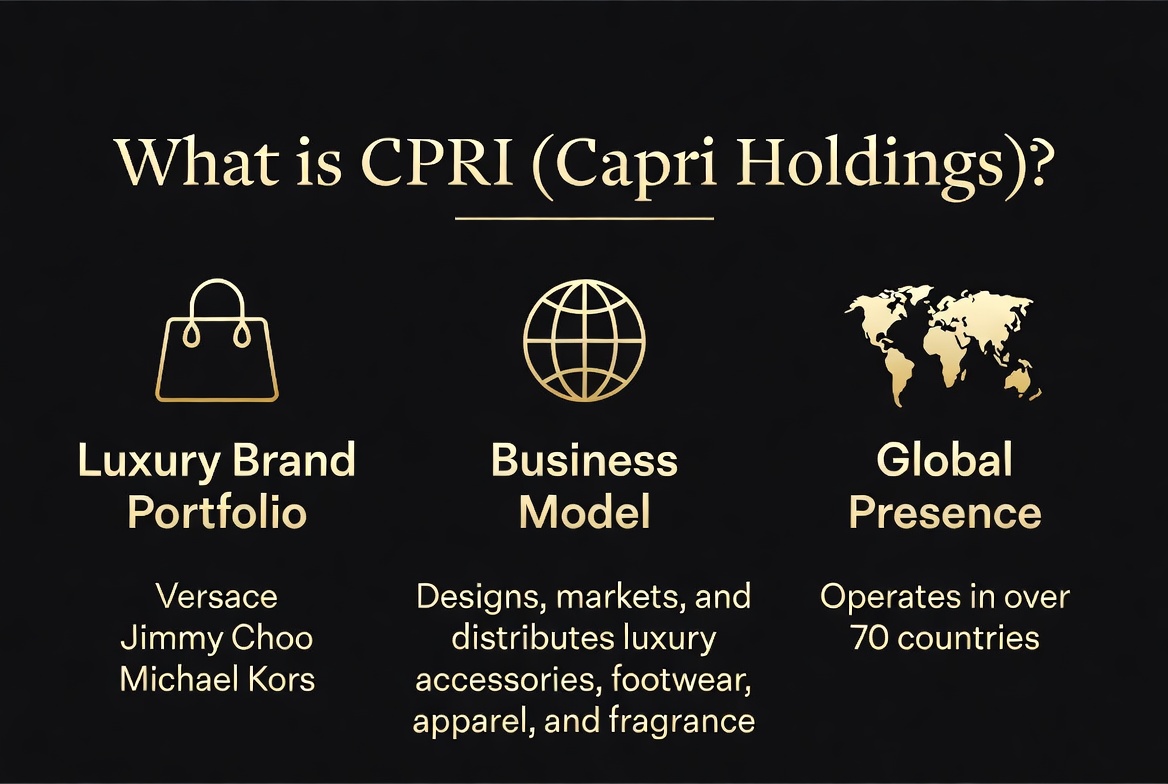
What Is CPRI (Capri Holdings)
CPRI was not built from scratch; it emerged from a process of brand consolidation and group expansion. The group's predecessor, Michael Kors Holdings, initially focused primarily on the Michael Kors brand. As the global luxury industry increasingly moved toward conglomerates, the company began seeking to expand its brand portfolio through acquisitions, thereby enhancing its international market influence and business diversification.
After acquiring Jimmy Choo in 2017 and Versace in 2018, the company officially renamed itself Capri Holdings. For management, this change meant not only a larger corporate scale but also a fundamental shift in business logic. The previous model of relying on a single brand for growth transitioned toward multi-brand synergy, requiring the group to simultaneously manage different brand positions, product systems, consumer bases, and market strategies.
From a market positioning standpoint, CPRI sits in the mid-to-large brand group tier of the global luxury industry. Although its scale cannot yet rival European luxury giants like LVMH or Kering, its brand portfolio already spans multiple levels: accessible luxury, high-end fashion, and traditional luxury. This positioning allows CPRI to compete in both mass premium and traditional luxury markets while maintaining strong influence in North America.
For global capital markets, CPRI is unique in that it combines the characteristics of a luxury group with a strong American fashion retail DNA. Therefore, analyzing CPRI requires attention not only to its brand development but also to global luxury industry trends, consumer market changes, and the group's operational strategies.
How CPRI's Core Business Works
CPRI's core business is not simply about selling clothing, footwear, or handbags—it revolves around long-term brand asset management. For luxury groups, the brand itself is often one of the most valuable assets. Consumers buy not just product functionality but the design philosophy, market positioning, and cultural value the brand represents. Therefore, the group's primary task is to continuously maintain brand influence and convert that influence into commercial revenue.
In practice, group revenue primarily comes from retail channels, wholesale channels, and licensing businesses. Retail channels include directly operated stores and e-commerce platforms, which are key touchpoints for direct consumer engagement. Wholesale channels expand market coverage through partnerships with department stores and specialty retailers. Meanwhile, licensing businesses allow third parties to use brand resources in specific product categories, generating additional revenue.
From a business model perspective, this structure helps CPRI maintain relatively stable revenue under different market conditions. When retail faces headwinds, wholesale and licensing can provide support; when consumer demand grows, direct channels boost profitability. This diversified revenue structure is a common model adopted by global consumer brand groups.
More importantly, the group is not just selling products—it is cultivating long-term brand value. Whether through product design, marketing, supply chain management, or digital retail development, the ultimate goal is to enhance brand competitiveness. In the luxury industry, brand value often determines the level of consumer recognition a company can achieve, and such value accumulation typically requires years or even decades of sustained investment.
How CPRI's Brand Ecosystem Is Structured
The brand matrix is one of the most important strategic assets for modern luxury groups. Compared to single-brand companies, multi-brand groups can cover a broader consumer base and create complementary effects through differentiated brand positioning. From the history of the global luxury industry, whether LVMH, Kering, or Richemont, their long-term competitiveness is closely tied to their brand portfolio capabilities. For CPRI, the brand ecosystem not only determines market coverage but also influences future growth potential.
Currently, CPRI's brand system consists mainly of Michael Kors, Versace, and Jimmy Choo. Although all three operate in the fashion and luxury space, they target different consumer groups, product tiers, and market strategies. Michael Kors has long focused on the mass premium consumer market with a strong global retail network; Versace represents traditional Italian luxury fashion, holding a significant position in high-end fashion and brand influence; Jimmy Choo is renowned for high-end footwear and accessories, enjoying high recognition among specific consumer segments.
The advantage of this brand portfolio model is that it reduces the group's dependence on any single brand. If a particular brand's market experiences cyclical fluctuations, other brands can maintain stable performance, enhancing overall resilience. At the same time, different brands can achieve synergies in supply chain management, digital operations, global retail channels, and marketing, improving resource utilization efficiency.
CPRI's Role in the Global Luxury Industry
The global luxury industry is a market highly dependent on brand value and consumer perception. Unlike traditional manufacturing, the core competitiveness of luxury companies comes not from production capacity but from brand heritage, design capability, market influence, and long-term consumer loyalty. Therefore, large luxury groups typically act as both brand managers and resource integrators.
Within this industry, CPRI is one of the world's significant luxury groups, but its development path differs from traditional European conglomerates. Groups like LVMH and Kering own numerous international brands and have built vast brand ecosystems through sustained acquisitions. CPRI, by contrast, has a shorter development history and a more concentrated brand portfolio, making it more reliant on the quality and operational efficiency of its core brands.
Differences Between CPRI and Other Luxury Groups
Although the luxury industry revolves around fashion consumption, there are clear differences in business models and market positioning among groups. Many consumers consider CPRI, LVMH, Kering, and Tapestry all to be luxury groups, but they differ in brand structure, market coverage, and development strategies.
LVMH is widely regarded as one of the largest luxury groups globally, with businesses spanning fashion, jewelry, watches, cosmetics, and wine & spirits. Kering focuses on the high-end luxury market with brands such as Gucci and Saint Laurent. In contrast, CPRI's business scope is more concentrated, primarily around fashion and accessories, resulting in a simpler revenue structure and brand layout.
Another key difference lies in market positioning. CPRI's brands simultaneously cover mass premium and traditional luxury consumer markets, while large European luxury groups tend to focus more on the high-end luxury segment. This positioning allows CPRI to reach a broader consumer base but also exposes it to more intense competition.
For investors and industry observers, the value of comparing different luxury groups is not to determine which is stronger but to understand the logic behind different business models. Different brand portfolios, market structures, and development stages all influence the future direction and competitive strategies of groups. These differences also provide important entry points for deeper research into the luxury industry.
Typical Application Scenarios for Luxury Brands
Luxury consumption is not just about buying high-priced goods—it reflects consumers' identification with brand value, design philosophy, and lifestyle. From a global perspective, luxury brands have permeated fashion, travel, business, gifting, and high-end social settings, forming a unique consumption ecosystem.
For individual consumers, luxury brands are most commonly used in apparel, handbags, footwear, and accessories. These products combine practical utility with brand expression and status symbolism. As consumption upgrades continue, more consumers are paying attention to brand culture and design value, going beyond mere product functionality.
At the same time, luxury brands are deeply involved in global tourism consumption and high-end retail infrastructure. In many international tourist cities, luxury brand stores are key components of commercial districts. Tourism spending, duty-free retail, and international shopping demand are also significant drivers of luxury industry growth.
How to Buy CPRI (Capri Holdings) Stock
CPRI is listed on the New York Stock Exchange (NYSE) under the ticker CPRI. Investors can typically purchase CPRI stock through securities accounts that support U.S. stock trading, thereby participating in the global luxury industry. Luxury companies' performance is often influenced by brand sales, retail and wholesale channel performance, licensing revenue, and overall high-end consumer market fluctuations. Therefore, when analyzing CPRI, investors focus on brand portfolio performance, market expansion strategies, and global retail network coverage.
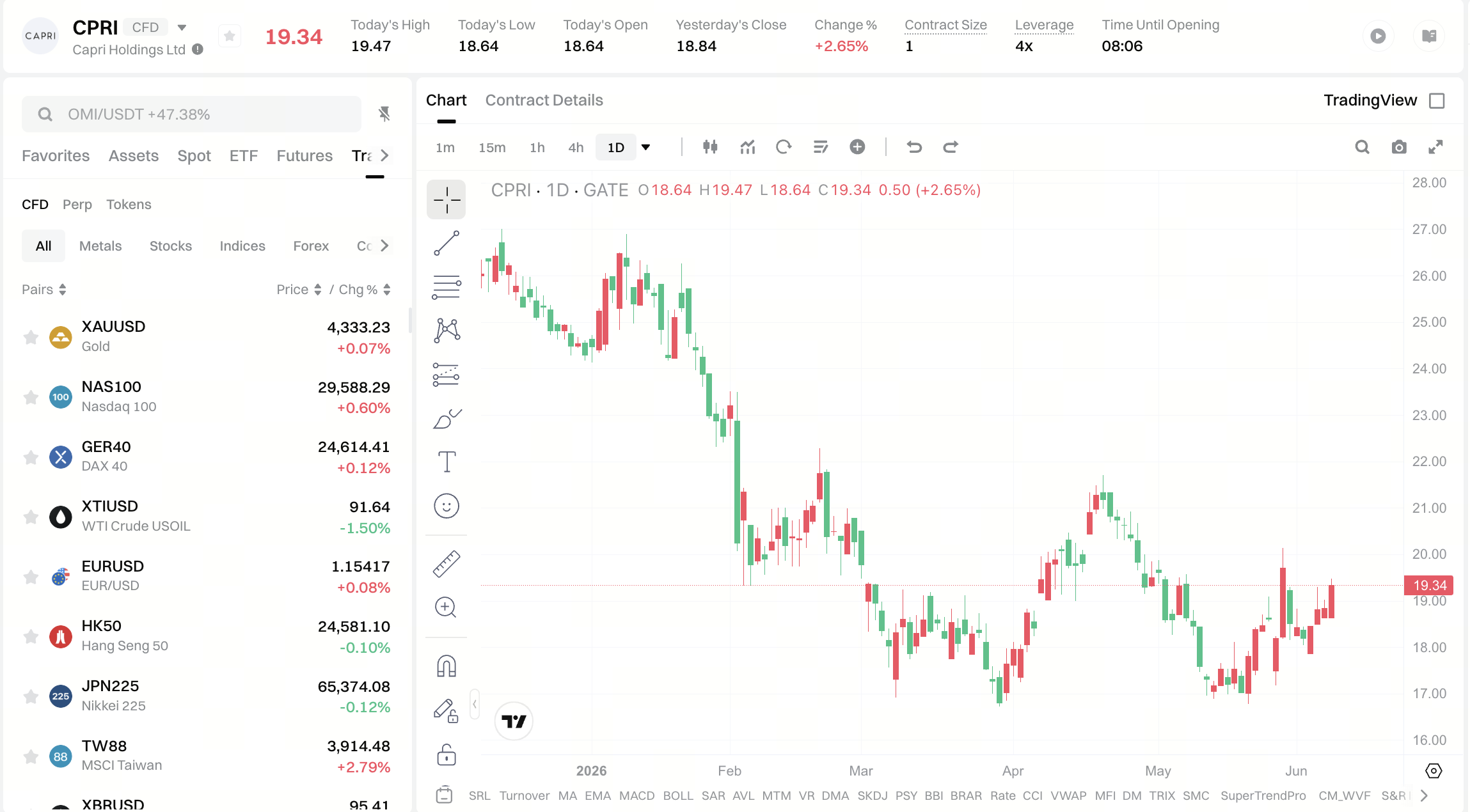
As digital asset markets gradually converge with traditional financial markets, some platforms now offer financial products linked to U.S. stock prices. The Gate TradFi platform is continuously expanding its traditional financial asset coverage, allowing users to monitor digital assets, U.S. stocks, ETFs, indices, and commodity markets within a single account. Some markets also offer Gate CFD products, enabling users to trade U.S. stocks using stablecoins (such as USDT), gaining exposure to CPRI stock price movements without opening a traditional securities account.
Whether participating through traditional securities accounts or digital asset trading tools, investors should thoroughly understand the relevant product mechanisms, fee structures, risk characteristics, and local regulatory requirements. A clear understanding of the rights and obligations of each method is essential for safe and effective asset management in global capital markets.
Advantages and Limitations of CPRI
From a competitive standpoint, the brand matrix is one of CPRI's most important strategic assets. By managing multiple independently positioned international brands, the group can cover different consumer tiers and reduce reliance on any single brand. This structure not only improves market coverage but also enhances business stability to a certain degree.
Global presence is another significant advantage. CPRI's business spans major consumer markets in North America, Europe, and Asia-Pacific, generating revenue from diverse regions. When one market faces economic pressure, performance in other regions can help maintain overall stability. This regional diversification is a common goal for international consumer brand groups.
At the same time, CPRI faces challenges inherent to the luxury industry. Shifting consumer preferences, evolving fashion trends, and the risk of brand aging can all impact long-term competitiveness. For luxury companies, maintaining brand appeal requires continuous investment in design innovation, marketing, and channel development.
Conclusion
CPRI (Capri Holdings) exemplifies a modern luxury group development model. By integrating brands such as Michael Kors, Versace, and Jimmy Choo, the group has built a brand matrix covering multiple consumer tiers and competes globally through its retail network, licensing business, and brand management capabilities.
From a business model perspective, CPRI's value derives not only from product sales but also from the long-term accumulation and management of brand assets. The brand matrix, global footprint, and diversified revenue structure together form the group's core competitive foundation.
For readers seeking to understand the global luxury industry, CPRI offers a compelling case study of how brand groups operate. Understanding its development history, business model, and industry positioning also provides deeper insight into the business logic and industrial structure behind the modern luxury market.
FAQ
What company is CPRI?
CPRI (Capri Holdings) is a global luxury group that owns internationally renowned brands such as Michael Kors, Versace, and Jimmy Choo. It competes in the global luxury market through brand operations, retail channels, and licensing businesses.
What brands does CPRI own?
Currently, CPRI's core brands include Michael Kors, Versace, and Jimmy Choo. These brands target different consumer groups and market positions, forming the group's brand matrix.
Why do luxury groups own multiple brands?
The multi-brand model allows coverage of a broader consumer market while reducing reliance on any single brand. For luxury groups, a brand matrix is also a key way to enhance market competitiveness and long-term stability.
What is the difference between CPRI and LVMH?
Both are luxury groups, but they differ in brand count, business scale, and market coverage. LVMH's business is more diversified, while CPRI's business is primarily focused on fashion and accessories.
How can I participate in CPRI-related markets using USDT?
Some digital asset platforms offer U.S. stock-related products settled in USDT, such as CFDs. These tools provide exposure to CPRI stock price movements, but users should understand the product mechanisms and associated risks in advance.
What is the core competitiveness of the luxury industry?
Brand value, design innovation, global channel capabilities, and consumer perception are the most critical competitive factors in the luxury industry. Over the long term, brand assets are often the key foundation of a company's competitive edge.