As blockchain evolves from a simple asset issuance platform into a financial services network, users increasingly demand more convenient tools for payments, custody, settlement, and asset management. However, persistent issues such as limited interoperability between traditional banking and on-chain assets, low settlement efficiency, and fragmented services have driven the market to explore a new financial architecture that merges banking functions with blockchain capabilities.
In this context, WeFi positions itself as an infrastructure provider for Deobank (Decentralized On-chain Bank). Unlike traditional DeFi protocols that focus primarily on lending, trading, or liquidity, WeFi prioritizes the on-chain implementation of bank-grade services—including account systems, payment networks, asset custody, card payment services, and financial institution onboarding. As a result, it is widely recognized as one of the important infrastructures connecting traditional finance and Web3 finance.
What Is WeFi? Where Does the Deobank Concept Come From?
WeFi is a decentralized banking infrastructure network designed for digital finance. Its goal is to rebuild traditional banking service workflows using on-chain technology, integrating payments, asset management, custody, and settlement into a single ecosystem.
Deobank (Decentralized Bank) is the core concept introduced by WeFi. Unlike traditional banks that rely on centralized institutions to manage accounts and assets, Deobank emphasizes on-chain transparency, verifiability, and open access. Users retain control of their digital assets while enjoying a financial service experience comparable to traditional banking.
How Does WeFi Work? A Breakdown of Its Three-Layer Infrastructure
WeFi's overall architecture consists of three layers: the base chain layer, the financial services layer, and the incentive and governance layer.
| Architecture Layer |
Core Component |
Primary Function |
| Infrastructure Layer |
WeChain |
Data recording, transaction execution, settlement network |
| Financial Services Layer |
Deobank Network |
Bank accounts, payments, custody, financial services |
| Incentive and Governance Layer |
WFI and Energy |
Governance, rewards, ecosystem incentives |
At the base, WeChain handles network data and transaction settlement. The middle layer, Deobank Network, provides banking service interfaces. Meanwhile, the WFI and Energy system manages ecosystem governance and user incentives.
This layered design allows different participants to interact with the ecosystem as needed while sharing a unified financial infrastructure.
Who Are the Key Participants in the WeFi Deobank Network?
The WeFi ecosystem consists of several participant groups.
Users are the end consumers of network services, using WeFi's accounts, payment tools, and asset management features to carry out financial activities.
Deobank operating institutions provide service entry points for end users, including account management, payment products, and related services.
Node operators maintain the underlying network, ensuring data consistency and system security.
Developers and partners can build payment, fintech, or digital asset applications on WeFi's infrastructure.
Compliance service institutions also play a critical role, supporting identity verification, risk management, and regulatory alignment.
What Is the Role of the WFI Token? Tokenomics Explained
WFI is the native token of the WeFi ecosystem and performs multiple functions in network operations.
| Function Category |
Description |
Energy |
| Network Fees |
Pay for certain ecosystem services |
Incentive points system |
| Staking Mechanism |
Support network security and ecosystem participation |
User incentives |
| Community Governance |
Participate in protocol governance and proposal voting |
Network usage behavior |
| Incentive Rewards |
Distribute rewards for ecosystem contributions |
Tier and reward system |
| Ecosystem Coordination |
Encourage participation from users and partners |
|
WFI is not just a medium of exchange; it is a vital tool for connecting network governance, user participation, and ecosystem growth.
Through its token mechanism, WeFi establishes long-term interest alignment and encourages ecosystem participants to collectively drive network development.
What Is the Energy System? WeFi's User Incentive Mechanism
Beyond the WFI token, WeFi has designed an ecosystem incentive system called Energy.
Energy functions more like an ecosystem points system or user activity metric. Its main purpose is to reflect users' contributions to the network and enable participation in reward distribution.
In practice, users can earn Energy rewards by making payments, holding assets, participating in ecosystem activities, or using financial services.
This dual-layer incentive model allows WeFi to balance long-term governance needs with day-to-day user growth.
| Dimension |
WFI |
Energy |
| Type |
Native token |
Incentive points system |
| Function |
Governance and value coordination |
User incentives |
| How to Obtain |
Ecosystem participation |
Network usage behavior |
| Primary Use |
Governance, staking, rewards |
Tier and reward system |
What Financial Services Does WeFi Offer?
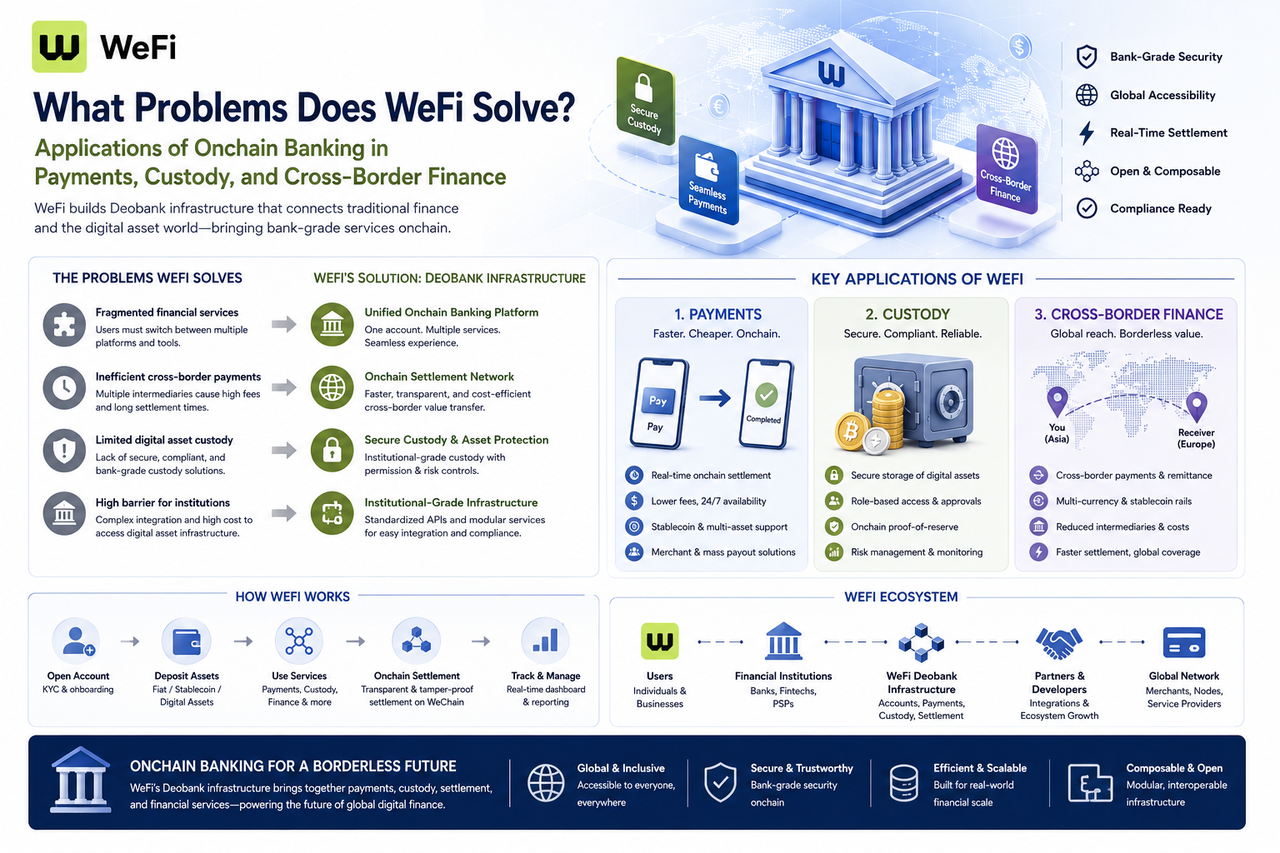
WeFi aims to build a comprehensive on-chain banking service system. Its service scope spans multiple financial scenarios.
Digital account services: Users can manage digital assets through a unified account system and perform fund transfers and payments.
Global payment capability: By leveraging blockchain settlement networks, payment and transfer processes achieve more efficient capital movement across different regions.
Additionally, WeFi offers digital asset custody, card-based payments, stablecoin management, and an AI-driven credit assessment system, all designed to improve the accessibility and reach of digital financial services.
Together, these services form the financial product matrix of the Deobank model.
How Does WeFi Differ From Traditional Banks, Neobanks, and DeFi?
While WeFi, digital banks, and DeFi all involve financial services, their design goals are distinctly different.
| Comparison Dimension |
WeFi (Deobank) |
Traditional Bank |
Neobank |
DeFi Protocol |
| Base Architecture |
Blockchain network |
Centralized system |
Centralized system |
Blockchain network |
| Asset Control |
User and protocol collaboration |
Bank custody |
Bank custody |
User self-custody |
| Payment Capability |
Supports on-chain and off-chain |
Supports off-chain |
Supports off-chain |
Primarily on-chain |
| Service Scope |
Bank-grade financial services |
Comprehensive financial services |
Digital banking services |
Single financial protocol |
| Openness Level |
High |
Low |
Medium |
High |
At its core, WeFi aims to merge the service capabilities of traditional banks, the user experience of digital banks, and the openness of DeFi to create a new form of financial infrastructure.
WeFi's Strengths and Potential Challenges
WeFi's main strength lies in its integration capabilities. Unlike single-purpose financial protocols, it seeks to build a complete financial network covering accounts, payments, asset management, and settlement.
Its on-chain architecture also improves transparency and enhances the efficiency of cross-border payments and digital asset transfers.
However, the Deobank model still faces challenges in regulatory coordination, user education, cross-chain compatibility, and mass adoption. Striking the right balance between openness and compliance remains an ongoing focus for the industry.
Conclusion
As a decentralized banking infrastructure network built on the Deobank concept, WeFi uses WeChain, the Deobank Network, the WFI token, and the Energy incentive system to bring together payments, custody, account management, and digital financial services in a unified ecosystem.
With growing demand for stablecoins, on-chain payments, and digital asset management, the Deobank model that WeFi represents is working to create a new type of infrastructure connecting traditional finance and Web3 finance. Its core value lies not in any single product but in building the underlying service framework needed to support the future digital financial network.
FAQs
What Is WeFi (WFI)?
WeFi is an on-chain financial infrastructure project centered on Deobank. It uses blockchain technology to integrate banking services, payment networks, digital asset management, and fintech capabilities, offering users and institutions a unified on-chain banking solution.
What Is the Difference Between Deobank and Traditional Banks?
Deobank emphasizes blockchain networks, digital assets, and open financial architecture, while traditional banks rely on centralized databases and institutional management systems. Both provide financial services, but their underlying technology and operating models are fundamentally different.
What Are the Uses of the WFI Token?
WFI is primarily used for network governance, staking, ecosystem reward distribution, and paying certain service fees. It serves as a key coordination tool in the WeFi ecosystem.
Is Energy a Token?
Energy is not a traditional cryptocurrency. It is an incentive and points system within the WeFi ecosystem that measures user activity and ecosystem contribution.
What Role Does WeChain Play in WeFi?
WeChain is WeFi's underlying infrastructure network, responsible for transaction processing, data recording, and value settlement. It provides technical support for the entire Deobank ecosystem.
Is WeFi a DeFi Project?
WeFi differs from traditional DeFi protocols. DeFi typically focuses on lending, trading, or liquidity services, while WeFi focuses on banking-grade infrastructure. Therefore, it is better described as a Deobank or on-chain banking network.