The Fed will release its July interest rate decision at 12:00 a.m. Beijing time on July 30. This was widely seen by the market as a “transitional meeting”—a policy window between the June pause and the expected action in September. However, a series of events over the past three weeks has completely changed the tone of the meeting.
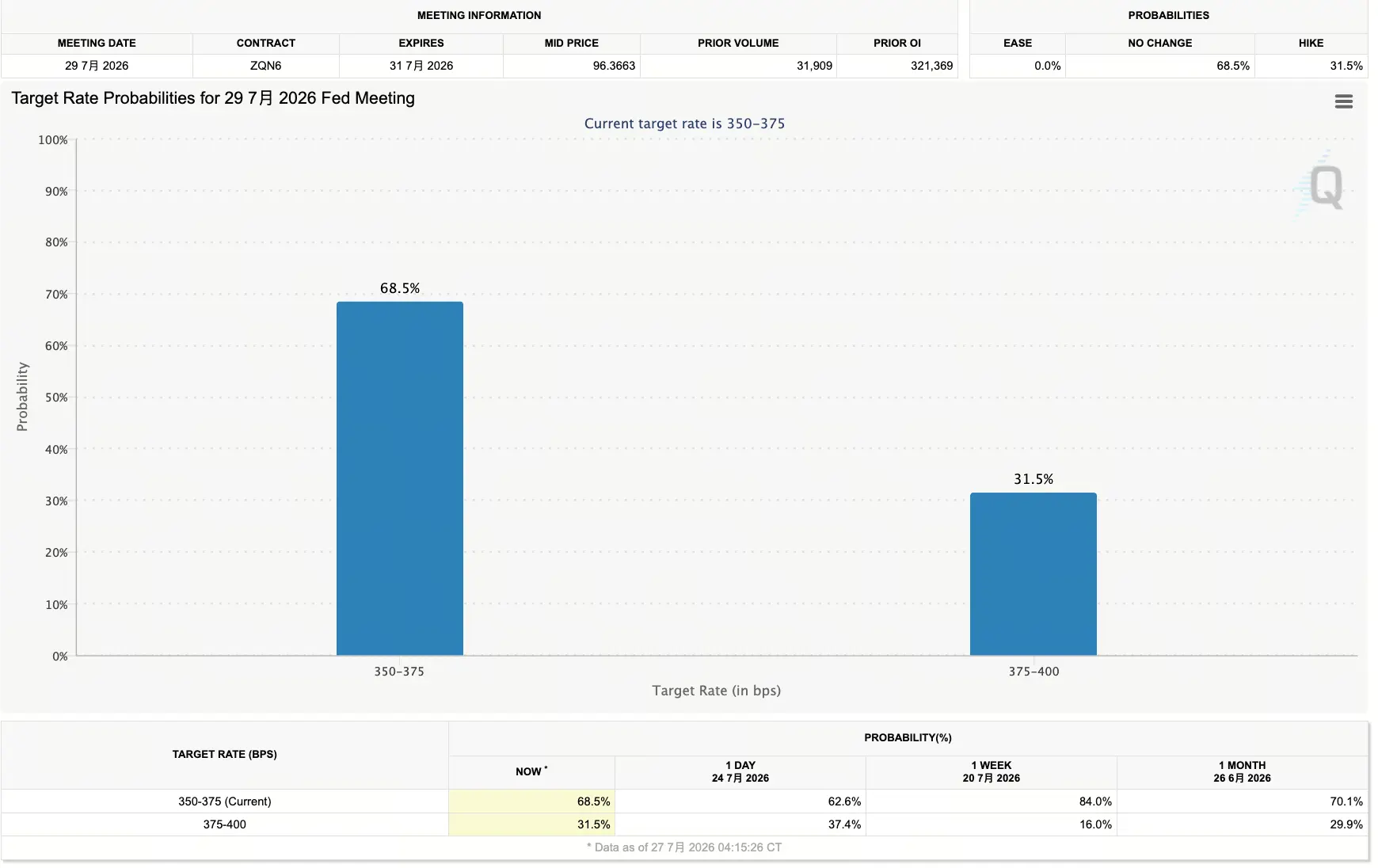
As of July 27, the CME FedWatch tool shows that the market is pricing a 68.5% probability that rates will be kept unchanged in July, while the probability of a 25 bps rate hike has risen to 31.5%. Although this rate-hike probability still qualifies as a “low-probability event,” it has already increased by more than three times compared with the pricing level of less than 10% at the beginning of July. Even more noteworthy is that market expectations for September have become far more aggressive: the probability of rates being unchanged is only 22.7%, while the combined probability of a 25 bps hike or more is as high as 77.3%.
There is a rarely seen large gap between market pricing and economists’ expectations in recent years. According to a media survey of 76 economists, all respondents expect the Fed to keep the benchmark rate unchanged in the 3.5% to 3.75% range. Yet futures traders are pricing in a rate-hike probability of more than 30%. This divergence alone sends a clear signal: the uncertainty for this FOMC meeting is far higher than for any prior “transitional” meeting.
For the crypto market, the significance of this meeting goes far beyond a single rate move. Bitcoin has been consolidating around $65,000 for weeks, and market sentiment is in a “neutral” range. On the eve of the meeting, ETF flows saw a single-day outflow of over $450 million after seven consecutive weeks of net inflows. The Fed’s policy signal—whether hawkish, dovish, or simply on hold—could become the key variable that breaks the current stalemate.
Why the July FOMC meeting is more important than before
The July 28–29 FOMC meeting has drawn intense attention largely because the Fed is facing its most complex policy trade-off in nearly two years.
In the third week of July, Brent crude briefly broke through the $100 per barrel level. According to Gate 行 new data, oil prices have since fallen to $85.52 per barrel (a 3.40% drop over 24 hours), but the price swing of more than $14 in just two weeks has already made a noticeable impact on inflation expectations. The latest WTI quote is $82.98 per barrel (a 3.69% drop over 24 hours), and natural gas is $2.783 per million BTU (a 3.84% drop over 24 hours). The sharp volatility in energy prices makes it difficult for the Fed to accurately judge the true trend of inflation—whether it is a temporary rise after a one-off geopolitical shock, or whether it will evolve into persistent, input-driven inflation pressure.
Meanwhile, the 10-year Treasury yield has risen by more than 30 bps cumulatively since the end of June to around 4.68%. The 30-year has touched 5.16%, the highest level since June 2007. Earlier tightening in financial conditions means that even if the Fed holds rates steady in July, the market has already completed part of the monetary tightening on its own to some extent.
Market focus is concentrated on three fronts: whether the benchmark rate will change, Chair of the Fed Waller’s tone at the press conference, and the latest assessment of inflation and employment. Unlike before, all three fronts feature significant uncertainty this time, and the 31.5% rate-hike probability given by the CME FedWatch tool is a quantitative expression of that uncertainty.
The Fed’s policy contradictions right now
Inflation pressure has not fully disappeared, while uncertainty on the energy front has surged
In June, the US CPI inflation rate was 3.5%, down from May’s 4.2%, but still far above the Fed’s 2% target. The Fed’s preferred PCE price index rose 2.6% year over year in the latest reading, while core PCE accelerated from 2.8% in June to 2.9%. Cleveland Fed’s forecasting model shows that July headline CPI is expected to fall to 3.32%, but core PCE is expected to show little relief at 3.36%.
The real variable comes from the energy side. Geopolitical risk around the Strait of Hormuz has sharply pushed up oil prices in July. Although as of July 27 Brent crude has fallen to $85.52 per barrel, this level is still significantly higher than the June average of about $78 per barrel. The rise in crude prices directly increases transportation costs and energy input prices, which then feed through to CPI. A report released by Bank of America in July warned that oil price volatility may force central banks to abandon their “look-through” strategy for energy-driven inflation. This implies that the Fed may not be able to treat higher energy prices as “temporary” and ignore them as it did in the past.
Economic growth pressure is increasing in parallel, narrowing policy room
The persistence of a high-rate environment is putting pressure on corporate financing costs and economic growth. The GDPNow model at the Atlanta Fed expects US third-quarter GDP growth of about 1.8% in the late-July period, slowing from 2.3% in the second quarter. The ISM manufacturing PMI has been below the boom-bust line for five straight months, and the services PMI has also shown marginal weakening.
The market expects a shift in monetary policy to support economic growth, but the reality that inflation has not fully faded prevents the Fed from easily releasing dovish signals. In testimony to Congress in mid-July, Fed Chair Waller explicitly said that the improvement in the June CPI data cannot be used to prematurely declare victory over inflation, and that rate tools remain among its policy options. Fed Vice Chair Jefferson also said publicly that if inflation does not cool down quickly, rate hikes should be considered.
This combination of “slower growth but sticky inflation” is exactly the policy dilemma the Fed least wants to face.
The logic and technical outlook for Bitcoin’s reaction to the FOMC
The core transmission chain from Fed policy to Bitcoin is clear and direct: an FOMC policy decision changes expectations for dollar liquidity, which then affects global risk appetite, and ultimately flows through to Bitcoin’s valuation multiple.
Rising rates mean higher risk-free yields and a higher opportunity cost of holding Bitcoin; at the same time, a tighter liquidity environment typically suppresses the valuation of risk assets. Conversely, if the Fed releases a loosening signal, it would support a repricing of the price of risk assets such as Bitcoin. This logic has been validated by data across the past four cycles: Bitcoin rose by more than 200% during the 2019 rate-cut cycle and fell by more than 60% during the 2022 rate-hike cycle.
As of July 27, according to Gate market data, Bitcoin is trading at about $65,208.7, up 1.03% over the past 24 hours, up 3.73% over 7 days, and up 0.56% over 30 days. Market cap is about $1.30 trillion, market sentiment is in a neutral range, and 24-hour trading volume is $13k.
On the technical side, Bitcoin’s price is above the 7-day SMA ($65,295), the 20-day SMA ($64,453), and the 50-day SMA ($63,360), suggesting a bullish bias in the short term. But the 200-day SMA is at $72,045—meaning the current rebound still counts as a corrective rebound within a larger time frame, not a trend reversal. Over the past 90 days, Bitcoin’s price has fallen by 15.27%; over the past year, it has fallen by 44.85%, retreating from the historical high of $126,193.0 to the current level.
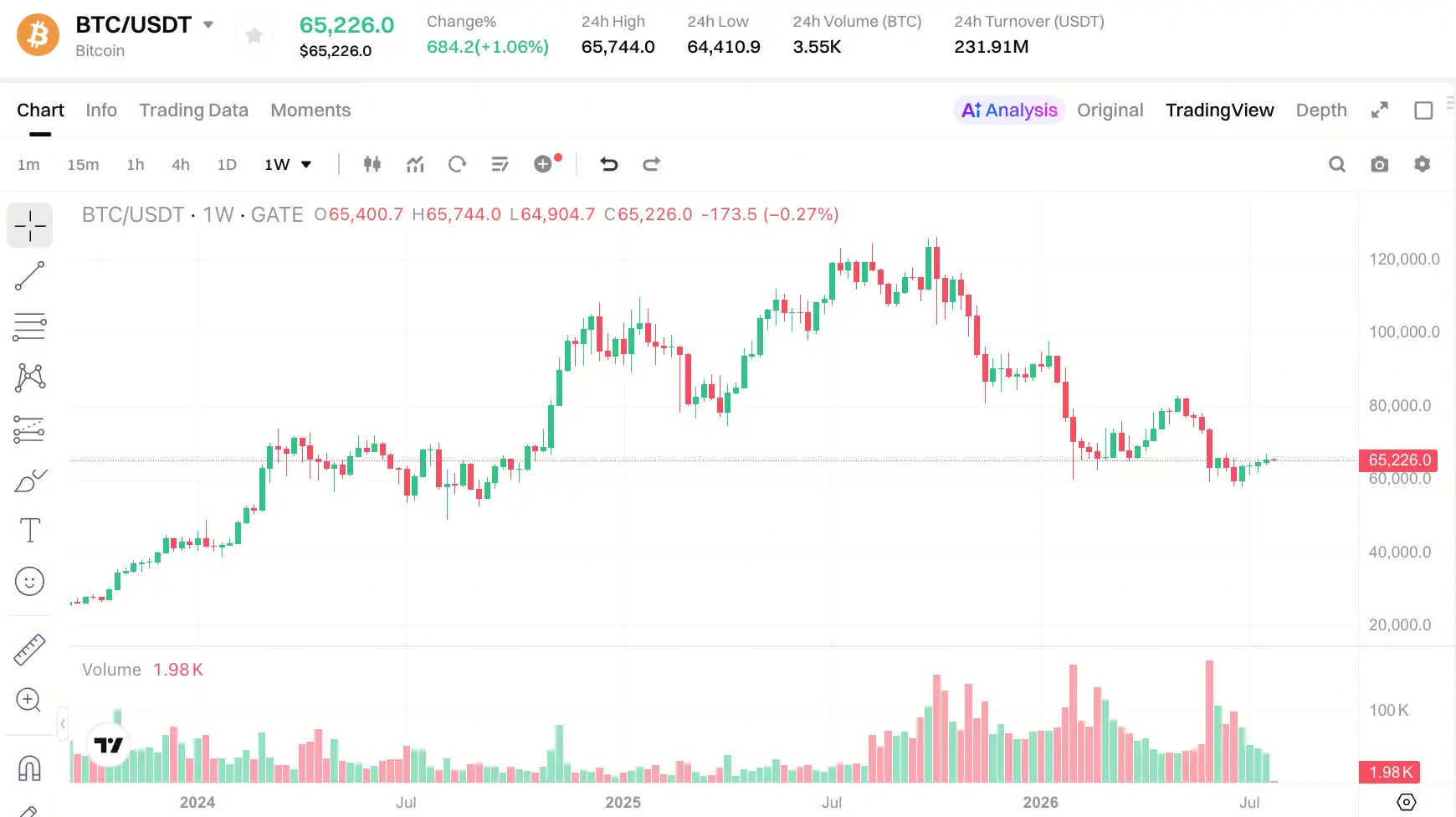
To the upside, $66,500 to $66,600 is the most critical resistance area in the near term. If it breaks successfully, the technical targets point to the $67,500 to $68,000 range. To the downside, $64,300 is the first key support level. If a hawkish FOMC outcome causes a breakdown below it, $62,000 will become the last line of defense for bulls—if that level is breached as well, it could trigger broader stop-loss selling and test the recent three-month lows of $60,000 and even $57,813.4.
Bitcoin ETF flow is also worth watching. On July 23 and 24, Bitcoin spot ETFs saw total outflows of more than $465 million, ending a trend of net inflows for seven straight trading days. But over a longer time frame, July still recorded net inflows, ending the persistent outflow trend since April. This indicates institutional money adopted a “wait-and-see” strategy ahead of the FOMC meeting rather than systematic exits. The meeting outcome will determine whether this wait-and-see capital re-enters or turns into continued outflows.
The real focus of the market: the September meeting is the main battleground
The market’s attention on the July FOMC has never been only about this one meeting itself. Data from the CME FedWatch tool makes it clear: the probability of no rate change in September is only 22.7%, while the combined probability of a 25 bps hike or more is as high as 77.3%.
The real question is: Is the FOMC shifting from an “anti-inflation mode” to a “support-growth mode,” or will it be forced to tighten again? The answer depends on how a series of key data points evolves over the next two months.
The CPI and PCE trajectories will determine whether inflation truly enters a sustainable downward channel. If inflation data continues to fall in July and August, the Fed will gain room to hold rates steady in September, even paving the way for discussions about rate cuts by year-end. Conversely, if rising energy prices begin to feed into core inflation, a September rate hike becomes a high-probability event, and the market pricing of 77.3% would be validated.
Nonfarm payroll employment data will reveal the true resilience of the labor market. If unemployment starts to rise and wage growth slows, the Fed will focus more on growth-side risks. The direction of US Treasury yields reflects market pricing of the policy path—if yields keep rising, further tightening in financial conditions can partially substitute for the Fed’s rate hikes. The strength or weakness of the DXY affects global dollar liquidity and the performance of emerging market assets, indirectly influencing incremental capital entering the crypto market.
The minutes of the June FOMC meeting show that the Fed has fully moved away from its earlier one-way bias toward rate cuts and entered a two-way, flexible policy wait-and-see period. Some committee members expect inflation to gradually cool, at which point there would be room to cut rates; other members believe prices will remain elevated and that further rate hikes are needed. This internal divergence means that regardless of the outcome of the July meeting, the real contest will continue between the August inflation data and the September meeting.
Conclusion
The July FOMC meeting opens amid the split in expectations between a 68.5% probability of holding rates steady and a 31.5% probability of a rate hike. Market participants are facing a rare situation—almost irreconcilable differences between economists and futures traders in their expectations for the same meeting. No matter the final outcome, the market’s volatility response may depend more on the wording of the statement and the tone of the press conference than on the rate change itself.
For Bitcoin, the price around $65,208.7 is at a critical contest point. To the upside, the resistance zone at $66,500 represents the threshold for trend continuation; to the downside, the $62,000 support level is the bulls’ last line of defense. The Fed’s policy signal will become the dominant force to break this balance. More importantly, the July meeting will lay the groundwork for September—market pricing already shows 77.3% for a September rate hike, indicating that the market has long shifted its gaze to the farther battleground.
FAQ
Q: What does the 31.5% rate-hike probability shown by CME FedWatch mean?
This means that Fed funds futures traders assign a 31.5% probability to a 25 bps rate hike in July and a 68.5% probability to keeping rates unchanged. While this probability is still below the 50% threshold, it has rapidly climbed from under 10% at the beginning of the month, reflecting increasing market concerns about inflation—especially the rise in oil prices. A 31.5% “unexpected” probability is relatively high in the history of FOMC meetings, meaning the market has not fully ruled out a Black Swan event.
Q: Why is the difference between market expectations and the economists’ survey so large?
The economists’ survey shows that 100% of respondents expect rates to be held steady, while market pricing gives a 31.5% probability for a rate hike. This difference mainly stems from different decision frameworks: economists make judgments based on economic models and historical patterns, while futures traders need to price “tail risks” and are more sensitive to short-term oil price volatility. In addition, during the 2022 to 2023 rate-hike cycle, the Fed repeatedly took actions “beyond market expectations,” so traders tend to retain a premium for such risks.
Q: Where are the key technical levels for Bitcoin after the FOMC meeting?
Key resistance is in the $66,500 to $66,600 area; after a breakout, the upside target points to $67,500 to $68,000. Key support is at $64,300 and $62,000. If a hawkish FOMC outcome leads to a breakdown below $62,000, it could trigger broader stop-loss selling and further test the recent three-month lows of $60,000 and even $57,813.4. The 200-day SMA is at $72,045, which is the key inflection point where the medium-term trend shifts from bearish to bullish.
Q: Why is the market more focused on the September meeting than the July meeting?
CME FedWatch data shows the probability of a September rate hike is as high as 77.3%, versus 31.5% for July. This is because the July meeting lacks sufficient new data to support a policy shift, while before the September meeting there will be two CPI releases for July and August, two PCE releases, and two Nonfarm payroll reports. These data will provide decisive evidence on whether inflation has truly cooled and whether the labor market has clearly weakened. The significance of the July meeting is to provide forward guidance for the policy path in September.
Q: How will gold likely perform before and after the FOMC meeting?
Gold is currently trading near $4,093.53 per ounce. If the Fed keeps rates unchanged but the statement is dovish, combined with persistent geopolitical risks, gold may challenge the $4,150 to $4,200 area. If there is a rate-hike surprise within the 31.5% probability scenario, gold in the short term may face pressure due to a stronger dollar and a jump in US Treasury yields, testing the $4,000 integer level. But in the medium term, if further rate hikes intensify worries about economic growth, gold’s safe-haven attributes will regain dominance.


